
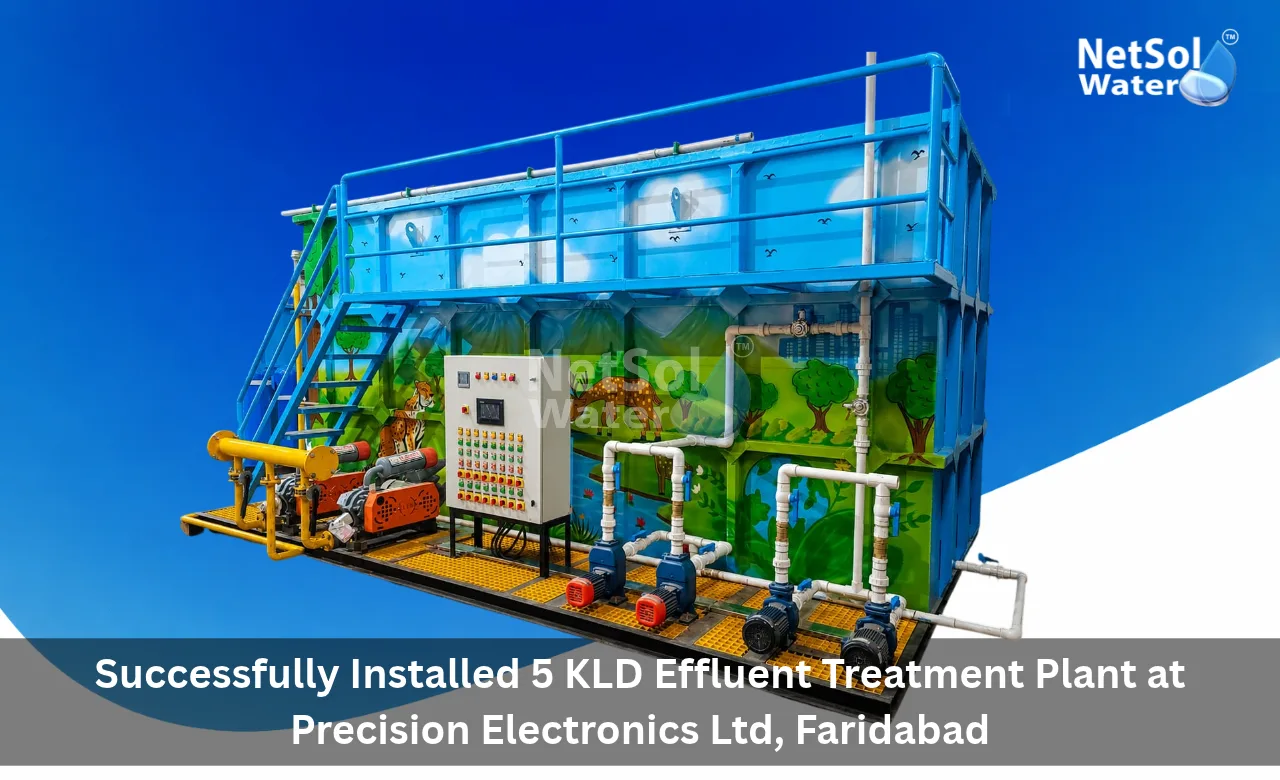
Successfully Installed 5 KLD Effluent Treatment Plant at Precision Electronics Ltd, Faridabad
For the industrial facilities, there is a need for a proper wastewater treatment plant to treat the wastewater produced from their normal daily activities. By cleaning up the wastewater properly, businesses can manage it responsibly and greatly improve control of its collection, treatment, and disposal. Industrial unit water management planning requires choosing a treatment plant appropriate to their water and wastewater quality and volume. We successfully installed a 5 KLD Effluent Treatment Plant in Precision Electronics Ltd. in Faridabad, Haryana. The project was to deliver an adequate wastewater treatment solution that has a clear treatment capacity of 5 KLD. The problem that was experienced by the client was to have a separate system to dispose of industrial effluent at their particular plant.
We are an effluent treatment plant manufacturer in Faridabad, providing project-specific solutions for industrial wastewater treatment needs. The characteristics of the wastewater, daily flow, available space, and the proposed treated water treatment/disposal must all be carefully considered for each installation. The treatment stages and the equipment needed to successfully operate the treatment will be determined by these factors.
Installation at Precision Electronics Ltd is an intensive solution to wastewater treatment for a plant with a relatively small treatment requirement. The project scope, plant capacity, treatment principles, installation factors, and performance considerations are discussed in the following sections.
Project Snapshot
| Parameter | Details |
| Client | Precision Electronics Ltd |
| Location | Faridabad, Haryana |
| Plant Capacity | 5 KLD |
| Plant Type | Effluent Treatment Plant (ETP) |
| Executed By | Netsol Water |
Project Overview
The first part of an industrial wastewater treatment project is to know what the wastewater treatment needs are for the facility and they must be treated with a system that is capable of doing so. The treatment capacity of the plant has to be appropriate and the treatment process design must match the effluent characteristics. Well-designed planning can also allow for a realistic setup for installation, use and maintenance in the future.
This project entailed setting up a 5 KLD Effluent Treatment Plant on the premises of Precision Electronics Ltd, Faridabad. It was its primary goal to offer a standalone treatment plant to handle the client’s facility’s wastewater. The treatment volume was determined by the stated capacity of the plant.
Typical activities in an ETP project generally include the evaluation of wastewater needs, selection of an ETP treatment facility, installation of the required equipment and preparing for operation.
The project’s aim was to ensure that the project had a treatment facility for the stated capacity, not relying on an inadequate or undefined wastewater management system. The installation also provides a foundation for measuring the wastewater that is fed into the plant and assessing the treated water in relation to the requirements.
In the given capacity of 5 KLD, Netsol Water approached this assignment. An analysis of the client and location provides understanding of the operational context of the treatment system installed.
Client Details
An understanding of the client’s operations is valuable in choosing an appropriate wastewater treatment system. The physical and chemical properties of wastewater vary from one industrial activity to another.
The client of this project is Precision Electronics Ltd and the installation was done in the premises of Faridabad. The wastewater stream at a facility is treated by a controlled treatment process facilitated by a suitable ETP. Treatment can be for suspended solids, pH fluctuations, organic matter, oils or other pollutants, as indicated by the wastewater analysis and as required. But client’s wastewater assessment is needed to determine actual treatment requirements. The confirmed project requirement for Precision Electronics Ltd was to install treatment capacity of 5 KLD. These records would aid in constructing a more thorough technical outline of the client’s therapy requirements.
Project Location
The layout, installation arrangements and day-to-day operation of a wastewater treatment plant (WWTP) are dependent on its location. The entire treatment system needs to fit into the space available at the industrial facility, while the wastewater can be conveyed to the treatment system, and the treated water can be conveyed to the approved location.
The 5 KLD ETP was installed at Precision Electronics Ltd, Faridabad (Haryana). Faridabad is an industrial and commercial hub in the NCR. Wastewater management is also a significant issue for industrial facilities that are located in such an environment; their wastewater management systems should be appropriate to their operations and the environmental regulations in force.
Within a single facility, the placement of the ETP in the facility may impact pipe routing, equipment placement, drainage connections and accessibility for operating staff. The wastewater system should be designed to flow from collection to treatment to a treated-water outfall or discharge.
Plant Capacity
An appropriate plant capacity is essential to ensure that wastewater production rates are controlled to match treatment capacity. Under sizing can cause the system to have difficulty with flows coming in, whereas oversizing can result in excess space and operating costs. The wastewater flow, operating schedule and anticipated fluctuations in wastewater production must be taken into account when planning for capacity.
The stated capacity for the installed plant at Precision Electronics Ltd is 5 KLD which is equivalent to 5 kilolitres per day. A kilolitre is the same size as a thousand litres. The capacity therefore refers to a nominal capacity of 5,000 litres per day for the design conditions for which the plant is intended.
This capability gives a clear foundation on which to plan wastewater collection and treatment at the plant. But the actual operating flow should be within the operating limits of the plant. Even if the same quantity of wastewater is discharged every day, as long as it is in the range of the stated capacity, the performance may be affected by variations in flow, wastewater strength or the timing of wastewater generation.
A plant that is receiving most of its daily wastewater in a short time, for example, might require appropriate managing of flows to avoid a hydraulic shock. Likewise, when the volume of wastewater remains the same, but the type or concentration of contaminants changes, then the effects of treatment change.
Treatment Technology
The separation of the solids, the management of the characteristics of the wastewater and the reduction of pollutants before the wastewater is used in the intended wastewater use is determined by the treatment technology. The chosen process should be compatible with the wastewater analysis, treatment goals and applicable discharge/reuse requirements. Operating conditions and equipment maintenance requirements are also taken into account in an appropriate design.
1. Understanding the Treatment Approach
Suspended particles, dissolved substances, organic pollutants or other contaminants that may be present in industrial effluents. ETP‘s are designed to treat the wastewater and control these characteristics by passing the wastewater through specific treatment stages. Depending on the type of wastewater, the process may be physical separation, chemical adjustment, biological treatment, and/or more filtration.
The physical treatment involves the separation of the material which can be separated by screening settling or other physical methods. Chemical treatment can be used to adjust pH and to remove specific contaminants. The potential for biological treatment can lower biodegradable organic matter if the composition and design of the wastewater supports the growth of microorganisms. Additional control may be needed by using filtration or disinfection when treatment objectives require it.
2. Importance of Process Selection
The designer must take into account the treatment objective and the reality of running this system for a plant of 5 KLD. The performance can be affected by the size of the equipment, retention time, chemical dosing, maintenance access, sludge handling.
Final design will be determined through the approved design documents. The confirmation of those documents would enable the precise description of the technology that was installed in the Precision Electronics Ltd installation without ascribing unknown attributes to the project.
Influent Characteristics
The quality of wastewater that enters the ETP has a significant influence on the design of the process and the performance of the ETP. Different wastewater treatment may be needed for two plants that have the same daily flow due to the presence of different pollutants at varying concentrations in the effluent. Running tests on the influent prior to finalizing the design process can help to understand those differences. The Precision Electronics Ltd. project has available information to confirm the plant location and capacity. It doesn’t have laboratory readings for the incoming wastewater.
Role of Wastewater Testing
A representative influent sample can be used to help the treatment designer decide on the necessary treatment process stages and setting appropriate operating conditions. Variations in activities within a facility should not be ignored when sampling—when the wastewater quality varies throughout the day, sampling should focus on that point.
The test report should also serve as a basis for post-commissioning comparison of effluent vs. treated water. These comparisons may help to illustrate the efficiency of the plant at removing the specific pollutants.
Treatment Process
By planning a treatment sequence, the wastewater will flow through the necessary treatment stages in a controlled way. There is a specific purpose for each step and the effectiveness of each step can impact the work needed in the next step. The process should be chosen based on the wastewater characteristics and the quality of the treated water.
A precise flow diagram for 5 KLD plant in Precision Electronics Ltd has not been provided. Common stages that can be a component of an industrial ETP are described below. It is not intended as an indicator that each stage below was a part of this particular installation.
1. Wastewater Collection and Screening
Typically, treatment starts at the point where the wastewater enters the plant via a collection line. Screening will remove coarse material from the stream, which will help prevent it from entering downstream equipment and pumps. This will minimize conditions that may cause blockage, and help things run more smoothly.
Screening requirements will vary based on the wastewater source and the physical properties. Screening should be determined by considering the materials that are likely to get into the collection system.
2. Flow Equalisation, pH Adjustment
Flow and composition of wastewater can vary during the day of operation. An equalisation tank can be used to equalise these changes in flow before the effluent is fed to subsequent treatment units. If necessary, pH correction is used to adjust the pH into the desired operating range for the process.
These stages can be used to facilitate more regular treatment downstream. Their size and operating requirements are, however, dependent upon the measured flow, pollutant concentration and the treatment technology selected.
3. Primary and Secondary Treatment
Primary treatment is a process to remove suspended matter or other separable contaminants from the wastewater by physical or chemical means. The system can employ settling and/or chemical dosing or another appropriate technique, depending on the wastewater composition.
In the presence of biodegradable organic contaminants in the effluent, biological treatment may be included in the process. Biodegradable materials are then broken down by the microorganisms in an environment of controlled conditions. The biological arrangement should be designed to the characteristics of the wastewater and the required treatment level.
4. Separation and Final Treatment
The main treatment phases may be followed by separating solids from the treated liquid. Depending on the final water quality requirements, additional filtration or disinfection may be required. The sludge produced during treatment should be collected and disposed of based on the nature of the sludge and the regulation requirements.
The actual sequence of Precision Electronics Ltd is confirmed by the approved flow diagram process. The verification of the design documents and operating records would enable to describe each installed stage of treatment with precision and its contribution to the treatment journey.
Treatment Process at a Glance
| Stage | Function |
| Wastewater Collection & Screening | Removes coarse material and prevents blockage downstream |
| Flow Equalisation, pH Adjustment | Equalises changes in flow and corrects pH where needed |
| Primary & Secondary Treatment | Removes suspended matter and biodegradable contaminants |
| Separation & Final Treatment | Separates solids from treated liquid; filtration/disinfection as needed |
Major Equipment
The choice and configuration of equipment influences the flow of wastewater into and out of an ETP, and the way it treats the water. The system should accommodate the pumps, tanks, dosing equipment and process units based on the design flow and treatment method. Plant maintenance access, safety of the operator and ease of plant control are also affected by equipment selection.
1. Collection and Treatment Tanks
Depending on the process design, tanks can serve a variety of purposes such as collection and equalisation, reaction, biological treatment or settling of wastewater. They should be able to handle the load of the wastewater and must be designed appropriately for the nature of the wastewater and the available treatment time.
2. Pumps and Transfer Arrangements
Pumps can pump wastewater from one treatment stage to the next and pump treated wastewater to the treatment plant outlet. They are selected based on flow, head, properties of the wastewater and the requirements for operation of the system. Flow interruptions can be avoided by proper installation and periodic checking.
3. Chemical Dosing Equipment
Dosing equipment can be used to provide controlled amounts of treatment chemicals when the treatment process calls for it. Chemical type and rate should be based on treatment design and operating trials and not be based on a general assumption.
4. Separation and Surveillance Devices
Filter or separation equipment or settling units can be a part of the process that is selected. Flow, pH or other appropriate parameters can also be monitored with instruments to control the treatment conditions. Equipment needed will vary according to plant setup and monitoring program.
The actuality for this project is the installation of a 5 KLD ETP. Specific models, process units or instrumentation cannot be included in the project record until the actual equipment inventory of the plant has been taken from the approved technical schedule or the handover documents.
Major Equipment Summary
| Equipment | Function |
| Collection & Treatment Tanks | Handles collection, equalisation, reaction, biological treatment or settling |
| Pumps & Transfer Arrangements | Moves wastewater between treatment stages and to the outlet |
| Chemical Dosing Equipment | Provides controlled amounts of treatment chemicals |
| Separation & Surveillance Devices | Filtration/separation and monitoring of treatment conditions |
Installation Process
The installation process makes the treatment design a reality. It involves coordination of plant layout, site conditions, equipment location and piping connections. System accessibility for operation is achieved by careful execution and a suitable foundation for future testing. The plant was set up at the Faridabad premises of the customer, Precision Electronics Ltd.
1. Site Preparation and Layout
Prior to equipment placement, the installation team should determine the available space and verify the proposed layout. The location must allow for adequate access for installation, inspection and maintenance. Tank positions, transfer routes and connections should follow the approved engineering drawings.
2. Equipment Placement and Connections
When the layout is set up, the equipment that is specified can be placed and secured. The team needs to align the tanks, pumps and process units as specified by the design. Piping should then be connected between the wastewater inlet, the treatment stages and the treated-water outlet.
Electrical connections and control must be in accordance with the equipment requirements and the related safety procedures. The team should also ensure that the operator can access all maintenance points and important controls without any undue hinderance.
3. Pre-operation Checks
Prior to introducing wastewater, the installation should be visually inspected and have the necessary piping, fittings, electrical connections and equipment mounting checks performed. Any problems that are discovered during any of these checks should be resolved prior to further testing.
The installation success result for Precision Electronics Ltd is defined as the project title and the mentioned plant capacity. A detailed installation report would be required to verify the specific activities that were undertaken, the inspection records and any site-related modifications during installation.
Plant Commissioning
Commissioning is used to determine if the installed system is performing as per the approved design, and if the process can treat wastewater under the operating conditions. Usually, it comes after installation and allows the user to detect any operating problems at an early stage prior to normal use.
1. Mechanical and Electrical Checks
The team should check equipment installation, piping connections, valves, pumps and electrical arrangements. For those pieces of equipment where testing is appropriate, each piece of equipment should be tested to ensure correct functioning and to check for unusual noises, leaks, vibration or other problems.
2. Process Testing
The team should then check the treatment sequence under the prescribed operating conditions. This may involve verifying wastewater flow, observing process behaviour and checking the operation of dosing or control systems where the design includes them.
Operating parameters should be recorded so the team can compare actual performance with the design expectations. Any required adjustments should follow the approved operating procedure.
3. Treated-Water Verification
The final assessment should use laboratory testing to compare the treated effluent with the applicable discharge or reuse criteria. The required parameters depend on the wastewater source, consent conditions and intended destination of the treated water.
Treated Water Reuse
Treated water can support better water management when its quality matches a suitable application. Reuse may reduce the need for fresh water in certain non-potable activities, while appropriate treatment and monitoring help ensure that the water remains suitable for its intended purpose. The installation of a 5 KLD ETP at Precision Electronics Ltd provides a treatment arrangement for the facility’s stated wastewater management requirement.
1. Identifying Suitable Reuse Options
Depending on the treated-water quality and the facility’s needs, industrial sites may assess applications such as floor washing, gardening or other suitable non-potable uses. These options are not automatically appropriate for every effluent stream. The required quality must be verified before treated water is assigned to any reuse application.
A reuse plan should consider the pollutant levels remaining after treatment, the needs of the receiving application and the applicable regulatory conditions. It should also provide a way to keep treated water separate from potable water supplies.
2. Monitoring and Water Management
Regular testing helps confirm whether treated water continues to meet the relevant requirements. Flow records can also show how much wastewater the plant receives and how much treated water becomes available for its intended destination.
For Precision Electronics Ltd, no reuse application or treated-water quality data has been supplied. The practical value of reuse should therefore be assessed once the intended application and supporting test results are documented.
Results and Performance
The results of a wastewater treatment project should be assessed against its design objectives, installation scope and measured operating performance. Plant capacity alone confirms the intended treatment volume but does not establish pollutant removal, water quality compliance or operating efficiency. These outcomes require suitable records and laboratory measurements.
The confirmed project result is the installation of a 5 KLD Effluent Treatment Plant at Precision Electronics Ltd in Faridabad. This establishes a defined treatment capacity for the facility’s wastewater management needs. It also provides a basis for recording wastewater flow, treatment conditions and the quality of the resulting effluent during operation.
Treatment Capacity and Operation
The stated capacity of 5 KLD corresponds to a nominal daily treatment volume of 5,000 litres. To assess actual performance, operating records should indicate the volume received, the hours of operation and any periods of interruption. These details help determine whether the plant handles the facility’s wastewater pattern as intended.
1. Water Quality Assessment
Laboratory results for influent and treated water are necessary to measure the reduction in individual pollutants. Relevant results may include pH, TSS, COD, BOD or other parameters selected from the wastewater analysis and regulatory requirements.
2. Operational and Environmental Considerations
A properly selected and operated ETP can support more controlled wastewater management. Its ongoing performance depends on operating practices, regular maintenance, suitable chemical handling where applicable, and responsible management of any treatment sludge.
The installation at Precision Electronics Ltd provides the stated treatment capacity, while a complete performance assessment would require commissioning records, influent and treated-water test reports, and operating data. These records would enable the client to document measurable results without relying on unsupported claims.
Customer Feedback or Testimonial
Customer feedback can help explain whether an installed system addresses the client’s needs and how the solution performs during routine operation. A useful testimonial should reflect the client’s actual experience with the project, including the installation process, the suitability of the system and any verified operational outcomes.
“Having a dedicated 5 KLD Effluent Treatment Plant installed at our Faridabad facility gives us a defined arrangement for managing our wastewater treatment needs. The plant’s specified capacity provides a clear basis for planning and monitoring the wastewater handled at our site. We recognise the importance of checking treatment performance through regular operating records and water quality tests. These checks will help us evaluate the plant against our operational requirements and the applicable standards.”
Read some interesting information for the Industrial RO Plant Manufacturer in Faridabad
Conclusion
The installation of the 5 KLD Effluent Treatment Plant at Precision Electronics Ltd in Faridabad marks a defined step towards managing the facility’s wastewater through a dedicated treatment system. The stated capacity establishes a basis for planning treatment operations and monitoring wastewater flow. Continued assessment of influent quality, treated-water results and plant operation will help determine how effectively the system meets the facility’s needs.
A suitable wastewater treatment solution must match the quantity and characteristics of the effluent while considering the intended discharge or reuse requirements. Accurate testing, appropriate process selection, careful installation and regular performance monitoring all contribute to responsible plant operation. Maintaining technical records also helps the client review performance and identify any changes required as operational needs evolve.
Netsol Water works to address industrial wastewater treatment requirements through solutions suited to individual project needs. As an Effluent Treatment Plant Manufacturer in Faridabad, the company can help businesses assess their treatment requirements and explore an appropriate plant capacity and process arrangement.
For organisations planning a new treatment facility or reviewing an existing wastewater management system, the first step is to establish the wastewater flow, conduct the required laboratory analysis and identify the applicable treatment objectives.
Contact Netsol Water to discuss your industrial wastewater treatment needs, request technical guidance or seek a consultation for an Effluent Treatment Plant suited to your facility.
Contact Netsol Water
| Contact Mode | Details |
| Phone | +91-9650608473 |
| enquiry@netsolwater.com |