
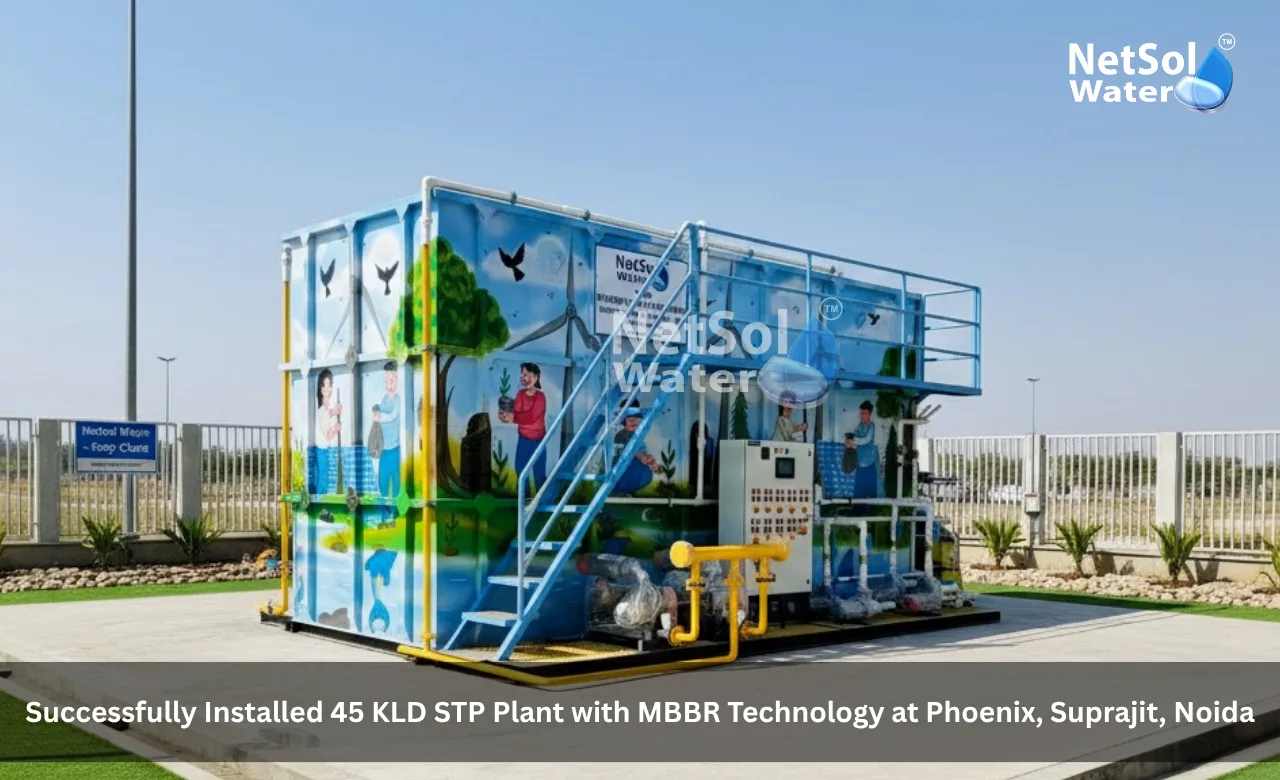
Successfully Installed 45 KLD STP Plant with MBBR Technology at Phoenix, Suprajit, Noida
Effective sewage treatment has become an important requirement for facilities that need to manage wastewater in a responsible and practical manner. At Phoenix, Suprajit, Noida, Netsol Water successfully installed a 45 KLD Sewage Treatment Plant based on MBBR technology. The project was planned to provide a suitable solution for the treatment of sewage generated at the facility and to support better wastewater management.
The client required a treatment plant that could handle the expected sewage load while providing a structured treatment process within the available site conditions. To address this requirement, the project included the design and installation of a 45 KLD sewage treatment system using Moving Bed Biofilm Reactor technology. The selected process offered a biological treatment approach that could be integrated into a compact treatment arrangement.
The project was important because proper sewage treatment helps facilities manage wastewater before it is reused or discharged according to their operational requirements. It also requires careful planning because plant capacity, process arrangement, equipment selection, installation and commissioning all need to work together. This project brought these elements together in one complete treatment solution.
A sewage treatment plant manufacturer in Noida, completed the installation with a focus on creating a functional system that matched the stated project capacity and treatment requirement.
Project Overview
A sewage treatment project must begin with a clear understanding of the wastewater requirement and the operating conditions of the site. The purpose is not simply to place treatment equipment at a location. The complete system must be planned so that wastewater can move through the treatment stages in a controlled manner and receive the required biological and physical treatment.
For Phoenix, Suprajit, Noida, the project focused on installing a 45 KLD Sewage Treatment Plant with MBBR technology. The main objective was to provide an organised treatment system for sewage generated at the facility. The plant was selected according to the stated treatment capacity and was planned as a complete system rather than as an individual piece of equipment.
The scope of the project covered the installation of the treatment plant and the integration of its major process components. This required proper equipment placement, interconnection of the treatment stages and preparation of the plant for operation. Every part of the installation had to support the overall treatment sequence so that the system could operate as one coordinated unit.
The project also required attention to practical site conditions. A treatment plant must fit into the available space and remain accessible for inspection and routine operation. With these considerations in mind, the installation was carried forward through a structured sequence that moved from preparation and equipment placement to connection, testing and commissioning.
Client Details
The client for this project was Suprajit at its Phoenix facility in Noida. The need for a Sewage Treatment Plant generally arises when a facility generates sewage that requires treatment before the treated water can be managed according to its intended use or disposal arrangement. In such situations, the treatment system becomes an important part of the site’s wastewater management infrastructure.
For the client, the requirement centred on a 45 KLD system. This meant that the proposed plant had to be designed around the stated sewage treatment capacity and arranged in a way that supported continuous movement of wastewater through the treatment stages. The project therefore required more than a capacity calculation. It also required a suitable process configuration and proper installation of the supporting equipment.
The client’s requirement was addressed through MBBR-based biological treatment. This approach allowed the plant to use a controlled biological process within the overall sewage treatment arrangement. The installed system was then prepared for operation through systematic testing and commissioning.
Project Location
The project was carried out at Phoenix, Suprajit, Noida. The location was an important part of the planning process because sewage treatment plants must be installed according to the physical conditions of the site. Equipment placement, available working space, connections and access for operation all influence how a plant is installed.
Noida is an active urban and industrial region where facilities may require organised wastewater management systems as part of their infrastructure. For an individual project such as this one, however, the treatment requirement is determined primarily by the sewage generated at the facility and the intended treatment capacity.
At the Phoenix, Suprajit site, the plant therefore had to be positioned and connected in a way that allowed the wastewater treatment process to function properly. The installation had to account for the movement of sewage through the treatment stages while also leaving adequate access for plant operation and maintenance.
The project location also made proper execution important because a treatment plant is a permanent operational system rather than a temporary installation. Once the equipment is positioned and connected, each process stage must work in the intended sequence. This made careful site execution an essential part of the project.
Plant Capacity
Correct plant capacity is one of the first considerations in any sewage treatment project. A plant that is not matched to the intended sewage load can create operational difficulties and reduce the effectiveness of the treatment arrangement. Capacity selection therefore needs to reflect the expected wastewater flow and the purpose for which the plant is being installed.
For the Phoenix, Suprajit project, the installed Sewage Treatment Plant has a capacity of 45 KLD, which means it is designed for a treatment capacity of 45 kilolitres per day. The stated capacity formed the basis for the process arrangement and equipment planning for the project.
The 45 KLD capacity provided the client with a defined treatment framework for managing the sewage generated at the facility. It also established the scale at which the biological treatment system and associated components needed to operate.
Capacity is closely linked with treatment sequence and equipment selection. Each stage has to accommodate the flow entering the plant so that sewage receives adequate treatment as it moves through the system. By installing a system designed for 45 KLD, the project established a treatment arrangement suited to the stated requirement.
Treatment Technology
The choice of treatment technology has a direct effect on how sewage is biologically treated inside the plant. Since the project required a sewage treatment solution with a defined capacity, the treatment process needed to provide effective biological contact within the available system configuration.
The plant at Phoenix, Suprajit, Noida uses MBBR technology, which stands for Moving Bed Biofilm Reactor. MBBR is a biological treatment process in which microorganisms grow on small carrier media placed inside the biological reactor. These microorganisms help break down organic matter present in sewage as the wastewater passes through the reactor.
1. Working Principle of MBBR
The MBBR process creates an environment where microbial growth can take place on the surface of carrier media. Aeration keeps the media moving within the reactor and supplies oxygen for the biological process. As sewage comes into contact with the media, microorganisms attached to the carriers consume and degrade biodegradable pollutants.
The continuous movement of the carrier media helps maintain contact between the wastewater and the biological growth. This allows the biological stage to remain active while the system operates. The process can therefore provide a controlled biological treatment stage within the overall sewage treatment sequence.
2. Role of Aeration
Aeration is an important part of the MBBR process. Air is introduced into the biological tank through an aeration arrangement that provides oxygen for microbial activity. At the same time, the air movement helps keep the carrier media in motion.
The combination of biological growth, wastewater contact and aeration supports the treatment process. Once the biological stage is completed, the treated stream moves forward to the next stage where suspended solids and other remaining materials can be separated.
The use of MBBR technology at the project site therefore provided a clear biological treatment mechanism within the 45 KLD STP arrangement.
Influent Characteristics
Understanding incoming sewage is important before establishing a treatment system because the treatment process must be able to handle the characteristics of the wastewater entering the plant. Parameters such as organic load, suspended solids, turbidity, pH and microbial content can influence treatment requirements.
Sewage typically contains organic matter and suspended impurities that need to be reduced through a controlled treatment sequence before the treated water can be managed further.
The MBBR process was selected to address the biological component of sewage treatment. The treatment system then uses downstream separation stages to help remove the solids generated during the treatment process. This shows why influent understanding and process design are closely connected.
The absence of detailed laboratory figures in the available project brief does not change the installed capacity or technology. It simply means that exact influent values should not be presented as project data unless they are supported by actual test records.
Treatment Process
A sewage treatment plant works through a sequence of stages in which each step prepares the wastewater for the next one. The overall purpose is to gradually remove physical impurities, biodegradable matter and suspended solids so that the treated water reaches the intended quality for its next use or management.
At the Phoenix, Suprajit site, the 45 KLD plant uses MBBR as the central biological treatment technology. The sewage first enters the preliminary treatment stage where larger physical impurities can be removed. This protects the downstream equipment and reduces the chance of blockage in later stages.
| Process Stage | Description |
| Preliminary Treatment | The incoming sewage is first screened to remove larger materials that should not enter the biological system. Screening helps protect pumps, pipes and other equipment by stopping coarse solids before they move further into the plant. After this stage, the flow moves into the collection and equalisation arrangement. Equalisation helps manage variations in incoming flow and provides a more consistent feed to the biological treatment stage. |
| Biological Treatment | From the preliminary stage, the sewage proceeds to the biological reactor containing MBBR carrier media. Air is supplied to the reactor to support microbial activity and keep the media moving. The microorganisms growing on the carrier surfaces consume biodegradable organic matter in the sewage. As the wastewater remains in contact with the biological media, the organic load is reduced through microbial action. This stage forms the main treatment step in the installed process. |
| Solids Separation | Following biological treatment, the water contains biological solids that need to be separated before the treated stream moves further. The treated mixture therefore passes into a settling stage where heavier solids can separate from the liquid. The settled solids can then be managed through the sludge handling arrangement while the clarified water proceeds to the subsequent treatment stage. |
| Final Treatment and Treated Water | After solids separation, the clarified water can undergo the final treatment steps included in the plant configuration. These stages help improve the treated water quality and prepare it for its intended reuse or disposal arrangement. |
The complete process therefore works as a chain. Screening protects the system. Equalisation supports stable flow. MBBR provides biological treatment. Settling separates biological solids. Final treatment prepares the treated water for further use or management.
Major Equipment
Proper equipment selection supports dependable plant operation because every component has a specific role in moving, treating or separating the wastewater. Even when the biological process is the main focus, the supporting equipment must also work correctly for the complete system to perform as intended.
The 45 KLD MBBR STP includes the major equipment and process components required to support the treatment sequence:
| Equipment / Component | Function |
| Inlet and Screening Arrangement | Forms the first stage by controlling what enters the treatment system. |
| Pumps and Piping | Help move wastewater between the different process sections. |
| MBBR Biological Reactor | The central treatment unit where carrier media and aeration support microbial activity. |
| Aeration Arrangement | Provides the air required for the biological process and also helps maintain movement of the media. |
| Settling Arrangement | Supports separation of biological solids after the MBBR stage. |
| Sludge Handling Components | Used to manage the solids collected during the treatment process. |
| Interconnecting Pipelines and Valves | Link the various sections and control the movement of wastewater between stages. |
All of these components contribute to the performance of the plant. A treatment system cannot depend on a single machine or tank. Its operation depends on the combined performance of the process units, pumps, air system, piping and controls.
Installation Process
Successful installation begins with proper planning because treatment equipment must be positioned in a logical sequence and connected correctly. The installation at Phoenix, Suprajit followed a structured approach that allowed the treatment system to be assembled step by step.
The first stage involved preparing the installation area and confirming the placement of the treatment components. The available space had to support equipment installation while also allowing access for operation and maintenance. Once the site arrangement was established, the main process equipment could be positioned according to the planned treatment flow.
The next stage involved connecting the major process units. Piping was used to link the treatment sections so that sewage could travel from the inlet stage to the biological reactor and then toward clarification and treated water handling. Pump connections and other utility connections were also completed as part of the system assembly.
The MBBR reactor and aeration arrangement required particular attention because biological treatment depends on proper air supply and movement of the carrier media. The equipment and connections therefore had to be checked before the plant was prepared for trial operation.
After mechanical and process connections were completed, the system was inspected as a complete installation. This provided a transition from physical installation to commissioning and operational testing.
Plant Commissioning
Commissioning is an important stage because it confirms that the installed plant can operate as a connected treatment system. It provides an opportunity to inspect the equipment, check the connections and verify the movement of wastewater through the process stages before regular operation begins.
For the 45 KLD STP, commissioning involved checking the installed equipment and the connections between the different treatment units. Pumps, aeration equipment and process pathways needed to operate as intended so that wastewater could move through the plant without interruption.
The MBBR section was also checked as part of the commissioning process because the biological reactor is central to the treatment sequence. The aeration arrangement needed to supply air properly while supporting movement of the carrier media inside the reactor.
The commissioning stage also helped identify installation issues that could be corrected before the plant entered regular operation. By testing the system as a complete unit, the project team could confirm that the plant was ready for its intended treatment duty.
This step completed the transition from installation to operational readiness and provided the basis for continued operation of the treatment system.
Treated Water Reuse
Treated water becomes more useful when a facility has a clear plan for how it will manage or reuse the treated stream. Reuse can reduce the need for fresh water for suitable non-potable applications and can form part of a broader wastewater management strategy.
The installed STP provides the client with a treated water stream that can be managed according to the site’s approved requirements and intended reuse practices. The treatment process is designed to reduce pollutants through biological treatment and solids separation before the water moves to its next stage of use or disposal.
The practical value of the plant therefore extends beyond treatment alone. By establishing a dedicated sewage treatment system, the facility has a structured process for managing the wastewater generated at the site.
Results and Performance
Project results help demonstrate whether the installed treatment solution meets its intended purpose. In a sewage treatment project, performance should be assessed through measurable operating data and water quality results rather than broad claims.
The key confirmed outcome for Phoenix, Suprajit is the successful installation and commissioning of a 45 KLD MBBR-based Sewage Treatment Plant. The project established a complete treatment arrangement that moves sewage through preliminary treatment, biological treatment, solids separation and final treated water handling.
The installed capacity provides a defined treatment framework of 45 kilolitres per day. The use of MBBR technology gives the plant a dedicated biological treatment stage in which microbial growth on carrier media supports the reduction of biodegradable pollutants.
The project also resulted in an operational treatment system rather than an incomplete equipment installation. Major equipment was placed and connected so that the treatment stages could function together. Commissioning further prepared the plant for regular operation.
Customer Feedback / Testimonial
Customer feedback provides useful insight into how a completed treatment project is viewed from the client’s side. A direct testimonial can help confirm satisfaction with installation quality, project execution and system performance.
The installation was completed as a 45 KLD MBBR sewage treatment solution for the stated facility. The successful completion of the installation and commissioning indicates that the project moved through the required delivery stages and resulted in a functioning treatment plant.
Read some interesting information for the Effluent Treatment Plant Manufacturer in Delhi
Call to Action
A well-planned sewage treatment system can help facilities manage wastewater through a defined and organised treatment process. The successful installation of the 45 KLD MBBR STP at Phoenix, Suprajit, Noida demonstrates how a project can bring together capacity planning, biological treatment, equipment installation and commissioning to create a complete sewage treatment arrangement.
For facilities that are evaluating similar requirements, choosing the right treatment capacity and process technology is an important starting point. The plant configuration should match the expected wastewater load while allowing the treatment stages and supporting equipment to work together effectively.
Netsol Water, a Sewage Treatment Plant Manufacturer in Noida, provides solutions for sewage and wastewater treatment requirements based on the needs of individual projects. Organisations planning a new treatment plant or looking to improve their wastewater management can contact Netsol Water to discuss their requirements, understand suitable treatment options and request a project consultation.
Contact Netsol Water
Phone: +91-9650608473
Email: enquiry@netsolwater.com