
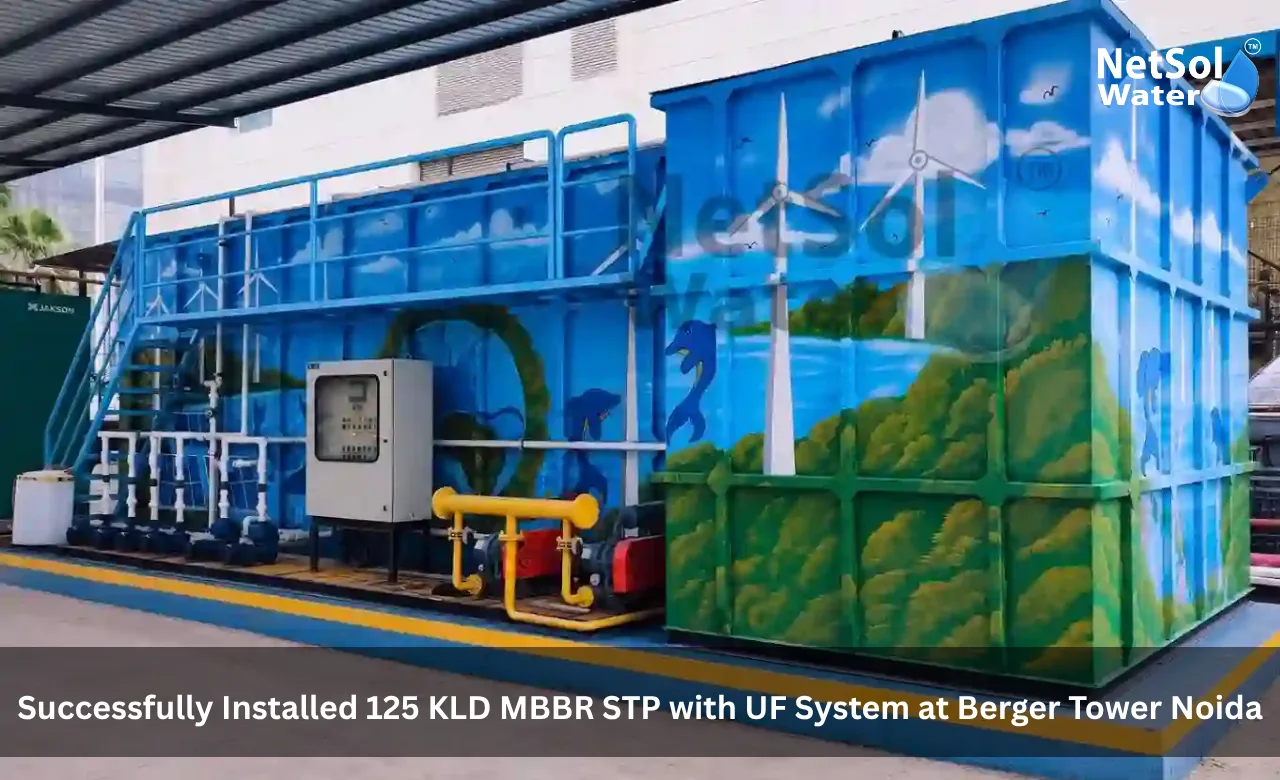
Successfully Installed 125 KLD MBBR STP with UF System at Berger Tower Noida
Managing wastewater is an important part of operating a large commercial facility. A busy building can generate a significant amount of sewage every day from restrooms, housekeeping areas, pantry facilities and other regular activities. Without a suitable treatment plant, this wastewater cannot be managed responsibly or reused for non-potable purposes. This makes a properly designed Sewage Treatment Plant an important part of modern commercial infrastructure.
At Berger Tower in Sector 16B, Noida, Wisdom Colonizers Private Limited required a suitable wastewater treatment solution for its commercial development. The project called for a system that could handle a daily sewage load of 125 KLD while producing treated water suitable for planned reuse. Netsol Water designed and installed a 125 KLD Sewage Treatment Plant based on Moving Bed Biofilm Reactor technology with an Ultrafiltration polishing stage. The project covered design, engineering, manufacturing, supply, installation, testing and commissioning.
The combination of MBBR and UF provided a practical treatment arrangement for a commercial building. The biological treatment stage addressed the main organic load in sewage while UF provided additional filtration before disinfection and reuse. The result was a treatment system designed around the capacity, space and reuse needs of the facility.
Project Overview
A commercial building needs more than a sewage collection system. It needs a treatment process that can manage changing wastewater flow throughout the day and provide treated water at a consistent quality. This project focused on creating such a system for Berger Tower while keeping the treatment arrangement suitable for a commercial site.
Wisdom Colonizers Private Limited engaged Netsol Water for the installation of a 125 KLD STP at Berger Tower in Noida. The project required a complete treatment solution rather than a standalone equipment supply. Netsol Water handled the work from design and engineering through manufacturing, installation, testing and commissioning. The selected treatment arrangement combined MBBR technology with an Ultrafiltration system.
The objective was to treat the sewage generated by the facility and produce water that could support non-potable applications such as flushing and landscaping. The design also considered the practical requirements of a commercial building where water generation can vary depending on occupancy and daily activity.
The project therefore required careful process selection and proper integration of each treatment stage. The treatment sequence had to protect downstream equipment while providing biological treatment and final filtration. With the overall scope established, the next consideration was the client and the nature of the facility where the plant would operate.
Client Details
The client for the project was Wisdom Colonizers Private Limited. Public company records identify Wisdom Colonizers Private Limited as an active private company registered in Noida. Its registered address is in Sector 16B and its business classification falls under real estate activities.
The project was associated with Berger Tower. The commercial development supports office and other commercial activities and therefore requires regular water use across different areas of the facility. Such a building generates wastewater as part of its normal daily operation. Restrooms, housekeeping and other building services contribute to the sewage load that must be collected and treated.
For the client, the treatment plant had to provide a suitable way to manage this wastewater within the facility. The plant also needed to support water reuse where treated water could replace part of the freshwater requirement for non-potable applications.
This requirement made treatment quality an important part of the project. The client was not simply looking for a system that could receive sewage. The plant needed to provide a controlled treatment process that could produce water suitable for the intended reuse applications. The location of the facility added another important consideration.
Project Location
The project was executed at Berger Tower in Sector 16B, Noida, Uttar Pradesh. Public records also associate Wisdom Colonizers Private Limited with Plot No. C-001 A/2 in Sector 16B.
The location is relevant because commercial development in an urban environment often places practical limits on the space available for wastewater treatment equipment. Treatment systems therefore need to use available space carefully while allowing access for operation and maintenance.
Berger Tower is a high-rise commercial building in Noida. Public building information identifies Berger Tower as part of the Delhi One development and places it in Noida. This setting made an organised treatment arrangement important. The system had to fit within the available facility layout and connect properly with the building’s wastewater and treated-water requirements.
The project was therefore approached as a site-specific installation rather than a simple equipment placement exercise. The capacity and treatment technology had to match the wastewater requirement and the conditions of the building. This led directly to the selection of the 125 KLD plant capacity.
Plant Capacity
Plant capacity determines how much wastewater an STP can treat during a normal operating period. Selecting the right capacity is important because the plant must accommodate the expected sewage generation without creating unnecessary treatment capacity. A suitable capacity also helps the treatment process remain stable when wastewater flows vary during different parts of the day.
For Berger Tower, Netsol Water installed a 125 KLD Sewage Treatment Plant. The stated capacity of 125 KLD corresponds to approximately 125,000 litres of sewage treatment capacity per day. The project source identifies the plant as a 125 KLD installation using MBBR technology with UF polishing.
The selected capacity was intended to address the wastewater generated by the commercial facility. Since sewage flow can change with occupancy and daily activity, the treatment arrangement also included an equalization stage. This helped balance variations before the wastewater entered the main biological treatment section.
Capacity alone does not determine plant performance. The treatment technology must also match the wastewater characteristics, available space and quality required at the outlet. For this project, MBBR combined with UF was selected to address those requirements.
Treatment Technology
Selecting the right treatment technology is one of the most important decisions in an STP project. Commercial buildings can experience changing wastewater flows and loads. The treatment process therefore needs to provide effective biological treatment while remaining practical to install and operate.
For Berger Tower, Netsol Water selected Moving Bed Biofilm Reactor technology followed by Ultrafiltration. The system used MBBR as the core biological treatment stage and UF as the polishing stage. Netsol Water identifies this combination as a suitable approach for the commercial tower because it provides advanced treatment without using a complete membrane bioreactor configuration.
1. Moving Bed Biofilm Reactor
The MBBR process uses specially designed carrier media inside the biological reactor. Microorganisms grow on the surface of this media and form a biofilm. When air enters the reactor through the aeration system, the media moves within the wastewater.
The microorganisms use organic matter in the sewage as part of their biological activity. This reduces the organic pollution load and supports the removal of substances such as BOD, COD and ammonia. The moving media also provides a large surface area for microbial growth within the treatment tank.
One practical advantage of MBBR is that the biological treatment stage can provide a high treatment capacity within a relatively compact arrangement. This makes the technology useful for commercial buildings where available plant space may be limited.
2. Ultrafiltration System
The UF system provides an additional filtration stage after biological treatment. Ultrafiltration membranes contain very small pores that physically separate fine suspended matter and microorganisms from the treated water.
At Berger Tower, the UF stage works as a polishing process after the MBBR and clarification stages. This improves the physical quality of the treated water before disinfection and reuse. The project information describes the system as a hollow-fibre UF arrangement.
The combination of biological treatment followed by membrane filtration creates a multi-stage treatment process. Each stage performs a defined function and prepares the water for the next stage. Before selecting these stages, however, the incoming sewage characteristics must be considered.
Influent Characteristics
Understanding the incoming wastewater is necessary before designing any treatment plant. Sewage quality can vary depending on the type of building, the number of users and the activities carried out at the site. Changes in flow can also affect the treatment process.
For a commercial facility such as Berger Tower, the incoming sewage is expected to contain biodegradable organic matter, suspended solids and microorganisms that are commonly associated with domestic sewage. Wastewater from restrooms and other building activities can also contain grease, food-related residues and other contaminants depending on the source.
Treatment system was designed around the expected characteristics of commercial sewage and the required treated-water quality. Pretreatment removed larger materials before the biological stage. Equalization helped balance the hydraulic load. MBBR then reduced the biological pollution load while the UF stage provided additional filtration.
This approach shows why influent assessment and process selection need to work together. Once the incoming wastewater enters the plant, each stage must support the next stage in a controlled sequence.
Treatment Process
A well-planned treatment sequence helps the plant operate consistently. Each stage performs a specific task and prepares the water for the following stage. At Berger Tower, the 125 KLD plant used a sequence that moved the sewage from preliminary screening through biological treatment, clarification, UF filtration and disinfection.
| Process Stage | Description |
| Bar Screen Chamber | The treatment process begins when incoming sewage enters the bar screen chamber. The screen captures larger solid materials that may be present in the wastewater. Items such as rags, plastic pieces and other coarse debris can create blockages or damage pumps and downstream equipment if they are allowed to pass through. Removing these materials at the beginning protects the rest of the plant. It also makes the following treatment stages easier to operate. |
| Equalization Tank | After screening, the wastewater enters the equalization tank. Commercial sewage does not arrive at a constant rate throughout the day. Flow can rise during busy periods and decrease when building activity is lower. The equalization tank stores the incoming wastewater and helps balance these changes. Mixing keeps the wastewater reasonably uniform and reduces the effect of sudden changes in flow on the biological treatment stage. The balanced flow then moves forward toward the MBBR reactor. |
| MBBR Tank | The MBBR tank serves as the main biological treatment stage. The reactor contains biofilm carrier media that supports the growth of microorganisms. Aeration provides oxygen and keeps the media moving. The microorganisms attached to the carriers use biodegradable matter present in the wastewater. Their biological activity reduces the organic load and supports the removal of pollutants. This stage is central to the overall treatment process because it converts dissolved and biodegradable pollutants into forms that can be separated from the water in later stages. |
| Secondary Clarifier | Following biological treatment, the wastewater contains biological solids and detached biofilm material. The secondary clarifier provides a quiet zone where these solids can settle. As the flow slows down, heavier solids move toward the bottom of the clarifier. The clearer water from the upper part moves toward the next treatment stage while the settled sludge is collected for further handling. This separation is important because the UF system should receive water with reduced suspended solids. The clarifier therefore acts as a bridge between biological treatment and membrane filtration. |
| Ultrafiltration System | The clarified water then passes through the UF system. The hollow-fibre membranes provide fine filtration and remove remaining suspended particles and microorganisms that may still be present after clarification. The project specification identifies UF as the tertiary polishing stage. It also states that the system was designed to produce treated water with low BOD, low TSS and low turbidity for reuse applications. The UF system also includes a membrane backwash arrangement. Regular backwashing helps control membrane fouling and supports stable filtration performance. |
| Disinfection and Treated Water Storage | After filtration, the treated water passes through disinfection. The project uses sodium hypochlorite dosing to reduce remaining pathogens before the water enters treated-water storage. The treated water is then stored and pumped toward the intended reuse points within the building. This final stage completes the treatment chain and makes the water available for suitable non-potable applications. |
Major Equipment
Good equipment selection supports reliable treatment and simplifies plant operation. Every major component must perform its intended function while working correctly with the equipment installed before and after it.
The Berger Tower plant included equipment for screening, wastewater equalization, biological treatment, clarification, UF filtration, aeration, disinfection and treated-water transfer.
| Equipment / Component | Description |
| MBBR Reactor | Used HDPE biofilm carrier media with a high internal surface area. Fine-bubble diffusers and blowers supplied air to the biological stage. |
| Ultrafiltration Section | Used hollow-fibre membranes for final filtration. Automated backwashing helped maintain membrane performance. |
| Control Panel | A PLC-based control panel for automatic start and stop functions, level controls and alarms. |
| Sludge Handling | A gravity thickener and sludge drying bed for sludge management, allowing solids collected during treatment to be handled separately from the treated-water stream. |
| Chemical Dosing | Sodium hypochlorite dosing equipment linked with the treated-water flow so that disinfection could be controlled during plant operation. |
Together, these components created a complete treatment system rather than a collection of independent machines. The next challenge was installing them correctly at the project site.
Installation Process
Installation work affects the long-term performance of any wastewater treatment plant. Equipment must be positioned correctly and connected according to the process design. Civil, mechanical, electrical and piping work must also remain coordinated throughout the installation.
At Berger Tower, the project followed a full-scope execution model covering design, engineering, manufacturing, supply, installation, testing and commissioning.
The process began with site planning and preparation. The available installation area was assessed against the plant layout and equipment requirements. The equipment and treatment tanks were then positioned according to the prepared arrangement.
Mechanical connections linked the different treatment stages. Piping connected the wastewater route from screening and equalization to the biological reactor, clarifier and UF system. Treated-water lines connected the final filtration and disinfection stages with the storage and reuse system.
Electrical work connected pumps, blowers, controls and other powered equipment to the control panel. The PLC-based panel provided automatic controls and alarms to support routine operation.
The installation process also included checking equipment alignment, pipe connections and control functions before the plant moved into testing. These checks reduced the risk of avoidable problems during commissioning and prepared the system for controlled startup.
Plant Commissioning
Commissioning is the stage where an installed plant moves from construction into operating condition. It confirms that the equipment works together and that the treatment process functions as intended.
After installation, the project team carried out testing and commissioning of the complete system. Equipment was checked individually and then operated as part of the full treatment sequence. Pumps, blowers, dosing equipment, control systems and membrane operations were examined during the process.
The biological treatment stage required particular attention because MBBR depends on an active microbial population. Operating conditions such as aeration and hydraulic flow have to support the biological process. The UF section was also checked for filtration and backwashing performance.
The commissioning stage provided an opportunity to identify issues before regular operation. Process connections, level controls and alarms were verified and the complete treatment flow was checked from inlet to treated-water storage.
Netsol Water’s published project scope includes testing and commissioning as part of the completed work. This helped establish the operating readiness of the plant before handover.
Treated Water Reuse
Treating wastewater becomes more valuable when the resulting water can be used effectively. Many commercial applications do not require drinking-quality water. Flushing and landscaping are examples where appropriately treated and disinfected wastewater can serve as an alternative water source.
For Berger Tower, the treated-water system was designed to support non-potable reuse. Netsol Water identifies flushing and gardening as reuse applications for the treated water produced by the plant.
This approach allows the facility to make better use of the water already consumed within the building. Instead of treating sewage only for disposal, the plant converts it into a resource for suitable secondary applications.
The UF stage supports this objective by producing clearer water with lower suspended solids and turbidity. Disinfection then provides an additional treatment barrier before reuse. The treated-water storage arrangement makes the water available for distribution according to the facility’s requirements.
The reuse system therefore connects directly with the wider purpose of the STP. It supports wastewater management while creating an opportunity to reduce the use of fresh water for applications that do not require potable water.
Results and Performance
Project results provide a practical measure of whether the treatment solution has addressed the original requirement. For this installation, the main outcomes relate to treatment capacity, process design, filtration quality and water reuse.
The completed plant has a treatment capacity of 125 KLD and uses MBBR followed by UF polishing. The project specification identifies treated-water targets that demonstrate the intended quality level of the treated output and its suitability for designated non-potable reuse:
| Parameter | Treated-Water Target |
| BOD | Below 10 mg/L |
| TSS | Below 10 mg/L |
| Turbidity | Below 1 NTU |
The plant also includes automated controls. A PLC-based control system manages start and stop functions, level controls and alarms. This reduces the need for continuous manual intervention in basic operating functions.
Another important result is the integration of the complete treatment process. Screening protects the equipment. Equalization balances the hydraulic load. MBBR performs biological treatment. Clarification removes settled solids. UF provides fine filtration and disinfection completes the final treatment barrier.
The project also reflects a broader water-reuse objective. Netsol Water lists Berger Tower as a 125 KLD MBBR and UF installation in Noida where treated water is reused for applications including flushing and gardening.
Customer Feedback or Testimonial
Customer feedback can provide useful insight into how a completed treatment system performs from the facility owner’s perspective. It can also help readers understand whether the project addressed the practical needs that existed before installation.
The installation covered design, engineering, manufacturing, supply, installation, testing and commissioning of the 125 KLD MBBR STP with UF. The treatment system was designed to support wastewater management and non-potable water reuse at the commercial facility.
Read some interesting information for the Commercial RO Plant Manufacturer in Delhi
Conclusion
A well-planned sewage treatment system can help a commercial facility manage wastewater in a more organised and useful way. The 125 KLD installation at Berger Tower in Noida demonstrates how biological treatment and membrane filtration can be combined to address the needs of a large commercial facility. MBBR provides the main biological treatment while UF adds a fine filtration stage before disinfection and reuse.
The project also highlights the importance of selecting a treatment system according to capacity, wastewater flow, available space and the intended quality of treated water. By following a complete treatment sequence and integrating automated controls, the plant provides a structured approach to sewage treatment and reuse.
Netsol Water has completed this installation as part of its work in water and wastewater treatment. The company states that it provides design, manufacturing, installation, commissioning and ongoing support for water and wastewater treatment projects. For organisations planning a new facility or upgrading an existing sewage treatment system, working with an experienced Sewage Treatment Plant Manufacturer in Noida can help ensure that the selected technology matches the actual site requirement.
Businesses, commercial developers and facility managers looking for a suitable STP solution can contact Netsol Water to discuss their wastewater generation, available space, treatment goals and water reuse plans. With the right assessment and process design, a sewage treatment plant can become an important part of responsible water management rather than simply a compliance requirement.
Contact Netsol Water
Phone: +91-9650608473
Email: enquiry@netsolwater.com