
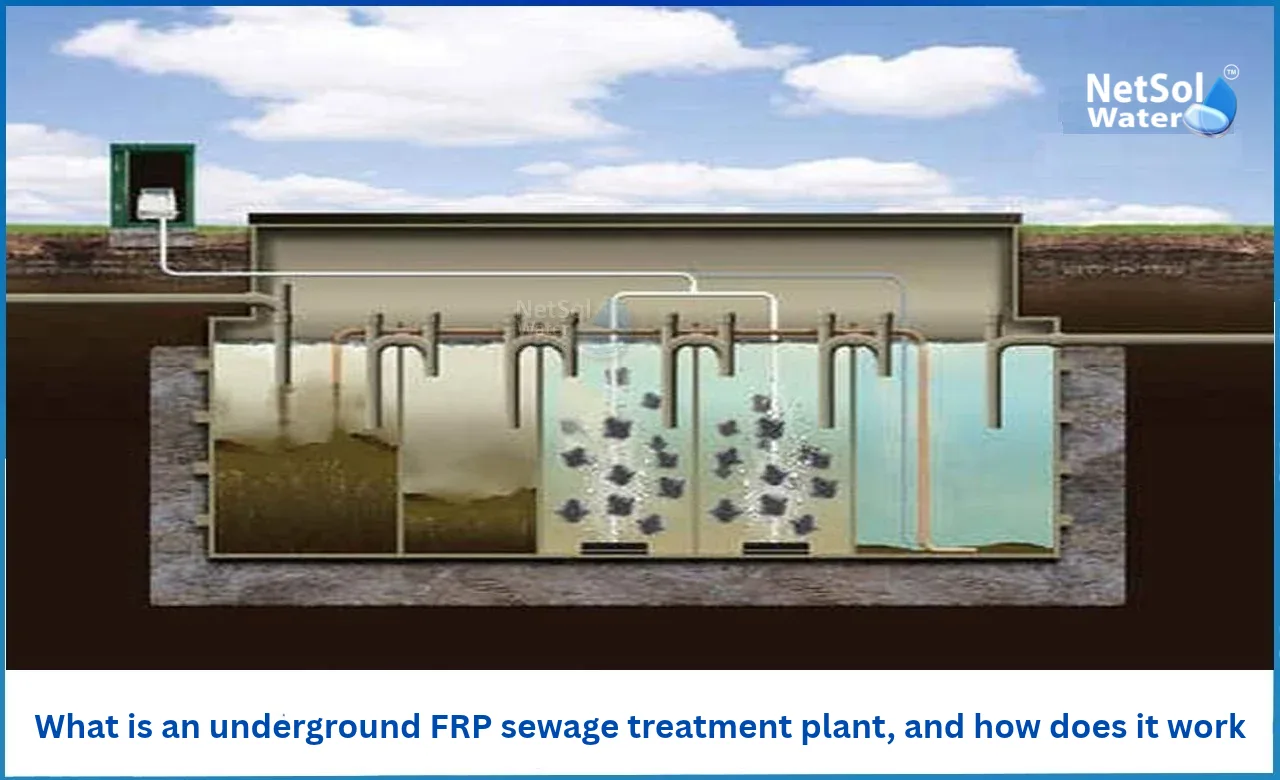
What is an underground FRP sewage treatment plant, and how does it work?
Buildings, including houses, offices, hotels, and hospitals, all generate wastewater. Appropriate wastewater treatment is needed so that this can then be safely released or reused. In cities, there is often restricted surface area, and so an underground wastewater treatment plant provides a good option. This enables subterranean tanks to be used for wastewater treatment so that space is available for parking and/or nature areas. Fibre Reinforced Plastic is a lightweight and durable material that can be moulded for a variety of applications. MBBR and/or MBR are just two of the possible wastewater treatment options that can be implemented within an underground FRP sewage treatment plant. Each has a differing approach and associated requirements. Untreated wastewater can pose environmental and even health issues, so appropriate wastewater treatment is advantageous. By working with a knowledgeable manufacturer, a project can determine both the correct size and wastewater treatment type for a given site.
What Is an Underground FRP Wastewater Treatment Plant?
This type of wastewater treatment plant utilises subterranean tanks and is ideal for sites that wish to make best use of their surface space. It is also a good option for enabling on-site wastewater treatment. Here, we examine some of the key aspects of underground wastewater treatment plants.
1. FRP Tank
FRP is a composite made up of plastics and fibres. Tanks can be produced from this and divided into sections for various stages of wastewater treatment. The number of sections will vary in accordance with the plant size and the type of wastewater treatment being used. As an underground tank, it is important that it can endure the ground pressure and also the groundwater situation. The installation location should be prepared appropriately, and the backfilling process should be implemented in accordance with the manufacturer’s guidelines. If the groundwater table is high, then further reinforcement may be necessary so as to avoid a risk of the tank floating if it is empty. Both the tank and the ground area must therefore be well designed. Furthermore, a good design will allow staff to easily and safely gain entry to the tanks for investigation and maintenance.
2. Areas of Application
Apartments and housing societies can implement underground wastewater treatment plants where there is little available surface space. Hotels and hospitals can also implement such systems in order to carry out on-site wastewater treatment. Commercial and institutional properties may elect for this type of wastewater treatment plant so as to preserve areas for parking and/or nature.
Following treatment, water can be reused for non-potable purposes, including garden irrigation and toilet flushing, provided that it conforms to relevant local regulations. Staff should analyse the average and maximum volumes of wastewater that will be generated and ascertain what standard of treated water is required. Using this information, a proficient manufacturer can decide on the most appropriate tank size and wastewater treatment type. Again, the design should allow easy and safe access for inspection and maintenance.
How Do Underground FRP Wastewater Treatment Plants Work?
Various stages are used to treat wastewater. At each stage, specific materials are targeted for either elimination or minimisation. The precise configuration will be influenced by the wastewater treatment technology in use. We now explore the general steps in most packaged wastewater treatment systems.
1. Screening and Biological Treatment
Initially, wastewater is channelled into a screening section. Here, large debris (for example, textiles and plastics) is filtered out so that pumps and pipework are not obstructed. The wastewater then travels to a holding/equalisation tank. This equalises wastewater volume fluctuations and distributes wastewater at an even rate to the treatment phase. Beneficial bacteria are then deployed to decompose organic matter. Within an MBBR wastewater treatment system, these bacteria are attached to tiny plastic media. This media is then circulated within an aeration tank. As the bacteria require air to function, this is provided. With an MBR wastewater treatment system, biological treatment is merged with a membrane filtering step. This enables treated water to be isolated from solids. Again, these treatment mechanisms aid in the minimisation of pollutants, and so the water can then progress to the following treatment stage.
2. Clarification, Filtration, and Disinfection
Post-biological treatment, the wastewater treatment plant divides the solids from the water. A clarifier facilitates the deposition of larger solids and biological matter at the base. Occasionally, membranes are utilised in place of a clarifier to achieve this solid-liquid division. Depending on the system, water can then be filtered using sand and/or carbon. Chlorine and/or ultraviolet light can also be applied to further treat water by diminishing the presence of deleterious bacteria. Treated water is then stored within a tank. It can either be reused or released in compliance with local legislation. Furthermore, surplus sludge is gathered and can then be safely managed and disposed of. Throughout the operational period, pumps, blowers, screens, and filters should be maintained in line with a set maintenance regime. Appropriate maintenance ensures uniform wastewater treatment is achieved.
Read some interesting information for the Industrial RO Plant Manufacturer
Conclusion
An underground fibre reinforced plastic wastewater plant is both space-efficient and efficient for wastewater treatment. Correct plant scale, wastewater treatment technology, installation, and maintenance are all integral to ensuring optimal operation. Netsol Water is a prominent manufacturer of underground wastewater treatment plants. It provides MBBR and MBR wastewater treatment types within its range, each of which is applicable to varying project needs. Engaging with a competent underground fibre reinforced plastic wastewater treatment plant manufacturer can enable companies and housing projects to competently manage wastewater. Contact Netsol Water to advise on your project and arrange a consultation to identify the most fitting wastewater treatment system for you.
Contact Netsol Water at:
Phone: +91-9650608473
Email: enquiry@netsolwater.com