
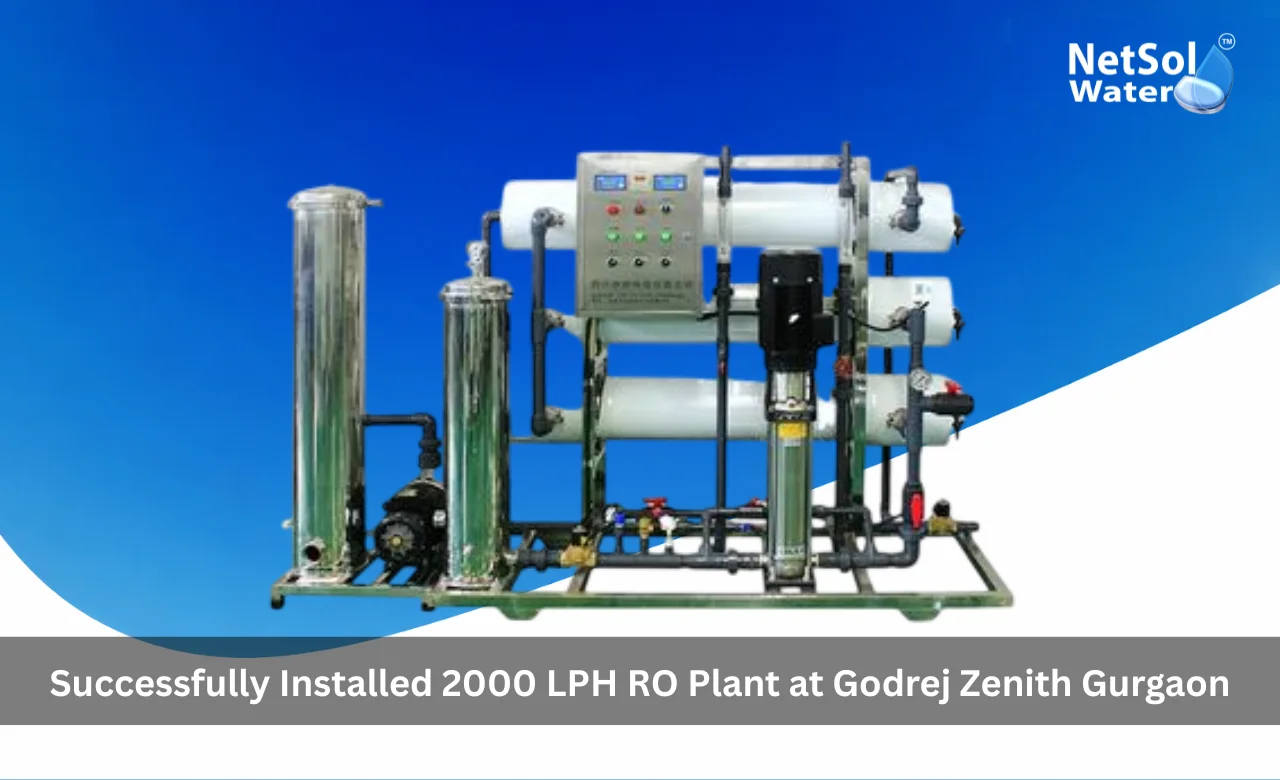
Successfully Installed 2000 LPH RO Plant at Godrej Zenith Gurgaon
The provision of good and properly treated water is a key requirement for today’s residential and commercial developments. Water quality can vary due to raw-water quality and/or dissolved solids, hardness, suspended matter, and other contaminants, which can have an impact on water usability, plumbing systems, equipment performance, and overall facility operations. In order to overcome these challenges, a suitable water-treatment plant should incorporate an efficient pretreatment process as well as a robust membrane filtration process.
A 2000 LPH Reverse Osmosis Plant was installed at Godrej Zenith, Gurgaon successfully, to ensure a reliable supply of treated water while sustaining the efficient running of the plant and the consistent quality of the water produced.
The project comprised the following activities: Water-treatment requirement assessment, selection of appropriate treatment technology, fabrication of the plant, transportation, installation, testing, commissioning and performance verification. The system was designed based on the reverse osmosis technology, which is protected by proper pretreatment stages and has high treatment efficiency.
This project showcases our capabilities as a leading Commercial RO Plant Manufacturer in Gurgaon and delivers customized RO solutions to residential complexes, commercial buildings, institutions, industries, hotels, hospitals, corporate buildings, and more, that demand reliable water purification.
Project Overview
The project entailed the supply, installation, testing and commissioning of a 2000 litres per hour (LPH) commercial RO plant for Godrej Zenith, Gurgaon.
The main goal was to implement a well-designed water-treatment method that could remove dissolved contaminants and enhance the water quality of the raw water. The performance of an RO membrane is highly dependent on the quality of water fed to the membrane system, so the project was planned as an integrated treatment system rather than just putting up an RO membrane unit.
All of these features – pretreatment, filtration, high pressure pumping, reverse osmosis membrane separation, instrumentation, flow control mechanisms, and collected treated water – constituted the full treatment arrangement.
The following were given special consideration:
- Consistent treated-water production
- Decrease in dissolved salts and undesirable impurities
- Protection of RO membranes
- Operational reliability
- Ease of maintenance
- Use of available space is maximized.
- Maintains a stable system pressure and flow.
- Convenient operator access
- The ability to install in a safe and systematic manner
- Long-term plant performance
The 2000 LPH capacity is based on the treated water demand of the site and anticipated operating conditions.
Its successful installation enables Godrej Zenith to have a water-treatment system that is planned to give its customers treated water of 2,000 litres per hour for the above stated operating conditions and parameters.
Client Details
| Project Detail | Information |
| Client/Project | Godrej Zenith |
| Water Resources | Water Resources Management, Water Treatment, Water Quality Management |
| Type of RO plant | Commercial. |
| Rated Capacity | 2000 LPH |
| Location | Gurgaon, Haryana |
Godrej Zenith needed a water treatment system that could supply a reliable amount of treated water, with consistent quality.
When choosing a RO for projects like this, the right choice of RO capacity is just part of the equation. Other factors to consider include water chemistry, operating hours, recovery expectations, pressure requirements, feed-water characteristics, pretreatment requirements, equipment accessibility and future maintenance requirements.
These requirements were analyzed by our technical team as part of the treatment configuration development.
This led to the development of a tailor-made 2000 LPH commercial RO unit, which is optimized for a combination of water quality enhancement, plant efficiency, protection of RO membranes and ease of maintenance.
Project Location – Godrej Zenith, Gurgaon
The RO plant was commissioned in Godrej Zenith at Gurgaon, Haryana.
Gurugram, popularly known as Gurgaon, has undergone a large scale residential, corporate, institutional and commercial growth. The region’s large properties need reliable water-management systems to keep them running.
Ground water and other sources of water may contain various amounts of dissolved minerals, hardness, suspended materials, and other contaminants. Other sources of water, seasonal changes, storage conditions, and area water supply systems can also impact water quality.
Therefore, plant capacity is not the only criterion to consider when choosing a water-treatment system. Water quality and water quantity must both be taken into account for proper treatment design.
Being one of the leading Commercial RO Plant Manufacturer in Gurgaon, we do not use a one size fits all approach for all projects, but customize the design of RO systems for each site.
Plant Capacity – 2000 LPH
The treated water production capacity of the RO system installed is:
2000 Litres Per Hour (LPH)
Plant size typically means that it is designed to give a purified water output of around 2,000 litres an hour under the plant design conditions.
The chosen capacity offers an ideal combination of:
- Required treated-water demand
- Available feed-water quantity
- Operating duration
- RO recovery
- Membrane loading
- Pump capacity
- Storage requirement
- Space availability
- Expected future usage
When a RO plant is installed correctly, it does not result in the problems caused by under sizing or oversizing the plant.
An undersized system can be running all the time and could come up short of meeting peak demand. A system that is too large, however, will waste money on capital expense, equipment size and power use.
The configuration of 2000 LPH was therefore chosen, to provide an effective solution for the water-treatment requirement of the site, yet maintain the ability to operate and maintain the system.
Treatment Technology
This project employs the main treatment technology of RO.
Reverse osmosis is a pressure driven membrane-separation process, which is widely used for removal of dissolved salts and other undesirable component from water.
In RO water treatment, feed water is pumped at high pressure through semi-permeable membranes, which are treated beforehand. As the water molecules cross the membrane, they leave behind a high concentration of salts and other rejected components as the concentrate stream.
But an effective commercial RO plant is more than just an RO membrane.
The treatment system installed at Godrej Zenith consists of various stages to ensure that the RO membranes receive the feed water suitably treated.
The overall technology is comprised of:
- Feed-water handling
- Pressure boosting
- Multimedia/sand filtration
- Activated carbon filters
- Micron cartridge filtration
- Chemical conditioning – as appropriate.
- High-pressure pumping
- Reverse Osmosis Membrane Separation
- Product-water collection
- Monitoring the flow and pressure.
- Influent Characteristics
The source or feed water had impurities that required further treatment prior to use.
In the context of local source and supply conditions, raw water from Gurgaon may pose treatment issues like:
- Dissolved salts or elevated TDS
- Hardness
- Fine suspended matter
- Turbidity
- Calcium and magnesium compounds
- Chlorides and other dissolved ionic constituents
- Colour or odour-causing substances
- Organic impurities
- Fine particles capable of fouling RO membranes
Wherever possible, the design of any RO system should be based on a water analysis.
The treatment train is designed for this installation to allow the removal of the contaminants from the water before it reaches the membranes and to create water with a much better quality.
Direct feeding of untreated water into RO membranes can lead to:
- Membrane scaling
- Fouling
- Reduced permeate flow
- Increased pressure requirement
- Reduced salt rejection
- More frequent membrane cleaning.
- Shortened membrane life
The influent water conditions thus influenced the type and configuration of the pretreatment equipment.
Treatment Process
Godrej Zenith Gurgaon installed 2000 LPH commercial RO plant which has a systematic treatment sequence.
Step 1: Feed Water Collection
Water that comes from the designated raw water source or water storage facility to the treatment system.
To maintain the continuous operation of the RO plant it is essential to have enough feed-water.
Step 2: Feed/Raw Water Pumping
The pretreatment units require a certain flow and pressure, which is achieved using a feed pump.
Feed pressure stability is crucial because fluctuations in feed pressure can impact the filtration process downstream and RO performance.
Step 3: Multimedia/Sand Filtration
Water for the feed is passed through a filtration unit which removes:
- Suspended particles
- Sediment
- Silt
- Turbidity
- Coarser particulate matter
These contaminants are removed to ensure protection of subsequent treatment stages.
Step 4: Activated Carbon Filtration
Activated carbon filtering to remove compounds that cause an undesirable colour, odour and some organic contaminants is required by the feed-water characteristics in most cases.
It can also serve as a protection for downstream membranes where there are oxidizing compounds to be controlled.
Step 5: Chemical Conditioning
Appropriate dosing can be added to prevent scaling and optimize membrane performance, depending on the chemistry of the feed water.
Dissolved minerals can be deposited on the surface of the membrane, causing scale formation, which is a critical issue in RO systems.
Chemical conditioning minimizes precipitation and can increase the operating life of the membrane.
Step 6: Micron Cartridge Filtration.
Water is filtered through small cartridge filters prior to entering the high pressure RO section.
This filtration stage serves as an extra layer of protection by getting rid of fine particles that might have gotten through the preceding filtration stages.
Step 7: High-Pressure Pumping
The feed water is pumped up to the required pressure for membrane separation by a high-pressure pump.
The pump is one of the most significant parts of the commercial RO plant as the required pressure should be sufficient to overcome the osmotic pressure for the desired product-water production.
Step 8: Reverse Osmosis Membrane Treatment
Feed water is pressurized and fed into the RO membrane housings.
The membrane system splits the feed stream into:
Permeate/Product Water: Water that goes through the RO membrane and has much lower concentration of dissolved impurities.
Rejected/Concentrated Water: Salt and impurities rejected by the membranes, while the water is concentrated.
Step 9: Product water collection tank
The purified permeate is fed to the treated-water storage facility, from where it is used.
Step 10: Monitor and control
Essential operating parameters can be monitored via pressure gauges, flow meters, valves and other instrumentation.
This allows the detection of plant performance changes before they become serious maintenance problems.
Major Equipment for 2000 LPH RO Plant.
The entire plant design includes equipment chosen based on the required treatment conditions, operating pressure and flow.
| Major Equipment | Purpose / Description |
| Raw Water/Feed Pump | Provides sufficient water flow and pressure to the pretreatment section. |
| Multimedia/Sand Filter | Minimizes suspended matter, silt, sediment and turbidity of incoming water. |
| Activated Carbon Filter | Removes undesirable organics, odours, colour and other contaminants. |
| Chemical Dosing System | Used for water conditioning and/or membrane-scale control based upon the characteristics of the raw water. |
| Micron Cartridge Filter | Fine filtration directly in front of the RO section. |
| High-Pressure Pump | Produces the operating pressure for efficient reverse osmosis. |
| RO Membrane Housings | Hold the reverse osmosis membrane elements and be able to resist the operating pressure of the system. |
| RO Membranes | Carry out the main dissolved-solids separation operation. |
| Flow Meters | Allow product-water and reject-water flow to be observed by operators. |
| Pressure Gauges | Assist in measuring pressure at significant treatment points and detect abnormal operating conditions. |
| Control Panel | Central Controls for electricity and helps in safe operation of pumps and other equipment. |
IPV is the process of connecting pipes and valves together.
Regulates and regulates water flow between treatment processes.
All major components have been installed to ensure ease of operation and future maintenance.
Installation Process
The installation of a commercial RO plant involves appropriate planning because even the well-designed RO plant can perform poorly if there is improper piping, electrical connection, foundation alignment, foundation preparation, or improper commissioning.
The installation of Godrej Zenith project was a systematic process.
1. Site Assessment
Prior to the final position of the equipment the available installation space and utility arrangements were evaluated.
Considerations included:
- Available floor area
- Water inlet location
- Drainage arrangement
- Electrical supply
- Treated-water outlet
- Operator movement
- Maintenance clearance
- Equipment accessibility
- Equipment Positioning
Key treatment components were placed in a logical sequence that started at the raw water intake and ended at the treated water discharge.
Equipment spacing was observed to allow for routine inspection and servicing as much as possible.
2. Piping Connections
The piping between the feed-water section, filters, dosing arrangement, cartridge filtration system, high-pressure pump, membrane system, reject line and permeate outlet was installed.
3. Electrical Connections
Electrical connections were made to pumps and control systems based on the plant operating criteria.
4. Instrument Installation
Monitoring equipment such as pressure, flow, valves, etc. placed at appropriate locations.
5. Leakage and Connection Checks
Inspection for leaks and alignment of piping joints, membrane housings, valves and connections were performed prior to regular operation.
Plant Commissioning
One of the most critical phases of any water-treatment system installation is commissioning.
It is not just about starting the RO plant, but it is about checking whether all the treatment stages are working properly or not and whether the whole system is working in an integrated manner.
The commissioning of the 2000 LPH RO plant at Godrej Zenith Gurgaon was a commissioning exercise that involved the following:
- Inspection of installed equipment
- Verification of piping connections
- Checking electrical connections
- Confirmation of valve positions
- Filter flushing
- Cartridge-filter inspection
- Pump operation checks
- High-pressure section inspection
- Membrane-system startup
- Pressure adjustment
- Flow-rate adjustment
- Permeate-flow monitoring
- Reject-flow monitoring
- Product-water quality checking
- System leakage inspection
- Overall operational testing
It was initially under a controlled operation until the pressure and flow of the system was stabilized.
The RO system was then tested to verify the production of the treated water is in line with the rated capacity and operating conditions of the plant.
The plant was successfully tested and put into operation for regular use.
The one of the biggest benefit of an onsite commercial RO plant is that you can generate treated water as per the operational requirements of the property.
Some potential applications of treated RO water are:
- Domestic water requirements
- Cleaning applications
- Utility requirements
- Process-water applications
- Food processing equipment that uses low TDS water
We also accept other alternative uses for property, as outlined below:
Treatment levels should always match the use(s) of the treated water and the regulatory/operational requirements.
The water quality of RO reject water may also be considered for potential non-potable reuse opportunities, when water quality, infrastructure, and local needs allow.
Applications may be selected cleaning, flushing or other non-critical uses, following suitability determinations.
This re-use can help to achieve more responsible water management and minimise unnecessary water waste.
Results and Performance
Godrej Zenith 2000 LPH RO plant was successfully installed and commissioned and it was found to be operating very stable with the designed parameters.
The main outcomes of the project were:
1. Consistent Treated-Water Production
Under the design operating conditions, the system was designed to produce about 2000 litres per hour of treated water.
A substantial decrease in the concentration of dissolved impurities.
The dissolved salts and other membrane-rejectable components of the feed water were significantly decreased through the use of the RO membrane stage.
2. Improved Water Quality
The treated water was significantly better than the untreated feed water and is suitable to the intended site use.
3. Stable Operating Pressure
The high pressure system was tuned during the commissioning process to obtain stable operation of the membrane.
4. Effective Pretreatment
The particulate and contaminant load entering the RO membrane section is reduced by the use of the pretreatment units.
5. Membrane Protection
The system minimizes the chances of fouling and scaling of the membranes by using the right pretreatment and chemical conditioning.
6. Reliable System Operation
Dependable day to day operation relies on correct size, systematic piping, instrumentation and commissioning.
7. Maintenance-Friendly Layout
The equipment layout enables filters, valves, gauges, pumps and membrane housings to be easily accessed for routine inspection and maintenance.
This successful installation proves that the proper combination of selection, pretreatment and the professional commissioning is of key importance.
Customer Feedback / Testimonial
Godrej Zenith’s commissioned 2000LPH RO plant is a testament to the client’s need for a reliable and professionally set up commercial water treatment system.
Client testimonial:
*The LPH RO plant was installed at our site successfully and the system is operating with a regular rate of treated water production. Technical team provided proper support during installation, testing and commissioning.*
The successful completion of this project further highlights our commitment for designing, fabricating, installing, commissioning, and after-sales technical support of not only RO equipment, but an entire water treatment solution.
Why opt for us as your Commercial Ro Plant Manufacturer in Gurgaon?
Capacity and price are not the only two criteria that should be used to select an RO plant.
The lifespan of a commercial RO system is determined by a number of factors such as:
- Raw-water analysis
- Appropriate plant sizing
- Pretreatment design
- Membrane selection
- Pump sizing
- Operating pressure
- Recovery percentage
- Instrumentation
- Installation quality
- Preventive maintenance
- Technical support, availability of support.
We are a Commercial RO Plant Manufacturer in Gurgaon and offer plants according to site specific needs.
RO solutions that are commercial and industrial, can be made to fit various capacities and applications such as:
- Residential societies
- Commercial complexes
- Corporate offices
- Hotels
- Hospitals
- Educational institutions
- Restaurants
- Manufacturing facilities
- Food-processing units
- Industrial plants
- Construction projects
- Institutional buildings
- Warehouses
- Shopping complexes
RO plants can be combined with other technologies like multimedia filtration, activated carbon filtration, softening, antiscalant dosing, UV treatment, ozone treatment, ultrafiltration and other water-treatment technologies, depending on the water characteristics and application.
Project Summary
Details of the project: Installation of Commercial RO Plant.
| Project Detail | Details |
| Client | Godrej Zenith |
| Location | Gurgaon, Haryana |
| Plant Capacity | 2000 LPH |
| Primary Technology | Reverse osmosis. |
| Pretreatment | Filtration and water conditioning according to the needs of the feed water. |
| Treatment | The use of treated water for plant needs. |
| Project Scope | Design, supply, installation, test and commissioning. |
| Install and Commission Status | Successfully Installed and Commissioned; |
The project illustrates the potential of a well-designed RO plant to be a reliable solution for consistent treated water quality for commercial and residential developments.
Every stage of the treatment requirement to the final commissioning was completed with a focus on operational reliability, membrane protection, efficiency and maintainability over time.
Call to Action
In cases where the issues are high TDS, hardness, dissolved salt, water quality, or intermittent availability of treated water in residential societies, commercial buildings, hotels, hospitals, institutions, offices, restaurants or industrial facilities, the right commercial RO system will be able to help.
We produce and install the customized RO plant as per your requirement:
- Raw-water quality
- Required treated-water capacity
- Daily water consumption
- Available installation space
- Operating conditions
- Intended application
- Budget
- Automation requirements
The system can be designed to meet the specific requirements of the project, whether for a 5000 LPH or any other higher capacity RO plant, or a 5000 LPH, 3000 LPH, 2000 LPH, 1000 LPH or 500 LPH RO plant.
Read some interesting information for the Industrial RO Plant Manufacturer in Faridabad
Need a Commercial RO Plant in Gurgaon?
Contact us for:
- Site Assessment
- Water Quality Evaluation
- RO Plant Design and Capacity Selection
- Commercial RO Plant Manufacturing
- Installation and Commissioning
- RO Membrane Replacement
- Plant Maintenance and AMC Services
- Existing RO Plant Upgradation
- Technical Support and Troubleshooting
If you are searching for a reliable Commercial RO Plant Manufacturer in Gurgaon, contact our water-treatment specialists to discuss your requirement and receive a customized solution.
Get in touch today for a commercial RO plant consultation, site visit, and customized quotation.
Contact Netsol Water at:
Phone: +91-9650608473
Email: [enquiry@netsolwater.com](mailto\:enquiry@netsolwater.com)