
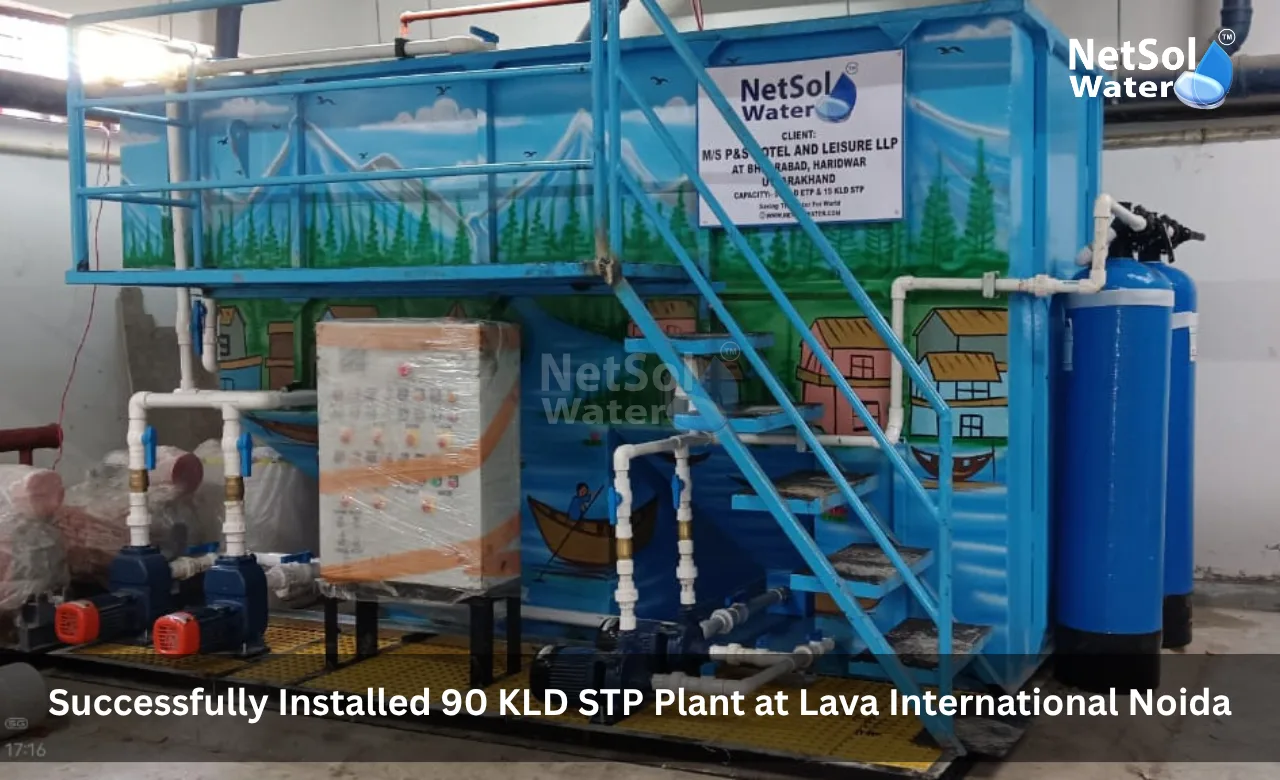
Successfully Installed 90 KLD STP Plant at Lava International Noida
Good sewage control is important in big sized industrial and commercial units that produce substantial amount of sewage daily. A well-designed Sewage Treatment Plant can effectively manage wastewater and help the organization use the treated water in non-potable applications, which can minimize fresh water usage.
Netsol Water installed successfully 90KLD Sewage treatment plant at Lava International, Noida. The project entailed planning, supply, installation, integration, testing and commissioning a sewage treatment system of the capacity to treat about 90 kilolitres of wastewater per day.
The main goal was to create an efficient and reliable wastewater-treatment solution that would reliably treat sewage generated at the facility and make it suitable for re-use in various other non-potable applications including flushing, horticulture, and as approved by the MWD.
Since we are a leading Sewage Treatment Plant Manufacturer in Noida, we made sure that we could provide an operationally easy, space saving, energy efficient and system which can give a consistent quality of treated water throughout the project.
Project Overview
The project was the successful installation of a 90 KLD Sewage Treatment Plant at Lava International, Noida, Uttar Pradesh.
A place like this produces domestic wastewater from various locations such as washers, washrooms, hand washing areas, pantry areas, and other employee-use areas. When not properly treated, this sewage may cause problems of the environment, hygiene, odour and wastewater disposal.
The need was thus to provide a centralized treatment system to capture and treat the resultant wastewater efficiently for reuse or disposal based on the applicable requirements.
The project involved:
| Project Activity |
| Estimation of the expected amount of sewage and wastewater. |
| Design and engineering of 90 KLD STP. |
| Tank and mechanical equipment, pumps, blowers, piping, and control systems to treat wastewater. |
| Installation and interconnection of the different treatment units. |
| Electrical and mechanical integration. |
| Operating and process development/trials. |
| Testing and commissioning of the entire STP. |
| Directions on plant operations and regular maintenance. |
Upon its completion, the finished plant will allow Lava International to have an organised wastewater management system, and will also contribute to the overall goal of conserving freshwater through reusing the treated water.
The project also showcases our competence as Sewage Treatment Plant Manufacturer in Noida in executing all Sewage Treatment Plant projects from design, procurement of equipment, installation to commissioning.
Client Details
| Field | Details |
| Client | Lava International |
| Industrial Sector | Electronics / Corporate and Industrial Facility |
| Application | Only domestic sewage produced on site can be treated by application. |
| STP Capacity | 90 KLD |
Lava International has facilities to accommodate the employees and associated support activities. Reliable wastewater infrastructure is important at such facilities, as there is continuous generation of wastewater.
The client needed a treatment system that would be able to handle the wastewater volume that they can expect each day, without adding excessive complexity to operations. During the project, the following factors were considered: reliability, compact installation, ease of maintenance and treated-water reuse were all important factors.
The 90 KLD plant was hence designed to offer an acceptable balance between treatment effectiveness, equipment reliability, operational control and ease of maintenance.
Project Location
The Sewage Treatment Plant was set up at Lava International, Noida, Uttar Pradesh.
Noida is one of the key industrial, commercial, IT, electronics and residential hubs of NCR. As commercial and industrial growth has become more significant throughout the region, the need for sustainable water and wastewater management has grown.
On-site wastewater treatment can be beneficial for factories, office complexes, institutions, commercial establishments, residential societies, hotels, hospitals etc. to achieve a substantial reduction in the discharge of untreated effluents and re-use of treated wastewater to a certain extent.
As a Sewage Treatment Plant Manufacturer in Noida, we know that the design of the STP systems in such a plant must not only be based on rated capacity but also operating conditions, space availability, variations in wastewater, maintenance requirements, energy consumption and the purpose of reusing treated water.
These factors were taken into account in the development of the Lava International project.
Plant Capacity
The installed Sewage Treatment Plant, its treatment capacity is:
| Parameter | Value |
| Treatment Capacity | 90,000 litres per day (LPD) – 90 KLD |
This is to accommodate an estimated inflow of about 90,000 litres per day of sewage, considering the actual hydraulic loading and condition of the STP‘s operation.
Capacity Selection is one of the critical design phases in STPs. An undersized plant can lead to hydraulic overload and inadequate treatment time, while an oversized plant can result in unnecessary high capital and operation expenses.
The size of the Lava International STP was chosen according to the estimated wastewater flow rate and treatment need of the plant.
Although average daily volume of sewage is a critical factor, the treatment system must also be able to cope with fluctuations in flow rates across the day. Thus, equalization and controlled pumping play a key role in a well-designed sewage-treatment process.
Treatment Technology
The 90 KLD STP utilizes a biological wastewater-treatment system supplemented with primary treatment, aeration, clarification/separation, filtration and disinfection stages.
The treatment philosophy is the removal of:
| Removal Target |
| Suspended solids |
| Organic pollutants |
| Biodegradable contaminants |
| Unpleasant odour-producing matter |
| Residual fine solids |
| Microbial contamination |
In domestic sewage, a large amount of the pollution load is in the form of biodegradable organic matter and biological treatment is especially important in this case.
In biochemical treatment process, the microorganisms in the sewage use the organic pollutants as a source of energy and nutrients. These microorganisms can be used to reduce the organic load of the wastewater under proper operating conditions and adequate aeration.
Treating water separates the solids from the treated water. The water is further treated using filtration and disinfection before storing and re-using it.
The treatment system has been designed to provide the required dependable wastewater treatment, and will be an easy system to operate and maintain for the plant staff.
Influent Characteristics
The quality of domestic sewage may vary based on the factors related to employee occupancy, water usage, sanitation usage, working hours, cleaning schedule, and other site-specific factors.
The key factors for the design of such an STP typically are:
| Parameter | Design Range |
| pH | 6.5–8.5 |
| BOD | 200–300 mg/L |
| COD | 400–600 mg/L |
| TSS | 200–350 mg/L |
| Oil & Grease | Variable |
| Daily Flow | Up to 90 KLD |
BOD, or Biochemical Oxygen Demand is a measure of the content of biodegradable organic pollutants in wastewater.
The Chemical Oxygen Demand (COD), which gives a wider range of indication of oxidisable pollutants.
Total Suspended Solids (TSS) is a measurement of the solids that are suspended in the wastewater.
These pollutants are treated at various stages of the STP before water is reused or disposed to an approved facility.
Treatment Process
The 90 KLD Sewage Treatment Plant is a series of treatment stages where the wastewater is improved progressively, rather than using one stage of treatment.
1. Sewage Collection
The waste water produced at the plant is collected and channeled to STP. A controlled sewage inflow at the treatment plant is provided by proper collection.
2. Screening
At the preliminary-treatment stage, sewage flows through screening arrangements which remove relatively large floating and solid materials.
Coarse material like plastic, cloth, paper, packaging fragments and other coarse material can cause problems with pumps, pipelines, and down stream treatment equipment. Screening thus safeguards the system, and enhances its operational reliability.
3. Equalization
Following preliminary screening, the wastewater flows into the equalization area.
The generation of wastewater is not constant during the day. Flows can be increased throughout the day, at lunchtime or specific times. These fluctuations are balanced with the equalization tank.
Mixing or aeration can also be used to prevent the formation of septic conditions in the wastewater and to reduce wastewater settlement in the tank.
The sewage is pumped at a controlled rate from the equalization stage towards the biological-treatment system.
4. Biological Treatment & Aeration
The biological stage is the central component in the sewage-treatment process.
Blower and diffusered air are fed to microorganisms that degrade biodegradable organic contaminants.
Proper aeration supports:
| Aeration Benefit |
| Biological degradation of the organic contaminants. |
| Mixing of wastewater and biomass. |
| Reduction of BOD. |
| Prevention of anaerobic conditions & odours. |
| Creating a stable biological treatment environment. |
Although oxygen levels and biological activity are not essential for treatment to be consistent, they are important.
5. Solid-Liquid Separation
Suspended biological solids need to be removed from the treated wastewater after biological treatment.
These solids are removed during the clarification/filtration stage to provide relatively clear treated water to the tertiary treatment stage.
Sludge created in the treatment process is occasionally conveyed to the correct sludge disposal system.
6. Tertiary Filtration
Biological treatment is very effective in upgrading wastewater quality, but there may be remnants of small suspended particles.
Depending on the final plant configuration water is thus passed through polishing filtration systems like pressure sand filtration and activated carbon filtration.
The residual suspended solids and turbidity are removed to some extent using the Pressure Sand Filter (PSF).
An Activated Carbon Filter (ACF) can be used to further polish the water and may help to remove any leftover organic chemicals, odour and colour.
7. Disinfection
After filtration, the water is disinfected.
The goal is to minimize microbial contamination prior to the treated water being returned to the final storage/reuse system.
The disinfection system chosen is used as specified based on the desired disinfection quality of treated water and its purpose.
The system is referred to as a treated water storage and reuse system.
The treated water is then gathered in a treated water tank.
This water is not regarded as waste but may be recycled for suitable non-potable uses which will include other water utilities within the facility.
Major Equipment
The 90 KLD STP is operated by several mechanical, electrical and process elements.
Most of the equipment that is usually put into the system is:
| Equipment | Function |
| Sewage Transfer Pumps | These are used to pump wastewater from one treatment stage to another. |
| Air Blowers | Provide the air needed for treatment and mixing in the biological processes. |
| Fine Bubble Diffusers | Efficiently distribute air inside the aeration/biological treatment tank. |
| Pressure Sand Filter | Residual suspended particles removal and improvement of clarity. |
| Activated Carbon Filter | Fine polishing and helps removing odours and organics. |
| Tertiary filtration pumps | Maintain the flow and pressure needed for tertiary filtration. |
| Sludge Transfer Pumps | For biological sludge that is generated during the wastewater treatment process. |
| Piping and Valves | Allow wastewater, sludge, air and treated water to be moved in a controlled manner throughout. |
| Electrical Control Panel | Provides control and protection over pumps, blowers and other electrical equipment. |
| Level Control Arrangement | Assists in controlling pumping as a function of water levels in the tank. |
| Disinfection System | Final microbial treatment before re-use. |
Selection of reliable equipment is important as it is not only the treatment principle that is important for the overall performance of an STP, but also the reliability of individual pieces of equipment.
Installation Process
The installation of the 90 KLD STP was achieved in a logical order in order to ensure proper alignment, interconnection, electrical safety and process functionality.
The first step was to look at the space available and verify the layout of various treatment units. Placement of equipment to allow adequate access for operation, inspection, servicing and future maintenance.
Mechanical equipment like pumps and blowers were installed as per approved plant arrangement.
The piping connections were then made between the various treatment stages. Flow regulation, isolation and maintenance was allowed by installing appropriate valves and fittings.
The air piping was linked from the blowers to the aeration system in order to get equal air distribution.
The overall treatment line was then connected to filtration systems, pumps, and treated-water connections.
Electrical cabling and connections to the control panel were installed and adequate protection and operating controls put in place.
The entire installation was checked prior to commissioning for:
| Pre-Commissioning Check |
| Correct equipment positioning. |
| Piping integrity. |
| Valve operation. |
| Electrical connections. |
| Pumping and working of the pump. |
| Blower performance. |
| Air distribution. |
| Leakage. |
| Suitable flow of treatment through treatment units. |
| General operational safety. |
This systematic installation procedure assisted the installation of the 90 KLD STP for trial operation and commissioning.
Plant Commissioning
Commissioning is an important phase in any Sewage Treatment Plant project as the job of mechanical installation is not enough to ensure proper biological treatment.
Once installed, the 90 KLD system was subjected to inspection, testing, trial operation and process stabilization.
The individual pumps, blowers, valves, pipeline, filters and control components were tested before running the plant as a system.
The flow of wastewater in each of the treatment stages was monitored and adjusted as needed.
The aeration system was inspected to make sure that there was sufficient and reasonably even air distribution through the biological-treatment section.
During process stabilization, operating conditions were gradually adjusted to support the development and maintenance of the microorganisms responsible for sewage treatment.
Plant operators were also guided regarding important operational aspects such as:
| Operational Aspect |
| Pump operation. |
| Blower operation. |
| Tank-level monitoring. |
| Sludge management. |
| Filter operation and backwashing. |
| Routine inspection. |
| Preventive maintenance. |
| Identification of unusual odour, foaming, or other abnormal operating conditions. |
After the necessary checks and stabilization procedures, the plant was successfully commissioned for wastewater treatment.
Treated Water Reuse
One of the best benefits of running an STP is that if the water is treated well, it can be a source of recycled water.
The 90 KLD STP treated water can be used for approved non-potable uses as per final water quality and applicable local requirements.
Applications for re-use are:
1. Horticulture
The treated water may be used for irrigation of landscaped areas, lawns, plants and other green spaces as permitted.
2. Toilet Flushing
If possible, there is a dual plumbing system where treated wastewater can be used to flush instead of using freshwater.
3. Cleaning of floors and external area
Also suitable cleaning applications may use treated water, provided the required quality standards are met.
Non-Potable Utility uses include the following:
Other utility uses might be taken into account if they can be guaranteed to meet the treated-water quality requirements and if there are no cross connections with potable-water systems.
The facility can utilize treated water to reduce its freshwater requirement for uses where potable-quality water is not required.
This means that sewage treatment is an important element of sustainable water-management planning.
Results and Performance
Post installation and commissioning, the 90 KLD STP offers Lava International a structured method of treating waste water produced at the plant.
The project has achieved a number of operational and environmental benefits.
| Benefit | Description |
| Effective Sewage Management | Wastewater is not treated or left without proper treatment, but passes through a known treatment process. |
| Lowering of Organic Pollution | The purpose of biological treatment is to reduce biodegradable pollutants, as measured by parameters like BOD and COD to a significant level. |
| A decrease in turbidity, or suspended solids | The clarification and tertiary filtration processes help to reduce suspended particles and to increase the clarity of treated water. |
| Better Odour Control | Good aeration and wastewater management will reduce the likelihood of extended anaerobic periods which may lead to odours. |
| Treated-Water Recovery | The system treats the wastewater and can be used for appropriate non-potable use. |
| Reduced Freshwater Requirement | Water reuse can replace fresh water, such as for horticulture and flushing, and lead to better water-use efficiency. |
| Reliable Plant Operation | Structured treatment process is provided by suitable pumps, blowers, treatment units, controls and filtration equipment, which are designed for regular operation. |
Customer Feedback / Testimonial
Good coordination between the installation team and client when carrying out and commissioning the project is indicated by the successful completion of the project.
Special attention was paid to the reliable operation, practical maintenance and treatment of wastewater produced at the facility in the installation of the STP.
Client Testimonial
The project was successfully installed and commissioned at our facility, the project team provided professional support during installation, testing and commissioning, and the system is designed to provide efficient wastewater treatment and reuse of treated water.
Project Feedback:
The successful installation and commissioning of 90 KLD STP at Lava International is proof of the effective implementation of the project starting from equipment installation to plant start-up and operational handover.
Why is it that we are selected as Sewage Treatment Plant Manufacturer in Noida?
The specific standards required for a sewage-treatment project vary from project to project. The appropriate STP size, technology, equipment, civil engineering, piping, automation and treated-water application are therefore a function of the site-specific situation.
The Sewage Treatment Plant Manufacturer in Noida offers solutions for all kinds of wastewater-treatment solutions.
We provide services such as:
| Service |
| STP design and engineering. |
| Manufacturing and selling sewage-treatment equipment. |
| Complete STP installation. |
| Mechanical and electrical integration. |
| Capacities upgrade and enhancement at STP. |
| Testing and commissioning. |
| Operation and maintenance support. |
| Pump, blower, diffuser and filter replacement. |
| Existing STP troubleshooting. |
| Treated-water reuse solutions. |
| Annual Maintenance Contracts (AMC). |
We are able to deliver sewage-treatment solutions for:
| Sector |
| Industrial facilities. |
| Corporate offices. |
| Commercial buildings. |
| Residential societies. |
| Hotels and resorts. |
| Hospitals. |
| Schools and colleges. |
| Universities. |
| Shopping complexes. |
| IT parks. |
| Factories and warehouses. |
| Institutional campuses. |
The successful installation of the 90 KLD STP in Lava International, Noida is a sample of our offering of an end-to-end solution for waste water treatment based on site needs.
Call to Action
Looking to install a new Sewage Treatment Plant in your factory, office, residential society, hotel, hospital, institution, commercial building or industrial plant?
Planning to install/Upgrade Sewage Treatment Plant in your factory/office/residential society/hotel/hospital/institution/commercial building/industrial plant?
Correct selection of Sewage Treatment Plant Manufacturer in Noida can affect the efficiency of treatment process, operating cost of sewage treatment plant, system reliability and maintenance costs.
Our team is here to help you determine the right STP capacity and treatment system for you, according to your:
| Requirement |
| Daily sewage generation. |
| Number of users. |
| Available installation area. |
| Wastewater characteristics. |
| Treated-water quality requirement. |
| Water-reuse application. |
| Existing infrastructure. |
| Budget and operating needs. |
From small STPs for smaller projects to larger industrial or commercial treatment systems, we can offer a solution that is suitable for the project.
Read some interesting information for the Effluent Treatment Plant Manufacturer in Gurgaon
Need an STP for Your Facility in Noida or NCR?
Contact us today for a site assessment, technical consultation, or quotation for your Sewage Treatment Plant requirement.
Let our wastewater-treatment specialists help you develop a reliable, efficient, and sustainable sewage-management solution for your facility.
Looking for a reliable Sewage Treatment Plant Manufacturer in Noida? Get in touch with us today to discuss your STP project.
Contact Netsol Water at:
| Contact | Details |
| Phone | +91-9650608473 |
| enquiry@netsolwater.com |