
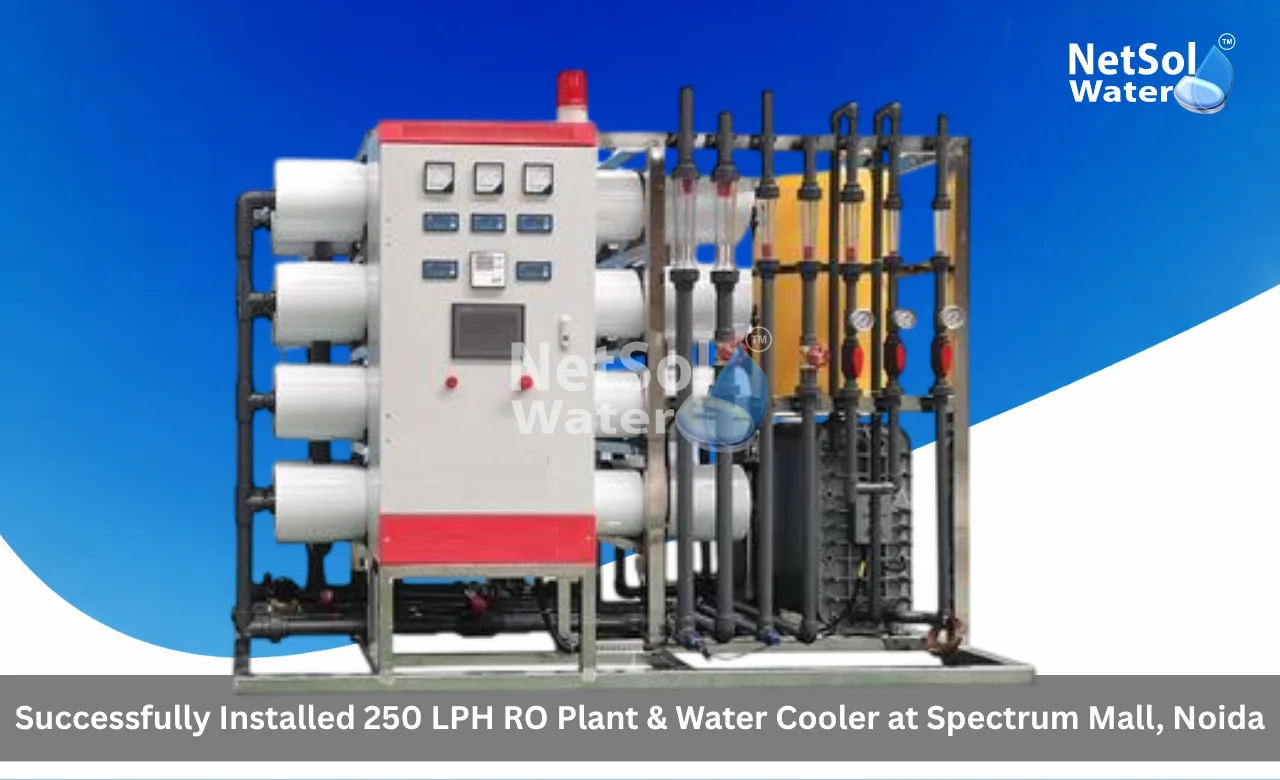
Successfully Installed 250 LPH RO Plant & Water Cooler at Spectrum Mall, Noida
Reliable access to treated drinking water is important for commercial facilities that serve a large number of people every day. Shopping malls need a practical water treatment plant that can support their operational requirements while maintaining a consistent supply of suitable drinking water. For this reason, Spectrum Mall in Noida required a compact and suitable water treatment solution that could provide treated water for its intended use.
Netsol Water successfully completed the installation of a 250 LPH RO Plant along with a water cooler at Spectrum Mall, Noida. The project focused on providing a dedicated reverse osmosis system with suitable cooling support for treated water. The selected capacity was planned according to the stated requirement of the facility and the treatment arrangement was designed to support regular water production.
As a commercial facility, the site needed a solution that could be installed properly and operated in a practical manner. The project therefore involved more than simply supplying an RO unit. It included equipment placement, system connections, testing and commissioning so that the installed setup could function as intended. The combination of RO treatment and a water cooler created a complete drinking water arrangement for the project.
This successful installation reflects Netsol Water‘s approach to delivering practical water treatment plants for commercial applications. As an experienced Commercial RO Plant Manufacturer in Noida, Netsol Water provides treatment solutions based on the required capacity and application. The Spectrum Mall project demonstrates how a properly selected RO system can support the drinking water requirements of a large commercial facility.
Project Overview
A commercial water treatment project must balance water quality, treatment capacity, equipment selection and ease of operation. The Spectrum Mall project was planned with these practical considerations in mind. The primary requirement was to install a water treatment system capable of producing treated water at the required rate while also providing cooled drinking water through a suitable water cooler arrangement.
The project included the installation of a 250 LPH RO plant and water cooler at the mall. The RO system was selected to treat incoming water through the reverse osmosis process. The treated water could then be supplied for the intended drinking water application. The water cooler formed an additional part of the solution by helping provide cooled treated water for users at the facility.
The objective was to deliver a complete and usable water treatment setup rather than an isolated treatment component. The scope therefore covered installation of the RO plant, placement of the related equipment, interconnections and final testing. Each stage was considered as part of the same system so that the treatment and cooling arrangements could work together.
The project also required proper coordination at the site. Commercial premises have fixed spaces and operational activities, so equipment installation needs to be carried out in an organised manner. Once the project requirements were established, the team could proceed with the installation and commissioning activities.
Client Details
Spectrum Mall in Noida is a commercial shopping facility that serves visitors, shoppers and the people working within the premises. Such a facility requires access to convenient drinking water as part of its day-to-day operations. Since the project was intended for a commercial environment, the water treatment system needed to support regular usage through a dedicated treatment and cooling arrangement.
The requirement at the site was focused on treated water production through an RO plant along with a water cooler. The installation was therefore intended to address the facility’s need for a suitable drinking water solution. Instead of depending only on untreated incoming water, the site could use a dedicated treatment process before making the water available for the intended purpose.
The project’s requirements also made equipment selection important. A system with an appropriate treatment capacity could help maintain a consistent supply without introducing unnecessary plant capacity. The chosen 250 LPH RO system provided a defined production rate for the application and was paired with a water cooler to complete the setup.
Netsol Water approached the requirement as a practical commercial water treatment project. The emphasis remained on providing the required treatment capacity and installing the system correctly within the client’s facility.
| Detail | Information |
| Client | Spectrum Mall, Noida |
| Facility Type | Commercial shopping mall |
| Requirement | Treated drinking water with cooling for visitors and staff |
| Solution Provided | 250 LPH RO Plant with Water Cooler |
| Installed By | Netsol Water |
Project Location
Location plays an important role in the planning of any commercial water treatment project. The system must fit within the available site conditions while also supporting the operational needs of the facility. In this project, the installation was completed at Spectrum Mall, Noida, which is a commercial environment with regular human activity.
The nature of a shopping mall makes convenient drinking water an important facility requirement. Visitors and staff use the premises throughout the day, which creates a need for an organised drinking water arrangement. A dedicated RO plant and water cooler can help the facility manage this requirement through a defined treatment and cooling system.
The Noida location also makes local project execution important. Equipment needs to be delivered and positioned at the site with proper planning. Connections between the treatment system and associated components must be completed carefully so that the plant can operate as intended.
For a local installation such as this one, working with an experienced Commercial RO Plant Manufacturer in Noida can help simplify coordination between system design, equipment supply and installation. Netsol Water completed the project by bringing these activities together at the client’s site.
Plant Capacity
Plant capacity determines how much treated water a system can produce within a given period. Selecting the right capacity helps ensure that the equipment is suited to the intended application without unnecessarily increasing the size of the treatment system. For a commercial facility, the selected capacity should match the expected requirement and the planned use of treated water.
The Spectrum Mall project used a 250 LPH RO plant, where LPH means litres per hour. This means the installed RO unit was designed around a rated treatment capacity of 250 litres per hour. The capacity provided a clear production rate for the intended drinking water application.
The use of a 250 LPH system also made the treatment arrangement suitable for a defined commercial requirement. The plant could process incoming water through the RO system and provide treated water for subsequent use through the water cooler arrangement.
Capacity alone does not determine plant performance. The quality of the incoming water, the condition of the equipment and regular operation also affect the overall output. However, selecting an appropriate rated capacity provides the foundation for a suitable treatment solution. In this project, the 250 LPH capacity formed the core of the installed drinking water system.
| Parameter | Specification |
| Installed Capacity | 250 LPH (Litres Per Hour) |
| Treatment Technology | Reverse Osmosis (RO) |
| Additional Equipment | Water Cooler |
| Project Site | Spectrum Mall, Noida |
| Plant Type | Commercial RO Plant |
Treatment Technology
The project used RO as the primary water treatment technology. RO is widely used for water purification because it can reduce dissolved substances from water through a membrane-based separation process. The technology is particularly useful when the incoming water contains dissolved salts and other impurities that need to be reduced before use.
In the Spectrum Mall installation, the RO plant formed the main treatment stage. Incoming water passed through the treatment system and reached the RO membrane after the required pre-treatment stages. The membrane allowed water to pass through while restricting many dissolved impurities.
1. Reverse Osmosis Process
The working principle of RO depends on pressure. The system applies pressure to the incoming water so that it passes through a semi-permeable membrane. The membrane separates a portion of the dissolved material from the water and produces treated water known as permeate.
This process is important because it does not depend only on physical straining. The RO membrane also helps reduce dissolved salts and other dissolved contaminants that conventional filtration may not remove effectively. The result is treated water with reduced dissolved impurity levels.
2. Water Cooling Arrangement
The project also included a water cooler. While the RO plant focused on treatment, the water cooler addressed the temperature and user convenience aspect of the drinking water arrangement. Treated water could be directed into the cooling system so that the facility could provide cooled drinking water for the intended users.
The RO plant and water cooler therefore served different but connected purposes. One handled purification while the other handled cooling. Together they created a more complete drinking water facility for the commercial site.
Influent Characteristics
Understanding the incoming water is an important part of water treatment planning. The design of an RO system depends not only on the required output but also on the quality of the feed water entering the plant. Parameters such as total dissolved solids, hardness, turbidity, iron and microbial content can influence the treatment arrangement and membrane performance.
For the Spectrum Mall project, the available project information does not provide specific laboratory test values for the incoming water. It would therefore not be appropriate to assign exact TDS, hardness, turbidity or microbial figures to the site without supporting test data.
The incoming water for an RO system may contain dissolved salts and other suspended or dissolved impurities. Such characteristics make pre-treatment important because RO membranes require suitable feed conditions for proper operation. The pre-treatment stage helps reduce substances that may affect the membrane and prepares the water for the RO process.
The actual influent characteristics should always be confirmed through proper water analysis when designing or modifying an RO plant. This ensures that the selected equipment and operating conditions match the real site conditions rather than assumed values.
Treatment Process
A properly arranged treatment sequence helps each stage perform its intended function. The treatment journey in an RO plant begins with raw water and continues through filtration and membrane treatment before the water reaches the final user point. In the Spectrum Mall project, the treatment system was installed as an integrated arrangement in which each part supported the next stage.
1. Raw Water Entry
The treatment process starts when incoming water enters the system. Raw water contains the characteristics of the source and may carry suspended particles, dissolved substances and other impurities. The first objective is to condition this water before it reaches the sensitive RO membrane.
2. Pre-Treatment
Pre-treatment prepares the water for membrane treatment. Depending on the system configuration and feed water quality, this stage can include filtration and other conditioning steps. The purpose is to reduce suspended matter and other substances that could interfere with downstream treatment.
The pre-treated water then moves towards the RO unit. Proper pre-treatment helps the membrane receive water in a more suitable condition and supports stable plant operation.
3. RO Membrane Treatment
After pre-treatment, the water enters the RO section. A high-pressure pump provides the pressure required to push the feed water through the RO membrane. The membrane separates a portion of dissolved impurities from the feed stream.
The treated permeate forms the main product water stream. Another stream carries the concentrated portion of the rejected dissolved material away from the membrane section. This separation is a central part of reverse osmosis operation.
4. Treated Water Collection
The treated water is then collected and made available for the next stage of use. Proper storage and transfer arrangements help maintain the flow of treated water from the RO plant to the final drinking water point.
5. Cooling and Final Use
The treated water is connected to the water cooler so that cooled drinking water can be provided at the intended point of use. This completes the treatment journey from raw water entry to final cooled water availability.
Each stage therefore contributes to the overall function of the plant. The pre-treatment prepares the water, the RO membrane performs the main purification step and the water cooler provides the final temperature adjustment required for convenient drinking water use.
| Stage | Function |
| Raw Water Entry | Incoming water enters the system carrying source characteristics and impurities |
| Pre-Treatment | Reduces suspended matter before water reaches the RO membrane |
| RO Membrane Treatment | High-pressure pump pushes feed water through the membrane; separates permeate and reject |
| Treated Water Collection | Treated water is collected and transferred for the next stage of use |
| Cooling and Final Use | Treated water is connected to the water cooler for cooled drinking water |
Major Equipment
Proper equipment selection supports consistent treatment and helps the plant perform according to its intended design. Every major component has a specific role. When the components are selected and connected correctly, the complete system can operate as one treatment unit rather than as separate pieces of equipment.
1. RO Plant
The 250 LPH RO plant is the main treatment equipment in the project. It contains the treatment components required to process the incoming feed water and produce treated water through reverse osmosis.
2. RO Membrane
The RO membrane is the central separation component of the system. It allows water to pass through while restricting a significant portion of dissolved impurities. The quality and condition of the membrane directly affect the treatment performance of the RO unit.
3. High-Pressure Pump
The high-pressure pump provides the pressure needed for membrane operation. Without sufficient pressure, water cannot pass through the RO membrane at the required rate. The pump therefore supports the membrane separation process and contributes to the production of treated water.
4. Pre-Treatment Filters
Pre-treatment filters help prepare incoming water before it reaches the RO membrane. Their function is to reduce suspended material and other impurities that may affect downstream treatment.
5. Water Cooler
The water cooler forms the final part of the installed solution. It receives treated water and provides cooled water for the intended drinking application. Its inclusion made the project more suitable for a facility where treated drinking water also needed to be conveniently cooled.
| Equipment | Role in the System |
| RO Plant (250 LPH) | Main treatment equipment; processes feed water through reverse osmosis |
| RO Membrane | Central separation component; restricts dissolved impurities |
| High-Pressure Pump | Provides pressure needed to push water through the RO membrane |
| Pre-Treatment Filters | Reduce suspended material before water reaches the membrane |
| Water Cooler | Receives treated water and provides cooled drinking water |
Installation Process
Successful installation depends on proper planning before the equipment is put into operation. The site must provide enough space for equipment placement and the required connections must be arranged carefully. For a commercial project, the installation process also needs to fit within the practical conditions of the facility.
The work began with preparation of the installation area. The team assessed the designated space and arranged the equipment so that the RO plant and water cooler could be positioned appropriately. Proper placement helps technicians access the system for operation and future maintenance.
Once the equipment positions were established, the major plant components were placed at their planned locations. The RO unit and related components were aligned according to the treatment flow. Attention was then given to the required water and interconnecting lines.
The team connected the raw water feed to the treatment system and completed the necessary connections between the pre-treatment stages and RO section. The treated water outlet was then connected to the downstream arrangement leading towards the water cooler.
After mechanical and piping connections were completed, the electrical and operational connections were checked. This stage ensured that pumps and other powered components could work correctly with the installed system.
The final part of installation involved inspecting the complete arrangement. Connections were checked for proper fit and the system was prepared for testing. This systematic approach helped move the project from physical installation to operational commissioning.
Plant Commissioning
Commissioning is necessary before a treatment plant begins regular operation. It allows the installation team to confirm that the equipment, connections and controls function correctly. It also provides an opportunity to identify and correct installation issues before the client begins routine use.
For the Spectrum Mall project, commissioning involved starting the installed system and checking its operation under working conditions. The team verified the functioning of the treatment components and observed the water flow through the plant.
The RO section was checked to ensure that the high-pressure system and membrane treatment process were operating properly. The treated water flow was also reviewed as part of the commissioning activity. The water cooler was checked to ensure that the downstream cooling arrangement worked with the treated water supply.
The complete system was inspected for proper operation and the necessary connections were reviewed during the testing process. These checks helped confirm that the installed plant was ready for its intended commercial application.
Commissioning therefore acted as the final technical stage before regular use. It linked the completed installation with actual operating conditions and allowed the system to move into service with the required checks completed.
Treated Water Reuse
Treating water is most useful when the resulting water can be put to practical use. In a commercial facility, the final purpose of treatment should remain connected to the original requirement. For this project, the installed system was intended to support the drinking water arrangement at Spectrum Mall.
The treated water produced by the RO plant could be supplied to the associated water cooler. This allowed the facility to combine purification and cooling within the same setup. The resulting arrangement provided treated and cooled water for the intended drinking application.
The value of the system therefore extended beyond the RO membrane itself. By connecting the treated water stream with the water cooler, the project addressed both water treatment and user convenience. This integrated approach made the installation more practical for the commercial environment.
Results and Performance
Project results provide a practical measure of whether the installed system meets its intended purpose. For the Spectrum Mall installation, the key outcome was the successful completion and commissioning of a 250 LPH RO plant along with a water cooler.
The project delivered a dedicated treatment setup rather than relying on a simple drinking water arrangement without purification. The RO plant introduced membrane-based treatment into the facility’s water supply process. The addition of the water cooler then provided cooled treated water as part of the final user arrangement.
One of the measurable project parameters is the installed treatment capacity of 250 litres per hour. This established a clear production rate for the RO unit and aligned the system with the defined project requirement.
The installation also brought together treatment equipment and cooling equipment within the same project. This reduced the need to treat purification and cooling as separate facility requirements. The completed setup therefore provided a more coordinated approach to the stated drinking water requirement.
| Confirmed Outcome | Status |
| Installation of 250 LPH RO Plant | Completed |
| Water Cooler Installation & Connection | Completed |
| System Testing & Commissioning | Completed |
| Laboratory/TDS Data | Not provided — not included in this case study |
Customer Feedback/Testimonial
Customer feedback is useful because it reflects the practical response to a completed installation. It can indicate whether the delivered system matched the original requirement and whether the overall project was handled satisfactorily.
250 LPH RO plant and water cooler were successfully installed at Spectrum Mall, Noida. The successful completion of the installation was executed according to the available requirement. The treatment system and water cooler were brought together as the intended commercial drinking water solution.
Call to Action
A properly planned commercial drinking water system can help a facility address its treatment needs through a defined and organised process. The successful installation at Spectrum Mall, Noida shows how a 250 LPH RO plant and water cooler can be combined to create a practical treatment and drinking water arrangement for a commercial site.
Netsol Water provides water treatment solutions for different commercial applications and focuses on selecting systems according to the required capacity and intended use. As a Commercial RO Plant Manufacturer in Noida, Netsol Water can support clients with RO plant selection, equipment supply, installation and commissioning based on project requirements.
For organisations looking for a suitable RO solution for a commercial facility, the first step is to assess the required water capacity, incoming water quality, intended use and available installation space. These factors help determine the right treatment configuration.
Contact Netsol Water to discuss your commercial water treatment requirement and request a suitable RO plant solution for your facility. A project-specific consultation can help identify the appropriate treatment capacity and equipment arrangement for your application.
Read some interesting information for the Sewage Treatment Plant Manufacturer in Noida
Contact Netsol Water
| Contact | Details |
| Phone | +91-9650608473 |
| enquiry@netsolwater.com |