
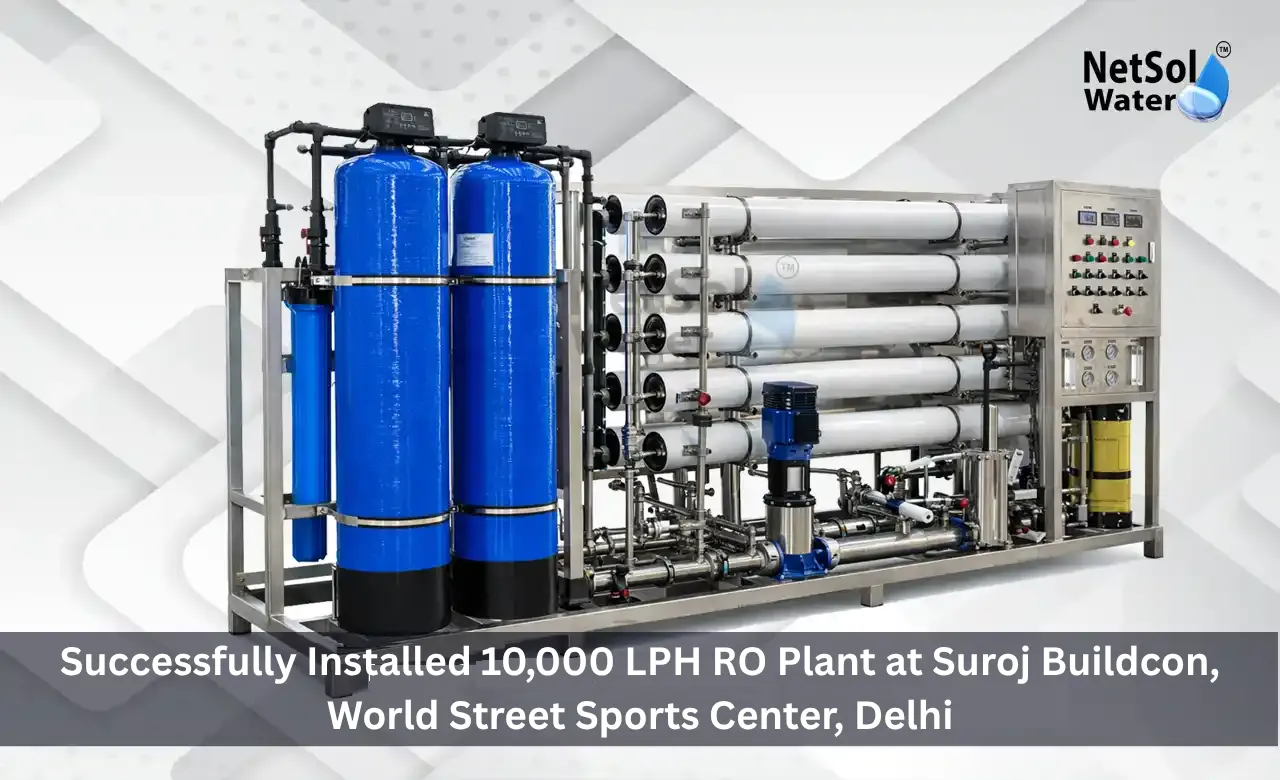
Successfully Installed 10,000 LPH RO Plant at Suroj Buildcon, World Street Sports Center, Delhi
Suroj Buildcon at World Street Sports Center in Delhi required a dependable water treatment solution to meet its operational water needs. For such a facility, the quality and availability of treated water can affect daily activities and the overall management of water resources. The project therefore called for a treatment system that could process the available water and provide a suitable source of treated water for intended use.
We completed the installation of a 10,000 LPH Reverse Osmosis plant at the site. The project focused on providing a practical treatment system that could support the client’s water requirement through a structured purification process. Reverse Osmosis offers a suitable method for reducing dissolved impurities in feed water. It works by pushing water through a semi-permeable membrane under pressure while separating a large part of the dissolved salts and other unwanted substances.
The successful completion of the installation added a dedicated water treatment system to the facility. It also demonstrated the importance of selecting the right plant capacity and arranging the treatment stages in a suitable sequence.
Project Overview
A commercial water treatment project needs more than the installation of a single purification unit. It requires an understanding of the site requirement and a treatment arrangement that can support regular operation. The project at Suroj Buildcon, World Street Sports Center, Delhi was planned around this need. The main objective was to install a suitable RO system with sufficient treatment capacity for the intended application.
The scope of the project included the installation of a 10,000 LPH RO plant. The treatment system was selected to address the need for treated water through membrane-based purification. The project also involved arranging the plant components in a practical sequence so that incoming water could move through the required treatment stages before reaching the final treated water section.
The installation had to suit the project site and provide an organised treatment setup. Proper equipment placement and system connection were important because the treatment process depends on coordination between different components. A well-planned arrangement also supports easier operation and maintenance.
With these requirements in mind, the project moved from planning to installation at the client’s facility. The next section looks at the client and explains the project requirement in relation to the site.
Client Details
Suroj Buildcon was the client for this project. The installation took place at its World Street Sports Center facility in Delhi. The need for an RO plant indicates that the facility required a controlled source of treated water for its intended operations. In a commercial setting, water treatment helps provide better control over water quality when the incoming water contains dissolved substances that need to be reduced. The treatment system can also help create a more consistent source of processed water than relying only on untreated feed water.
For this project, the client selected a system with a 10,000 LPH treatment capacity. That choice established a clear treatment scale for the installation and allowed the plant to be designed around the required output.
The project was carried out at a specific commercial facility in Delhi. Its location was an important part of the installation because the treatment system had to fit the available site conditions and work within the operational setting of the facility.
| Detail | Information |
| Client | Suroj Buildcon |
| Facility | World Street Sports Center |
| Location | Delhi |
| Solution Provided | 10,000 LPH RO Plant |
| Installed By | Netsol Water |
Project Location
The location of a water treatment plant influences how the equipment is arranged and how the system is connected. Commercial facilities often have existing infrastructure and space limitations that must be considered before equipment installation begins. The RO plant at Suroj Buildcon was installed at World Street Sports Center in Delhi.
Delhi is a large urban environment where commercial sites can have varied water sources and different treatment requirements. For a project like this, the treatment system must fit the actual site rather than follow a fixed arrangement. The plant therefore needed to be positioned in a manner that allowed the treatment stages and related connections to function properly.
The World Street Sports Center site provided the setting for the installation of the 10,000 LPH system. The project team had to consider the available installation area and the practical arrangement of the treatment equipment. This helped create a setup that could support the intended treatment process without unnecessary complications.
Once the location and site needs were considered, the next major factor was plant capacity. The treatment output had to match the purpose for which the system was installed.
Plant Capacity
Selecting the right plant capacity is important because an RO system must process enough water to serve the intended requirement. A plant with insufficient capacity may not meet demand when treated water is needed. A suitable capacity provides a defined treatment output and creates a clear operating basis for the facility.
For Suroj Buildcon, Netsol Water installed a 10,000 LPH RO plant. LPH stands for litres per hour. This means the plant has a designed treatment capacity of 10,000 litres of feed water per hour under the relevant operating conditions.
The installed capacity gives the project a substantial treatment scale for commercial use. It provides a clear flow rate for planning the treated water supply within the facility. At the same time, actual production can depend on operating conditions and feed water characteristics. Factors such as membrane performance, pressure, water temperature and feed quality can influence real output.
The 10,000 LPH capacity formed the basis of the treatment system. To achieve effective purification, the plant also needed the right treatment technology. Reverse Osmosis was selected as the main purification process for the project.
| Parameter | Specification |
| Installed Capacity | 10,000 LPH (Litres Per Hour) |
| Treatment Technology | Reverse Osmosis (RO) |
| Project Site | World Street Sports Center, Delhi |
| Plant Type | Commercial / Industrial RO Plant |
| Influencing Factors | Membrane performance, pressure, water temperature, feed quality |
Treatment Technology
The treatment technology determines how the plant removes unwanted substances from water. For this project, Reverse Osmosis served as the primary purification method. RO is widely used in water treatment where the objective is to reduce dissolved salts and other impurities from feed water.
1. Reverse Osmosis Process
Reverse Osmosis works by applying pressure to water and directing it through a semi-permeable membrane. The membrane allows water molecules to pass through while restricting many dissolved salts and other dissolved contaminants. The process produces two streams. One is the treated water that passes through the membrane and the other is the reject or concentrate stream that carries a higher level of rejected dissolved substances.
The performance of an RO plant depends on preparing the feed water before it reaches the membranes. Suspended particles and other substances can affect membrane operation if the water enters the RO section without suitable pre-treatment. Pre-treatment therefore supports the main membrane stage by improving the quality of water entering the RO unit.
2. Role of Membrane Treatment
The RO membrane acts as the central separation stage in the plant. Water passes across the membrane under pressure. The membrane separation process reduces the concentration of dissolved substances in the permeate stream. This makes RO useful when a facility needs a more controlled treated water source.
The technology selected for the Suroj Buildcon project was therefore aligned with the need for membrane-based purification. However, the exact feed water chemistry remains important because RO design depends on incoming water quality. This brings the discussion to the influent characteristics considered for the project.
Influent Characteristics
Understanding the incoming water quality is an important part of designing and operating an RO plant. Feed water characteristics determine the treatment burden placed on the system and influence the level of pre-treatment required before membrane filtration. Parameters such as TDS, hardness, turbidity, iron, suspended matter and microbial content can affect treatment performance.
The importance of feed water quality remains clear. Dissolved salts can increase the load on the RO membrane. Hardness-forming substances can contribute to scaling under unsuitable operating conditions. Turbidity and suspended particles can affect upstream filtration. Iron and other unwanted substances may also need attention depending on the source water.
The treatment system must therefore address the feed water in stages. Pre-treatment prepares the incoming water, while the RO section carries out the primary dissolved impurity reduction. The following section explains how this treatment sequence works.
Treatment Process
A successful RO plant follows a treatment sequence in which each stage prepares the water for the next. This sequence helps protect the major treatment components and improves the overall functioning of the system. At the Suroj Buildcon site, the 10,000 LPH RO plant was arranged around the basic principle of controlled feed water movement followed by membrane purification.
1. Raw Water Entry and Pre-Treatment
The process begins when raw water enters the treatment system. Before the water reaches the RO membrane, it needs appropriate conditioning and filtration. Pre-treatment helps reduce the load caused by particles and other substances that may interfere with downstream equipment.
Depending on the actual feed water condition, pre-treatment can include filtration and other conditioning stages. The purpose is to provide water of a more suitable quality for the RO membrane.
2. Pressure and RO Feed
After the required pre-treatment, the water moves towards the RO section. The RO membrane needs pressure to perform the separation process. A high-pressure arrangement pushes water through the membrane while the membrane restricts many dissolved impurities.
This stage produces the treated permeate stream. It also generates reject water that contains a higher concentration of the substances removed by the membrane. Managing these two streams is an important part of RO operation.
3. Treated Water Collection
The permeate produced by the RO membrane moves into the treated water section for collection and use. The final water quality depends on feed water quality and plant operating conditions. The treatment sequence therefore creates a controlled path from raw water entry to purified water output.
Every stage supports the next. Good pre-treatment helps protect the membrane. Proper membrane operation supports the desired separation. Controlled collection ensures that the treated stream remains available for its intended application.
The treatment process can perform effectively only when the equipment supporting each stage is selected and installed correctly. This makes the major equipment an important part of the project.
| Stage | Function |
| Raw Water Entry & Pre-Treatment | Conditions and filters incoming water to reduce the load reaching the RO membrane |
| Pressure and RO Feed | High-pressure arrangement pushes water through the membrane, producing permeate and reject streams |
| Treated Water Collection | Permeate moves into the treated water section for collection and use |
Major Equipment
Equipment selection has a direct effect on the working of a water treatment plant. Each component performs a specific role and must work in coordination with the other stages. At the Suroj Buildcon project, the equipment arrangement supported the 10,000 LPH RO treatment process.
1. RO Membrane System
The RO membrane system forms the main purification section of the plant. Its function is to separate a large share of dissolved substances from the feed water by using pressure-driven membrane filtration. The permeate becomes the treated water stream while the concentrate leaves as reject water.
2. Feed and Pressure Arrangement
An RO plant needs controlled water flow and pressure so that the membrane can operate within its required conditions. The feed arrangement supplies water to the treatment line and the pressure system supports membrane filtration.
3. Pre-Treatment Equipment
Pre-treatment equipment prepares the feed water before it reaches the RO membrane. Its role is to reduce the effect of suspended matter and other feed water conditions that could interfere with membrane performance.
4. Piping and Interconnections
Piping forms the connection between the different treatment stages. Correct routing is important because the system depends on controlled movement of raw water, treated water and reject water. Proper connections also help reduce the risk of leakage or incorrect flow during operation.
Together, these components create the functional treatment system. Their correct installation was the next step in completing the project.
| Equipment | Role in the System |
| RO Membrane System | Main purification section; separates dissolved substances from feed water |
| Feed and Pressure Arrangement | Supplies water to the treatment line and supports membrane filtration |
| Pre-Treatment Equipment | Reduces suspended matter and conditions that could interfere with membrane performance |
| Piping and Interconnections | Connects treatment stages and controls movement of raw, treated and reject water |
Installation Process
Plant installation requires careful planning because water treatment equipment must work as one connected system. The installation process at the Suroj Buildcon site involved arranging the treatment system so that the major components could function in the required sequence.
The first stage involved preparing the site for equipment placement. The installation area needed to provide sufficient space for the plant and its connections. Equipment was then positioned according to the planned treatment flow. This arrangement helped maintain a logical path from raw water entry through the treatment section to treated water collection.
After placement, the different system components were connected to form the complete treatment line. The required piping connections were arranged between the relevant stages. Electrical and operational connections were also completed as part of the installation process.
Attention to connection and alignment was important because even a properly selected treatment unit can perform poorly when the installation does not support the required flow and operating conditions. The installation team therefore completed the system as an integrated setup rather than treating each component as a separate unit.
After the physical installation was completed, the system moved to the testing and commissioning stage. This step was necessary before regular operation could begin.
Plant Commissioning
Commissioning confirms that an installed water treatment plant is ready for operation. It allows the team to test the system and identify issues that may not be visible during physical installation. For the 10,000 LPH RO plant, commissioning formed the final technical stage before the system could be placed into regular service.
The commissioning process involved checking the installed treatment arrangement and verifying that the equipment and connections worked together correctly. The team assessed water movement through the treatment stages and checked the operating behaviour of the RO section. The system also needed to demonstrate that it could function according to the intended project capacity and treatment arrangement.
Commissioning is particularly important for RO plants because membrane treatment depends on controlled flow and pressure. The team must therefore ensure that the treatment sequence operates correctly before the plant is handed over for regular use.
Once the system passed the required checks, the plant could move into operation. This provided the client with a dedicated treatment system for the intended use of treated water.
Treated Water Reuse
Treating water is most useful when the facility can make effective use of the treated output. An RO plant does not simply improve water quality at the treatment point. It creates a processed water stream that can support the applications for which the system was installed.
At Suroj Buildcon‘s World Street Sports Center facility, the 10,000 LPH RO plant provides treated water for the client’s intended requirement. The practical value of the system comes from providing a dedicated source of treated water that the facility can manage according to its operational needs. The plant capacity and treatment process establish a structured way to produce treated water rather than leaving the facility dependent only on incoming raw water quality.
This treatment arrangement also connects directly with the project’s overall performance. A successful result depends on the plant providing the required treatment capacity while operating as an integrated system.
Results and Performance
Project results help show whether an installed treatment system has met its intended purpose. In this project, the main measurable fact provided is the successful installation of a 10,000 LPH RO plant at the client’s facility.
The completed installation gave Suroj Buildcon a dedicated commercial RO treatment system designed for a capacity of 10,000 litres per hour. This provides the facility with a defined treatment output and a structured process for producing treated water.
The project also established a complete treatment route from feed water entry to RO-based purification and treated water collection. The value of this arrangement lies in its ability to bring water treatment into a dedicated plant system that can be managed and operated for the facility’s requirements.
The successful completion of the installation is itself an important project outcome. It shows that the planned treatment capacity and RO technology were implemented at the specified site. The next measure of project value comes from the client’s response.
| Confirmed Outcome | Status |
| Installation of 10,000 LPH RO Plant | Completed |
| Treatment System Connections (piping, electrical) | Completed |
| Plant Commissioning | Completed |
| Laboratory/TDS Data | Not provided — not included in this case study |
Customer Feedback or Testimonial
Customer feedback provides useful insight into how a completed installation performs from the client’s perspective. It can confirm whether the project met the expected requirement and whether the client was satisfied with the installation and treatment solution.
We are pleased with the installation of the 10,000 LPH RO plant at our World Street Sports Center facility in Delhi. Netsol Water understood our requirement and provided a suitable water treatment solution for the site. The installation was completed professionally and the system was commissioned as planned.
The overall installation process was handled in an organised manner. The team supported us during equipment installation, system connections and commissioning. We appreciate the professional approach taken by Netsol Water and the attention given to completing the project according to our requirement.
The 10,000 LPH RO plant has provided us with a dedicated water treatment system for our facility. We are satisfied with the successful completion of the project and the support provided by the Netsol Water team.
Read some interesting information for the Effluent Treatment Plant Manufacturer in Noida
Conclusion
The installation of the 10,000 LPH RO plant at Suroj Buildcon‘s World Street Sports Center in Delhi created a dedicated water treatment solution suited to the project’s stated requirement. The system uses Reverse Osmosis as its main purification technology and provides a defined treatment capacity of 10,000 litres per hour. From site preparation and equipment placement to system connections and commissioning, each stage contributed to the successful completion of the project.
The project also highlights the importance of choosing the right treatment capacity and arranging the treatment process in a clear sequence. Proper pre-treatment supports membrane operation while the RO stage helps reduce dissolved impurities from the feed water. The completed installation gives the client a structured source of treated water for its intended commercial requirement.
Netsol Water is the leading Commercial RO Plant Manufacturer in Delhi and provides water treatment solutions for commercial and industrial requirements. Businesses looking for a suitable RO plant can discuss their water source, treatment needs and required capacity with the Netsol Water team.
For information about RO plant solutions or to discuss a similar requirement, contact Netsol Water for a consultation.
Contact Netsol Water
| Contact | Details |
| Phone | +91-9650608473 |
| enquiry@netsolwater.com |