
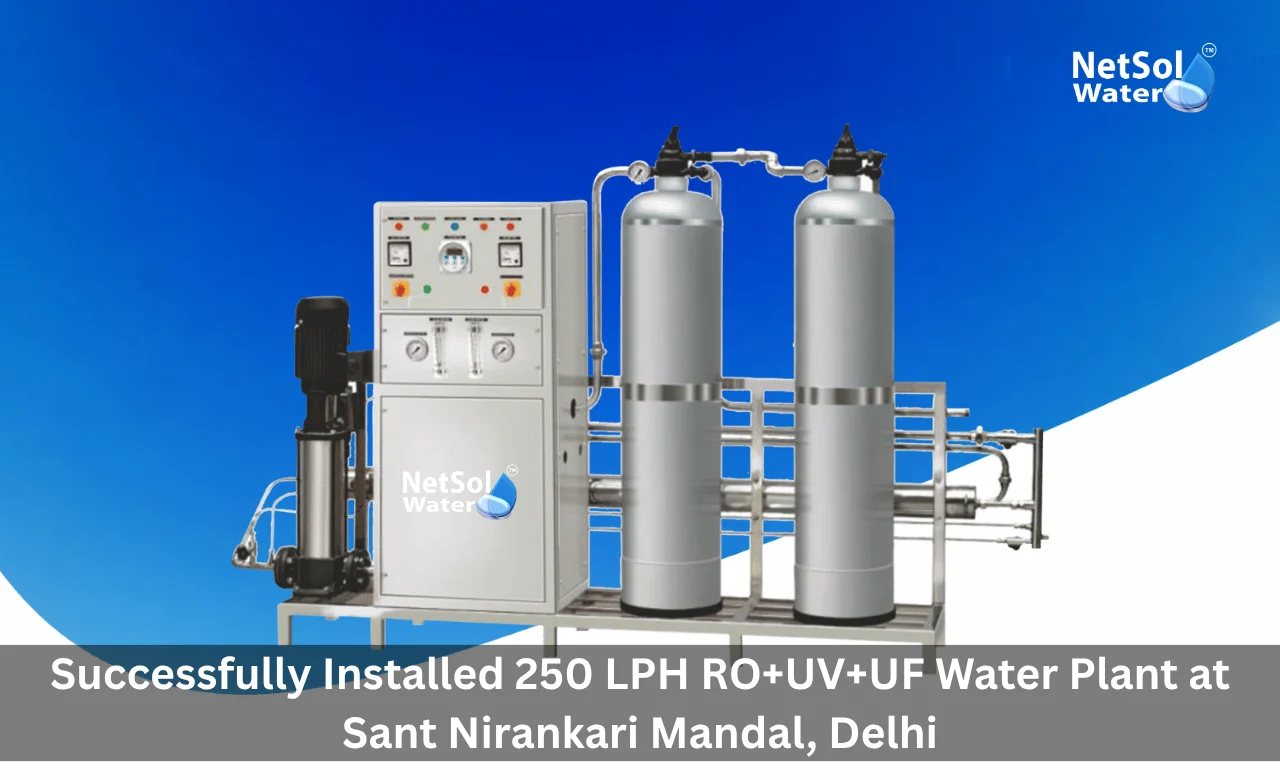
Successfully Installed 250 LPH RO+UV+UF Water Plant at Sant Nirankari Mandal, Delhi
Providing suitable water quality is important for facilities that need a consistent source of treated water for their daily activities. Sant Nirankari Mandal in Delhi required a water treatment solution that could process incoming water and provide treated water through a controlled treatment system. To address this requirement, Netsol Water installed a 250 LPH RO+UV+UF water plant at the facility. The project combined three important treatment methods to improve the quality of water supplied for intended use.
The selected system brought Reverse Osmosis, Ultraviolet treatment and Ultrafiltration together in one treatment arrangement. Each stage performs a different function. Reverse Osmosis helps reduce dissolved impurities from water. UV treatment supports microbial control by exposing treated water to ultraviolet light. UF provides membrane-based filtration that helps remove suspended matter and other particles according to the system design.
The project focused on creating a practical treatment arrangement that matched the stated capacity requirement of the client. The installation also involved placing the treatment equipment and connecting the different treatment stages so that water could pass through the system in a controlled sequence. Netsol Water delivered a commercial water treatment solution suited to the stated requirement of Sant Nirankari Mandal in Delhi.
Project Overview
A water treatment plant must match the actual requirement of the facility where it will operate. The treatment capacity needs to suit the expected demand while the selected processes should address the quality concerns associated with the incoming water. The project at Sant Nirankari Mandal followed this approach by combining RO, UV and UF treatment into a single water treatment plant.
The client’s requirement was for a plant with a production capacity of 250 litres per hour. The objective was to establish a treatment plant that could process incoming water and provide treated water through multiple filtration and purification stages. Rather than using a single treatment method, the project used a combination of technologies so that different types of impurities could be addressed at different stages.
The scope of the work covered the supply and installation of the 250 LPH RO+UV+UF water plant. It also involved setting up the treatment arrangement and connecting the major process stages so that the system could operate as one integrated unit. The installation needed proper sequencing because water must move through the treatment stages in the intended order for the overall process to work effectively.
The completed installation gave the client a defined treatment plant for its water requirement. The project also demonstrated the importance of selecting treatment technologies according to the nature of the required water output.
Client Details
Sant Nirankari Mandal was the client for this water treatment project. The organisation required a dedicated water treatment arrangement at its facility in Delhi. Water quality can vary depending on the source and the impurities present in incoming water. A treatment system gives the user a defined process for handling that water rather than using untreated water directly for applications that need improved quality.
The selected 250 LPH system gave the client a treatment arrangement designed around the stated production requirement. The combination of RO, UV and UF added several treatment stages within the same plant. This arrangement allowed the water to pass through membrane filtration and disinfection processes in a structured sequence.
For a project of this type, equipment integration is as important as the individual treatment technologies. The system must allow each stage to work with the next stage while maintaining a controlled flow of water. This requirement influenced the planning and installation of the plant at the Delhi facility.
| Detail | Information |
| Client | Sant Nirankari Mandal |
| Location | Delhi |
| Solution Provided | 250 LPH RO+UV+UF Water Treatment Plant |
| Treatment Stages | Reverse Osmosis (RO), Ultraviolet (UV), Ultrafiltration (UF) |
| Installed By | Netsol Water |
Project Location
The location of a water treatment plant affects how the equipment is installed and operated. A treatment system needs suitable space for placement and access for routine operation and maintenance. The project was completed for Sant Nirankari Mandal in Delhi where the client required the water treatment plant at its facility.
Delhi facilities can have different water-use requirements depending on their size and activities. However, no project-specific source-water condition or site limitation has been provided for this installation. Therefore, the project discussion remains focused on the stated requirement for a 250 LPH RO+UV+UF system.
Installing the plant at the client’s facility brought the treatment process closer to the point where treated water was required. This created a dedicated water treatment arrangement within the premises instead of depending entirely on external treatment or untreated supply. The system could therefore process incoming water through the installed treatment stages according to the designed operating sequence.
The Delhi location also made proper equipment placement and system connections an important part of the project. Once the site arrangement was prepared, the team could move toward setting up the treatment equipment and establishing the treatment flow.
Plant Capacity
Plant capacity is one of the first considerations when selecting a water treatment system. A plant that produces too little water may not meet the requirement while an unnecessarily large system can increase equipment and operating needs. The selected capacity for this project was 250 litres per hour.
The installed plant had a capacity of 250 LPH. This means the system was designed to produce treated water at a rate of 250 litres per hour under the relevant operating conditions. The capacity directly reflected the requirement specified for the project and formed the basis for the overall treatment arrangement.
A 250 LPH capacity also provides a clear operating benchmark for the plant. The client can assess plant operation against its designed production rate while monitoring the treatment process and maintaining the equipment as required. The capacity gives the system a defined output target rather than leaving the water production requirement open-ended.
The plant capacity also needed to work with the selected RO, UV and UF stages. Each process had to form part of a compatible treatment sequence so that the overall system could deliver the intended treated-water output. With the capacity established, the next consideration was the treatment technology used to achieve the required water quality.
| Parameter | Specification |
| Installed Capacity | 250 LPH (Litres Per Hour) |
| Treatment Technologies | RO + UV + UF |
| Project Site | Sant Nirankari Mandal, Delhi |
| Plant Type | Commercial / Institutional Water Treatment Plant |
| Design Basis | Defined output target matched to client’s stated requirement |
Treatment Technology
The choice of treatment technology determines how incoming water is processed and what types of impurities the system can address. For this project, the plant combined Reverse Osmosis, Ultraviolet treatment and Ultrafiltration. The three technologies serve different treatment purposes and work together as part of the installed arrangement.
1. Reverse Osmosis
Reverse Osmosis is a membrane-based water treatment process that uses pressure to move water through a semipermeable membrane. The membrane allows water to pass while retaining many dissolved salts and other dissolved impurities. This makes RO an important stage when the treatment objective includes reducing dissolved substances from the incoming water.
In the installed system, the RO stage formed the main dissolved-impurity reduction process. Incoming water reached the RO section through the plant flow arrangement and passed through the membrane under pressure. The treated stream then continued to the following purification stages according to the system configuration.
The effectiveness of an RO process depends on several factors such as feed-water quality, operating pressure, membrane condition and proper maintenance. For this reason, the plant needs suitable operation and periodic inspection after installation.
2. Ultraviolet Treatment
UV treatment uses ultraviolet light to support microbial control in water. When water passes through the UV chamber, microorganisms are exposed to ultraviolet radiation. The process helps reduce microbial activity without adding a chemical disinfectant to the treated water.
The UV stage forms part of the overall purification arrangement and adds a disinfection step to the membrane-based processes. Its position within the treatment sequence allows the system to combine physical separation with microbial treatment.
3. Ultrafiltration
Ultrafiltration uses a membrane with very small pores to separate suspended particles and other contaminants according to the membrane’s separation characteristics. UF can support water clarification and provide an additional filtration barrier within a treatment system.
In this project, UF was included alongside RO and UV. The combined arrangement provided more than one treatment mechanism within the same plant. The exact placement and process configuration depend on the plant design. The important point for this project is that the three selected technologies were brought together to create the required treatment solution.
| Technology | Treatment Function |
| Reverse Osmosis (RO) | Membrane-based process that reduces dissolved salts and other dissolved impurities |
| Ultraviolet (UV) | Exposes water to ultraviolet light to support microbial control without chemicals |
| Ultrafiltration (UF) | Membrane with very small pores separates suspended particles and other contaminants |
Influent Characteristics
Understanding the quality of incoming water is important before selecting and operating a treatment plant. The composition of raw water affects the treatment requirements and can influence the performance of filtration and membrane equipment. Parameters such as TDS, hardness, turbidity, iron and microbial content can help define the condition of the feed water. The system used RO, UV and UF treatment for the client’s water treatment requirement.
1. Importance of Feed-Water Assessment
Feed-water testing normally helps determine how a treatment system should operate. Dissolved solids can affect RO performance while hardness may contribute to scaling. Turbidity and suspended solids can place additional pressure on filtration stages. Iron can also create treatment and maintenance concerns when it is present at elevated levels.
Microbial content is another consideration when the treated water requires microbial control. The inclusion of a UV stage in the installed plant provided a treatment step specifically intended to address microbial concerns through ultraviolet exposure.
| Parameter | Relevance to Treatment |
| TDS / Dissolved Solids | Can affect RO performance |
| Hardness | May contribute to scaling |
| Turbidity & Suspended Solids | Can place additional pressure on filtration stages |
| Iron | Can create treatment and maintenance concerns at elevated levels |
| Microbial Content | Addressed through the UV treatment stage |
2. Project-Specific Information
Since no laboratory report or raw-water analysis has been included in the project details, this case study does not state a numerical influent profile. The treatment selection itself provides the available information about the planned water treatment approach. The RO, UF and UV combination indicates that the project required both filtration and purification processes rather than a single basic filtration stage.
Accurate monitoring of feed water remains important during operation. A change in raw-water quality can affect the performance of membranes and other treatment components. Regular assessment can therefore help the client maintain the system according to actual operating conditions.
Treatment Process
A water treatment system must follow a proper sequence because each stage supports the performance of the next stage. The 250 LPH plant used at Sant Nirankari Mandal combined RO, UV and UF within a connected treatment arrangement. The water moved through the system from raw-water entry toward the treated-water outlet.
1. Raw Water Entry and Initial Flow
The treatment cycle began when incoming water entered the plant. The feed-water arrangement directed the raw water toward the treatment sections. Proper water flow was necessary to ensure that the treatment stages received water in the intended sequence. Before membrane treatment, the system had to maintain a controlled flow suitable for the treatment equipment.
2. Ultrafiltration Stage
The UF stage provided membrane filtration within the treatment process. Water passed through the UF membrane where suspended particles and other larger contaminants could be separated according to the membrane’s filtration characteristics.
This stage supported the overall treatment process by providing another filtration barrier. The quality of water entering the later stages depends partly on effective filtration upstream. Proper filtration also helps reduce the load placed on downstream treatment equipment.
3. Reverse Osmosis Stage
After moving through the relevant filtration arrangement, water entered the RO treatment stage. Pressure forced the water through the RO membrane. The membrane separated much of the dissolved material from the water stream.
The RO stage played an important role in producing treated water with reduced dissolved impurities. Since dissolved substances are not removed by simple physical screening alone, membrane treatment provided the necessary separation mechanism for the project. The RO process generated a treated water stream and a separate reject stream.
4. UV Treatment Stage
Water then passed through the UV treatment arrangement as specified in the plant configuration. The UV chamber exposed the water to ultraviolet light to support microbial control.
This stage added another level of treatment after the membrane-based processes. Combining membrane filtration with UV treatment created a broader purification arrangement within the same system.
5. Treated Water Output
Once the water completed the required treatment stages, it reached the treated-water outlet. The plant was designed for a capacity of 250 LPH, providing the stated treated-water production rate for the client’s requirement.
The complete process therefore connected filtration, dissolved-impurity reduction and UV-based microbial treatment into one system. Each stage had a defined function and contributed to the overall treatment objective.
| Stage | Function |
| Raw Water Entry and Initial Flow | Directs incoming water toward the treatment sections at a controlled flow |
| Ultrafiltration Stage | Membrane filtration separates suspended particles and larger contaminants |
| Reverse Osmosis Stage | Pressure forces water through the RO membrane, separating dissolved material |
| UV Treatment Stage | UV chamber exposes water to ultraviolet light to support microbial control |
| Treated Water Output | Treated water reaches the outlet at the rated 250 LPH production rate |
Major Equipment
Proper equipment selection helps a water treatment plant operate in a controlled manner. The major components need to work together so that water can move through the treatment stages without interrupting the process. The installed project used equipment associated with RO, UV and UF treatment.
1. RO Treatment Equipment
The RO section formed the membrane-treatment part of the plant. Its primary components included the RO membrane arrangement and the equipment needed to supply water to the membrane under pressure. The RO stage performed the main dissolved-impurity reduction function in the system.
The membrane section required proper flow and pressure conditions for effective operation. Routine inspection and maintenance are also important because membrane performance can change with operating conditions and feed-water quality.
2. UV Treatment Equipment
The UV section included the ultraviolet treatment chamber used to expose water to UV light. This component supported microbial treatment as the water moved through the purification sequence.
The UV system requires proper electrical operation and suitable flow conditions. Keeping the UV equipment clean and maintaining the associated components helps support its intended function during plant operation.
3. UF Treatment Equipment
The UF section used a membrane-based filtration arrangement. It provided an additional physical separation stage within the plant and supported the treatment of suspended contaminants according to the membrane’s filtration characteristics.
Together, the RO, UV and UF sections formed the core treatment equipment for the installation. The plant also required the associated connections and control arrangement necessary to move water through these processes in the intended order.
| Equipment | Role in the System |
| RO Treatment Equipment | RO membrane arrangement plus equipment supplying water under pressure; main dissolved-impurity reduction |
| UV Treatment Equipment | Ultraviolet treatment chamber supporting microbial treatment |
| UF Treatment Equipment | Membrane-based filtration providing an additional physical separation stage |
| Connections & Control Arrangement | Moves water through the treatment processes in the intended order |
Installation Process
Successful installation requires more than placing equipment at the site. The treatment system must be arranged correctly so that water can move through each stage and the equipment can operate as intended. The installation at Sant Nirankari Mandal followed the basic requirements of setting up the treatment plant and connecting its treatment sections.
1. Site Preparation
The first stage involved preparing the site for placement of the treatment equipment. The available installation area needed to support the plant and provide access for connecting the process sections. Proper site preparation created the base for the next stages of installation.
The installation team then positioned the treatment equipment according to the planned arrangement. Careful placement helped maintain an orderly flow path between the different treatment stages.
2. Equipment Placement
The RO, UV and UF treatment sections were placed in their intended positions within the plant arrangement. Positioning the equipment correctly was important because the treatment sequence depends on the movement of water from one stage to another.
The plant layout also needed to allow access to the equipment for inspection and maintenance. A properly arranged treatment system makes it easier to monitor equipment and perform routine service activities after commissioning.
3. Piping and Connections
Once the equipment was placed, the treatment sections needed to be connected so that water could pass through the system. The piping arrangement linked the different treatment stages and directed water toward the treated-water outlet.
Electrical connections were also necessary for the powered components within the treatment system. The connection work had to be carried out carefully so that the equipment could operate together under the intended plant configuration.
4. Final Installation Checks
After the equipment and connections were completed, the installation required inspection before operation. The team checked the treatment arrangement and ensured that the system was ready for testing.
These final checks helped prepare the plant for commissioning. Once installation was complete, the next stage focused on operating the system and checking whether the treatment arrangement functioned as expected.
Plant Commissioning
Commissioning provides the transition between installation and regular operation. It allows the treatment team to verify that the equipment, connections and treatment stages work together correctly before the plant is placed into normal use.
For this project, commissioning involved operating the installed treatment system and checking the flow through its major treatment stages. The RO, UV and UF sections needed to operate in coordination so that water could move through the complete process.
During commissioning, the plant could be observed for basic operating conditions such as water movement, equipment response and proper functioning of the treatment sections. Any installation-related issue could then be identified and addressed before the system entered routine operation.
The commissioning stage also provided an opportunity to confirm that the installed plant matched the stated treatment arrangement and capacity requirement. The project had a specified output of 250 LPH and the commissioning process helped establish the plant for operation around that capacity.
A successful commissioning process gives the client a treatment system that is prepared for regular use. It also helps create a clear starting point for future monitoring and maintenance.
Treated Water Reuse
Using treated water effectively is an important part of any water treatment project. The value of a treatment plant depends not only on its ability to process incoming water but also on how the treated water fits into the facility’s intended requirements.
The treated water produced by the system can be directed toward the intended application defined by the client and the site’s operational requirements. The RO+UV+UF arrangement gives the facility a controlled source of treated water instead of relying on untreated incoming water for applications that require improved water quality.
Proper storage and distribution arrangements can also influence the practical use of treated water. These arrangements should match the client’s actual requirement and should maintain the quality achieved by the treatment system.
Results and Performance
Project results help show whether a treatment solution meets the requirement for which it was installed. In this project, the main measurable details available are the installed treatment configuration and the rated plant capacity of 250 LPH.
The installation provided Sant Nirankari Mandal with a dedicated RO+UV+UF water treatment plant in Delhi. The system brought three treatment technologies together within one plant. RO addressed dissolved impurities through membrane separation. UF added membrane-based filtration while UV provided ultraviolet treatment for microbial control.
The plant capacity of 250 LPH matched the capacity specified for the project. This gave the client a defined water production rate for the installed system. The integrated arrangement also allowed the treatment process to follow a structured sequence rather than depend on a single purification method.
From an installation perspective, the project achieved the stated objective of setting up the required 250 LPH RO+UV+UF treatment system at the client’s facility. The completed plant provides a dedicated treatment arrangement that can be operated and maintained according to the site’s water treatment needs.
| Confirmed Outcome | Status |
| Installation of 250 LPH RO+UV+UF Water Plant | Completed |
| Integration of RO, UV and UF Treatment Stages | Completed |
| Piping, Electrical Connections & Final Checks | Completed |
| Plant Commissioning | Completed |
| Laboratory/Influent Analysis Data | Not provided — not included in this case study |
Customer Feedback/Testimonial
We are pleased with the successful installation of the 250 LPH RO+UV+UF water treatment plant at our facility in Delhi. The system was provided according to our requirement and gives us a dedicated arrangement for treating incoming water.
The combination of RO, UV and UF treatment provides us with a structured water purification process. We appreciate the way the different treatment stages have been integrated into a single system and the plant has been set up according to the required 250 LPH capacity.
The project was completed with proper installation of the treatment system and its related connections. We value the practical solution provided for our water treatment requirement and appreciate the support provided by Netsol Water during the project.
We are satisfied with the completed installation and the water treatment solution provided for our facility.
Read some interesting information for the Commercial RO Plant Manufacturer
Conclusion
The installation at Sant Nirankari Mandal in Delhi brought together RO, UV and UF treatment in a 250 LPH water treatment plant designed around the client’s stated requirement. The project involved setting up the treatment equipment, connecting the treatment stages and preparing the plant for regular operation. By combining membrane filtration with UV treatment, the system created a structured treatment process for incoming water.
A suitable water treatment solution should always consider the required capacity and the quality objectives of the facility. The installed 250 LPH plant gives the client a dedicated treatment plant with clearly defined process stages. Proper operation and routine maintenance will remain important for supporting consistent plant performance over time.
Netsol Water provides water treatment solutions for commercial and institutional requirements. As a Commercial RO Plant Manufacturer in Delhi, Netsol Water can help organisations assess their treatment needs and identify a suitable system based on capacity and water-quality requirements. For similar RO, UV and UF water treatment projects, contact Netsol Water to discuss your requirement and request a suitable consultation.
Contact Netsol Water
| Contact | Details |
| Phone | +91-9650608473 |
| enquiry@netsolwater.com |