
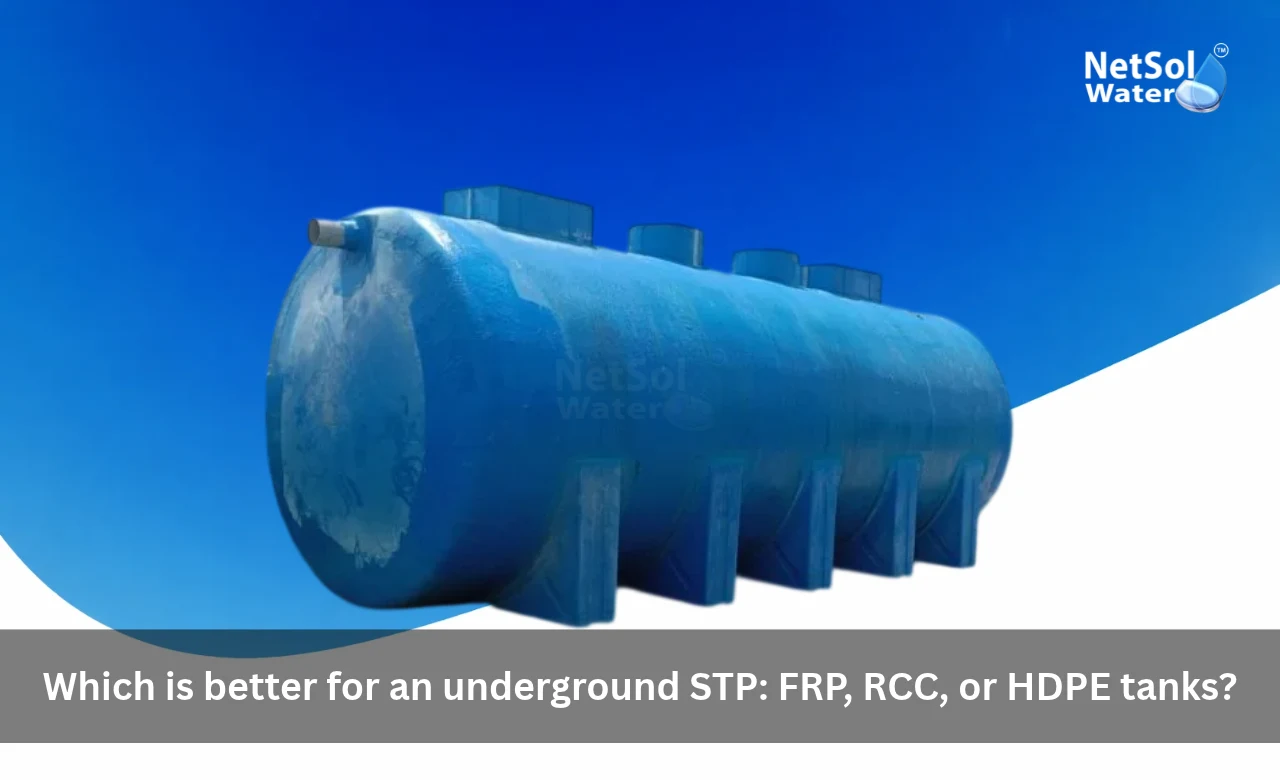
Which is better for an underground STP: FRP, RCC, or HDPE tanks?
It is important to identify the appropriate material for tanks in an underground STP. The correct choice will, in turn, determine a tank’s durability. As well as this, it will influence the cost of both installation and maintenance. With rapid urbanisation, cities such as Delhi and Bengaluru in India are in great need of efficient sewerage treatments. Underground STPs are a realistic choice, as they free up valuable ground-level space that can then be used for alternative functions. Identifying the most appropriate tank for an underground STP is not a simple task. There are numerous materials that can be used, including Fibre Reinforced Plastics (FRP), Reinforced Cement Concrete (RCC), and High-Density Polyethylene (HDPE). Each material has its own strengths and areas for improvement. An expert Underwater Sewage Treatment Plant Manufacturer can advise on the most suitable material for a specific site and application.
Now let’s explore the properties of these materials.
FRP Tanks
FRP tanks have been increasingly utilised for small, pre-fabricated STPs. The material is a composite of fibreglass and resin and so is durable and light. Furthermore, it is non-corrosive and can be easily transported. Consequently, it is well suited for both residential and commercial applications.
There are a number of key properties that can be identified for FRP tanks.
1. Benefits of FRP
FRP is water and chemical resistant. Unlike metallic tanks, it does not suffer from rust. Its light nature means that it can be easily transported and installed. Manufacturers can tailor the shape and size of FRP tanks to suit an application’s STP capacity. In addition, FRP tanks contain a smooth inner lining that is ideal for preventing accumulation. They are also compatible with small-scale sewage treatment processes, including MBBR and MBR. Furthermore, Netsol Water has developed an innovative range of underground STPs using FRP technology: its PavNeer range. Again, these can be applied to both residential and commercial settings and are designed for small-scale use.
2. What to take into account for FRP
Whilst there are many benefits associated with this material, it is crucial to ensure that tanks are installed appropriately. Following installation, tanks must be able to endure earth and groundwater pressures. Incorrect backfilling and/or installation can cause structural issues. In addition, it is necessary to verify that the resin and fibre components are of good quality. Manufacturers should produce tanks to meet appropriate structural standards for the planned depth of underground installation and the surface load that will be applied.
RCC Tanks
RCC tanks consist of steel-reinforced concrete and so are commonly used for extensive sewage treatment applications. They are robust and so are applicable for large-scale STPs.
1. Benefits of RCC
With accurate engineering, RCC tanks can endure significant structural loads. Consequently, they are appropriate for extensive residential communities and industry locations, as they can provide large-scale sewage treatment. Moreover, RCC tanks can be constructed to fit around available ground space. Engineers can also incorporate separate treatment cells within one tank. Good-quality materials and appropriate construction methods can result in durable RCC tanks.
2. Issues with RCC
As with concrete in general, RCC tanks require appropriate sealing measures due to the potential for seepage through cracks and poorly sealed junctions. In addition, concrete can be adversely affected by chemicals. During wastewater breakdown, hydrogen sulphide can be released, which can then convert into sulphuric acid. This can, in turn, corrode concrete. Therefore, engineers should determine the most fitting concrete type to use and apply sealant or inner linings where needed. As mentioned, RCC tanks require greater construction time, as additional effort is needed to reinforce and allow concrete to set.
HDPE Tanks
HDPE tanks are yet another material that can be used for underground STPs. Being manufactured from high-density polyethylene, these tanks are both chemically resistant and pliable. Again, as with FRP, HDPE is light and so can be simply handled and transported.
1. Benefits of HDPE
Similar to FRP, HDPE is water and chemical resistant. It is also non-rusting and can endure a variety of corrosive situations. Unlike typical steel tanks, it does not need the same form of sealing.
Together with its pliability, HDPE can endure some degree of movement without cracking in the way that less malleable materials can. Manufacturers can construct HDPE tanks using various methods to suit differing applications. This material can be a good choice for smaller-scale STPs where chemical resistance and ease of handling are key considerations.
2. Issues with HDPE
Correct engineering is essential prior to underground installation. Without sufficient tank strength and/or external support, earth pressure can distort a tank. In addition, groundwater exerts an upward force that has the potential to displace an empty tank. Where groundwater levels pose this issue, engineers need to establish suitable anchorage and foundations. They should also evaluate a tank’s ability to endure the pressure of both earth and above-ground vehicles/structures. The BMTPC has outlined the requirements for external earth pressure and groundwater displacement for underground polyethylene tanks.
FRP, RCC, and HDPE – What Is Most Appropriate?
All three of these tank materials have their own respective benefits. Therefore, the most suitable material will often be determined by an application’s scale and location, and not just its cost. FRP tanks are appropriate for small, pre-fabricated underground STPs. RCC tanks are a good option for large-scale STPs where bespoke sizing and robustness are needed. HDPE tanks are both pliable and chemically resistant and can be well engineered for underground use. When deciding on a material, it is important to analyse a site’s earth and groundwater characteristics. Furthermore, the anticipated sewage flow rate and the load from above-ground vehicles and/or buildings should be investigated. An expert Underwater Sewage Treatment Plant Manufacturer will typically evaluate these aspects and then suggest the best tank material for a given application. This will aid in minimising repair expenses and ensuring seamless STP functioning in the long term.
Read some interesting information for the Effluent Treatment Plant Manufacturer
Conclusion
Identifying the right material is fundamental in developing a reliable underground STP. FRP is convenient and non-corrosive. RCC is robust and so is appropriate for larger structures. HDPE is pliable and also chemically resistant. Nonetheless, all of these tank types must be well engineered and installed in order to function effectively underground. As a leading Indian underground STP manufacturer, Netsol Water devises modified solutions to align with an application’s STP capacity and installation needs. Collaborating with an expert Underwater Sewage Treatment Plant Manufacturer can assist in determining the most fitting tank material for a particular application.
Contact Netsol Water at:
Phone: +91-9650608473
Email: enquiry@netsolwater.com