
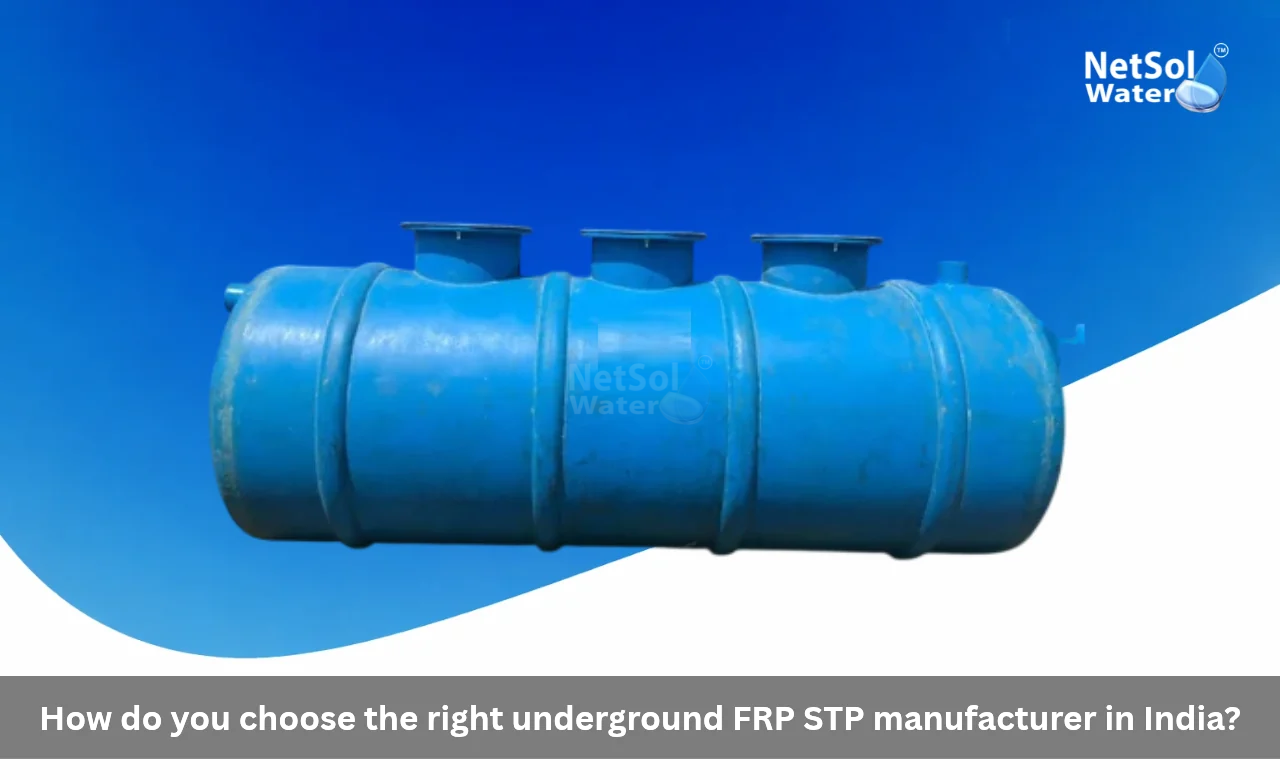
How do you choose the right underground FRP STP manufacturer in India?
India continues to develop both urban and industrial areas. Furthermore, residential areas are also increasing. These all create significant volumes of wastewater. Efficient wastewater processing allows effluent to be either reused or discharged safely and so is good for both public health and surrounding environments. In addition, a below-ground STP can be ideal where there is little available above-ground area and/or a requirement to discreetly house plant components. Fibre-reinforced plastic (FRP) can be used to create a durable storage tank. However, not all FRP STPs are appropriate for each scheme. In order to supply the correct system, a sewage treatment plant manufacturer in India must take into consideration aspects including the wastewater flow rate, ground and subsoil properties, groundwater information, and the desired processing method.
Assess knowledge and FRP quality
As an underground STP has to both appropriately process wastewater and resist pressures to which it will be subjected, the Sewage Treatment Plant Manufacturer in India must have knowledge of wastewater processing and below-ground works. Obtain information regarding the design of the system. Below are factors to analyse:
1. Assess FRP and design
FRP comprises glass fibres and resin. The strength of an FRP tank is influenced by the type of resin, fibre, and tank wall thickness, together with the manufacturing technique. Rather than simply being told the strength of the tank, obtain data and test results. Alongside analysing ground and subsoil properties and groundwater information, the design should also recognise the effect of backfilling and prevent buckling caused by tanks becoming hollow. Further, the manufacturer should describe how it ensures watertightness and how it enables inspection. Obtain information on installation and tank foundation details so that your civils contractor can correctly prepare the site. This then reduces the likelihood of leakage and/or displacement once the tank is below ground. Written information should also be provided regarding the anticipated lifespan of a tank.
2. Ensure appropriate processing capability and technology
An STP must be compatible with both the volume and nature of wastewater generated by your property. The sewage treatment plant manufacturer in India should analyse wastewater flow rates and recognise high-usage times for domestic, hotel, hospital, and business premises. They should also clarify how their processing technology is appropriate for achieving the desired effluent discharge or reuse. For example, MBBR and SBR utilise different methods from MBR. Appropriate technology will be influenced by wastewater quality, the available area, energy consumption, and the required post-processing water quality. Obtain a schematic of the processing method, together with inlet and outlet figures. A competent sewage treatment plant manufacturer in India will clearly convey the basis of its designs and will not necessarily supply identical units for all clients.
Analyse conformity, experience, and after-sales service
As a below-ground STP is a permanent feature, it can prove both challenging and costly to carry out maintenance once it has been installed. Hence, it is important to analyse a Sewage Treatment Plant Manufacturer in India’s experience and the service it can deliver. Avoid basing your assessment solely on initial quotes. Below are areas to analyse:
1. Analyse conformity information and experience
In addition to obtaining information on design, processing, and equipment, request data relating to conformance. Where appropriate, obtain test information. Further, confirm with your local pollution control body the necessary discharge criteria, as these may vary depending upon the scheme and discharge point.
If the packaged STP is manufactured using GFRP and/or other specific materials, then ascertain if BIS IS 18797:2024 is relevant. This standard defines FRP and design issues, together with information on a tank’s strength and conformance testing for packaged STPs. Further, obtain references for previous below-ground FRP schemes of comparable size. Talking to or visiting a current client can also provide useful insight into how well a system functions in everyday operation.
2. Compare installation, warranty, and in-service service
Installation of a below-ground tank should not be a “one-off” activity by a sewage treatment plant manufacturer in India. Ensure that somebody is available to advise on excavating, tank installation, pipework, and wiring. Further, ascertain who will oversee testing and commissioning. Obtain a documented warranty and establish its provisions. Understand anticipated energy consumption, chemical requirements, and the frequency of sludge clearance and standard maintenance. Finally, confirm that the supplier can supply replacement components and technical advice as and when needed.
Read some interesting information for the Commercial RO Plant Manufacturer
Conclusion
Factors such as tank and processing quality, installation, and ongoing service all require thorough analysis when selecting a sewage treatment plant manufacturer in India. Rather than simply comparing initial costs, assess the overall worth of different providers. An appropriate below-ground FRP system can allow efficient wastewater processing and optimize space utilization. Netsol Water provides below-ground STPs to address a variety of scheme needs. Contact the company to talk through your needs and to arrange an advisory session. Engaging a knowledgeable sewage treatment plant manufacturer in India can enable you to effectively establish a resilient wastewater processing solution and so promote sustainable water management for many years to come.
Contact Netsol Water at:
Phone: +91-9650608473
Email: enquiry@netsolwater.com