
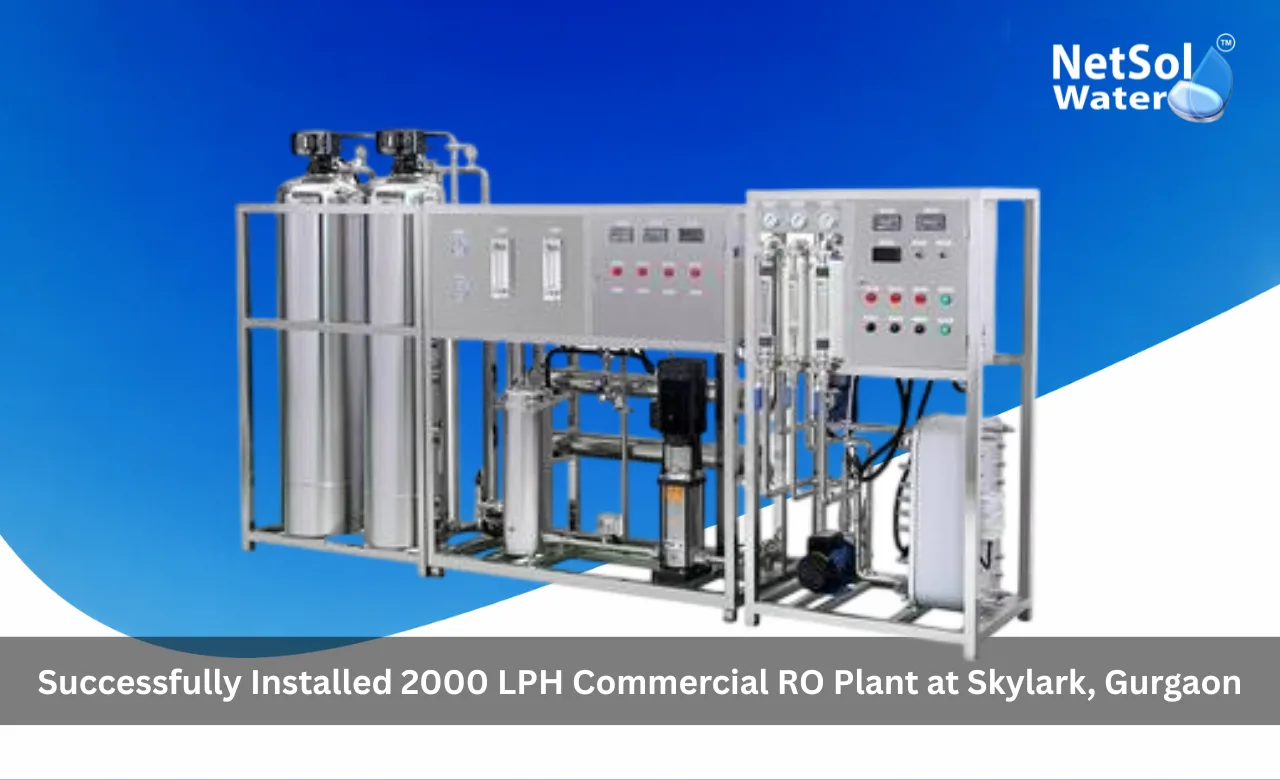
Successfully Installed 1000 LPH Commercial RO Plant at Skylark, Gurgaon
Commercial offices, infrastructure companies, manufacturing facilities, institutions and hotels need reliable access to appropriately treated water. The incoming water may have excessive dissolved salts, hardness, suspended particles or other undesirable constituents; a properly designed commercial RO system can help maintain the necessary treated-water quality. We installed and commissioned a 1000 LPH Commercial RO Plant at Skylark, Gurgaon for its production of about 1000 litres of RO treated water per hour with the specified operating conditions. The project embodies our work as a reputed Commercial RO Plant Manufacturer in Gurgaon.
Project Overview
The main goal of this project was to set up a commercial water treatment system which would produce about 1000 LPH of RO treated water at Skylark‘s Gurgaon site.
The water-treatment systems used in commercial facilities are different to those in small domestic RO units. The equipment should be able to process greater flow rates, operate longer hours and process different feed-water characteristics, and be easy to operate and maintain.
The treatment system was designed for a 1000 LPH commercial RO plant with appropriate pre-treatment stages for this project. The goal was to not only install RO membranes, but to design an entire treatment sequence that would safeguard the membranes and ensure consistent output.
The overall work involved in the installation comprised assessment of the area, equipment planning, plant fabrication and assembly, plant transportation, positioning of the plant equipment, plant plumbing connections, electrical connections, plant pretreatment setup, plant RO membrane installation, testing, plant flushing, plant trial operation and final plant commissioning.
The final product was a water-treatment system that satisfied the commercial need of Skylark with a convenient access path for future inspection and maintenance of the major components of the system.
Client Details
The project was for Skylark, Gurgaon as a client. It has EPC, mining, toll collection and highway maintenance as its major business segments.
The company’s operations feature large-scale infrastructure activities, and a significant employee base. Such an organisation needs reliable utility services capable of supporting the normal running of business.
One of these utilities is water-treatment infrastructure. An appropriate size commercial RO plant can process water at a central location, and the purified water can be stored for use as required at the facility, rather than using small purification units.
Thus the 1000LPH Commercial RO Plant was selected which proved to be a good solution for the site with a relatively small footprint for the system.
Project Location
The RO plant installed at Skylark, Gurgaon, Haryana. Their address in Gurgaon is: 267, Udyog Vihar, Phase IV, Gurgaon – 122015, Haryana, India.
One of the prominent commercial and industrial hubs of Gurgaon, Udyog Vihar is home to offices, manufacturing units, warehouses and corporate establishments in the various stages.
Water supply to commercial establishments in Gurgaon may be from various sources and the water quality may vary depending on the source and local conditions. Therefore, it is best to choose the water-treatment equipment based on the water’s feed-water quality, not just on the basis of its LPH rating.
Therefore, as a Commercial RO Plant Manufacturer in Gurgaon, our emphasis is on the capacity of the RO Plant and the number of treatment stages that will be required for a particular application as well as the quality of the water source.
Plant Capacity
The commercial RO system installed has a product water capacity of:
| Parameter | Value |
| Product Water Capacity | 1000 Litres Per Hour (LPH) |
This implies it is capable of delivering about 1,000 litres per hour of RO water under the plant’s operating and feed-water conditions.
Capacity must be determined based on a number of considerations such as:
| Capacity Consideration |
| Daily treated-water requirement |
| Peak water demand |
| Number of operating hours |
| Available raw-water storage |
| Treated-water storage capacity |
| Feed-water quality |
| Membrane performance |
| Required product-water characteristics |
A theoretical yield can be calculated: For a 1000 LPH plant, if it is able to work for 8 hours, then the theoretical output is about 8,000 litres. The theoretical production at the same time of effective operation is about 10,000 litres.
The actual production may change depending on the feed-water temperature, pressure, condition of the membrane, concentration of dissolved-solids, fouling, maintenance and other operating conditions.
This means that Skylark is able to deliver commercial scale water production with a 1000 LPH capacity, but not with a much larger treatment plant.
Treatment Technology
The key purification technology applied in the project is Reverse Osmosis (RO) together with the appropriate pre-treatment.
Reverse osmosis is a pressure driven membrane separation process. The water is pushed across a semi-permeable membrane, creating product water or permeate and reject water or concentrate, which is a concentrated stream.
The pretreatment decreases the loading rate on the membranes, fine filtration gives further protection against particulates, the high-pressure pump creates the pressure for membrane separation, and the RO membranes decrease the concentration of dissolved material in the product-water stream.
The plant can be systematically maintained and a practical solution for commercial water treatment is possible.
Influent Characteristics
An RO plant‘s performance is highly dependent upon the properties of the influent, or raw water entering the plant.
For commercial RO systems, some key feed-water parameters that are normally considered in designing and operating systems are:
| Influent Parameter |
| Total Dissolved Solids (TDS) |
| Total hardness |
| Calcium and magnesium |
| Turbidity |
| Suspended matter |
| pH |
| Chloride |
| Alkalinity |
| Iron, where present |
| Hard Minerals (Silica, etc.) |
| Organic matter |
| Microbiological Condition |
Treatment Process
The 1000 LPH Commercial RO Plant consists of a series of treatment units that work together in a coordinated manner.
1. Raw-Water Feeding
Raw water is initially delivered to the pretreatment part by the feed line. Flow of feed is essential as subsequent equipment relies on a steady supply of feed water.
2. Pressure/Media Filtration
The primary filtration section filters out suspended impurities and turbidity.
Particulate loading is reduced at this stage which leads to less loading of fine filters or RO membranes.
3. Activated Carbon Treatment
Activated carbon treatment is available to remove chlorine, odour and some organic material in feed water if needed.
Granular activated carbon is widely utilised in water treatment applications for the adsorption of taste and odour-causing compounds and a number of organic contaminants.
4. Antiscalant Dosing
If scaling has the potential to occur, controlled antiscalant dosing can decrease the growth of mineral deposits on membrane surfaces.
As scaling builds up it can decrease membrane output, increase differential pressure, and over time increase maintenance needs.
5. Micron/Cartridge Filtration
Water flows through fine cartridge filtration before going to the high pressure RO section.
This provides another protection to keep small suspended particles away from the membrane elements.
6. High-Pressure Pumping
This high-pressure pump raises the water pressure to the amount necessary for a good reverse osmosis.
The RO process is dependent on pressure and requires it to push water through the semi-permeable membrane.
7. RO Membrane Separation
Water is split into two streams in the membrane housings.
These are referred to as RO permeate, which flows through the membrane at much lower levels of many dissolved substances.
The second is the concentrate or reject stream that contains more of the substances that are rejected by the membrane.
The EPA also explains RO as generating a permeate/product water stream and a reject/concentrate stream.
8. Treated-Water Collection
The RO permeate is finally channeled to the intended treated water storage facility for distribution and use.
Major Equipment
Skylark Gurgaon‘s 1000 LPH Commercial RO Plant features all necessary equipment needed for a commercial water treatment system.
The main functional elements are:
| Equipment |
| Raw-water feed arrangement |
| Feed-water pump |
| Pressure/media filtration system |
| Activated carbon filtration is used |
| Antiscalant dosing system |
| Micron cartridge filter |
| High-pressure pump |
| Commercial RO membrane elements. |
| Membrane pressure housings |
| Pressure gauges |
| Product-water flow monitoring |
| Reject-water flow monitoring |
| TDS/water-quality monitoring arrangement |
| Control panel |
| Valves and inter-connections pipelines |
| Treated-water outlet arrangement |
| Reject-water discharge arrangement |
Equipment was set up both to be functional and accessible.
Maintenance or inspection of parts such as filter elements, dosing equipment, membrane housings, pumps and instruments requires regularity, particularly in a commercial RO plant, where accessibility is of paramount importance.
A quality commercial RO system should therefore be capable of yielding treated water, but also be designed to serve a long time.
Installation Process
The installation process was systematically conducted so that the RO plant is able to function after its commissioning.
A review of the available installation area and the selection of suitable locations for the RO skid and pretreatment equipment was the first step.
Wherever possible, working space was kept clear around the treatment units to enable routine changes of the filters, pressure checks and maintenance to be carried out conveniently.
Post equipment positioning, the raw water line was hooked up to the feed section and interconnections between the pretreatment components and the RO system were made.
The product-water piping and reject-water piping were not connected to each other so as to avoid mixing of the two streams.
Electrical connections to the feed pump and the high-pressure pump were then made, along with the feed pump, dosing system and control panel.
The installation team preperformed the following checks before starting the plant:
| Pre-Startup Check |
| Pipe connections |
| Valve positions |
| Electrical connections |
| Pump direction |
| Filter installation |
| Membrane housing connections |
| Pressure lines |
| Conveying product and reject outlets |
| Potential leakage points |
The process of installation was systematic which facilitated controlled startup and commissioning of the system.
Plant Commissioning
Commissioning of plants is the point where the installed equipment is tested as a whole water-treatment system.
Firstly, the 1000 LPH RO plant was flushed to prepare the filtration section and membrane section for normal operation.
Feed pump was then operated and then low pressure section was started in a controlled way.
The technical team was monitoring the operating condition such as feed-flow, pressure, product-water generation, reject-water discharge etc. during the commissioning.
Leaks were tested and the pressure and operation of the pumps were monitored for any abnormality.
The plant was slowly ramped up to operating conditions to avoid unnecessary hydraulic stressing of the plant.
The treated water production rate was verified against the desired plant capacity of 1000 LPH
There was also basic operational guidance provided in the commissioning process, such as:
| Operational Guidance Topic |
| Plant startup |
| Plant shutdown |
| Pressure observation |
| Product-water monitoring |
| Cartridge-filter replacement |
| Chemical dosing |
| Membrane maintenance |
| The detection of abnormal flow and/or pressure. |
| Preventive maintenance requirements |
Following successful testing and adjustment, the plant was made ready for routine operation.
Treated Water Reuse
The treated water from the plant can be stored in a separate treated water tank until such treated water is required for Skylark‘s own water usage.
Depending on the quality needed for each application, treated water can be used for:
| Treated Water Use |
| After required final treatment and verification, drinking-water supply. |
| A full pantry and kitchen will be supplied. |
| A well-equipped kitchen and pantry will be provided. |
| Office utility requirements |
| Appropriate equipment or process applications |
| Other purposes with relatively lower TDS water |
The actual end use should always determine the required final water-quality specification.
If treated water is to be used for human consumption, then hygienic storage and disinfection as required, and routine laboratory testing should be observed. IS 10500:2012 specifies requirements for drinking water in India, which can be used to evaluate the water quality parameters relevant to it.
The reject water from RO system should be disposed properly. The EPA states that the concentrate stream will include salts and other materials that are trapped by the membrane, and therefore, should be treated appropriately before being discharged or managed.
Only the reject water’s quality and the needs of the intended non-potable use should be taken into account when considering possible reuse.
Results and Performance
The successful installation and commissioning of the 1000 LPH Commercial RO Plant at Skylark Gurgaon has enabled the facility to have a dedicated on-site water-treatment system which can provide about 1,000 litres of RO water per hour under its specified operating conditions.
The project was successful in achieving the project objective of having a stable commercial scale production of treated water using a structured pretreatment and membrane-separation process.
The main results are:
| Result | Description |
| Well defined treated water production | The plant offers treated water as a separate source of water rather than relying only on smaller point-of-use water purifiers. |
| Commercial scale capacity | A rated capacity of 1000 LPH is considered a reasonable scale of production/capacity to install. |
| Removal of dissolved mineral content | RO Membrane technology is used specifically for the removal of a variety of inorganic constituents and dissolved solids. |
| Pretreatment for membrane protection | Proper filtration prior to the RO stage can minimise fouling and plugging, which are known operational issues of membrane treatment. |
| Easy system monitoring | Pressure monitoring points, flow monitoring points and water-quality monitoring points allow system operators to monitor plant operation during regular operation. |
| Sustainable equipment layout | System installed to allow convenient access to consumables and major equipment needing routine maintenance. |
This overall installation thus provides both 1000LPH purification capacity and a complete commercial treatment solution including pretreatment, membrane separation, monitoring and the collection of treated water.
Customer Feedback / Testimonial
Installing and commissioning processes were executed professionally, keeping in mind operational ease and system reliability.
After commissioning, basic maintenance and operation of the plant was demonstrated to the concerned personnel.
As a result of not having received an independently verified customer quotation for this case study a direct statement must not be attributed to Skylark without permission.
The installation and commissioning of the 1000 LPH Commercial RO Plant in our Gurgaon facility is done professionally and the plant is functioning well as per our water treatment requirement and the technical team gave us proper guidance about the operation and routine maintenance of this plant.
Looking for a trustworthy Commercial RO Plant Manufacturer in Gurgaon for your office, factory, hotel, school, hospital, warehouse, commercial complex or industrial plant?
Some of the points to consider in a well-designed system:
| Design Consideration |
| Raw-water quality |
| Daily water requirement |
| Peak demand |
| Required treated-water quality |
| Available operating hours |
| A space that allows for the installation of equipment. |
| An area that can accommodate equipment. |
| Pretreatment requirements |
| Water storage |
| Maintenance requirements |
| Intended treated-water application |
We supply complete solution from the designing to manufacturing, installation and commissioning of RO Plant for Commercial applications in Gurgaon for various capacities.
Commercial RO plant can be designed in various capacities like:
| Available Capacities |
| 500 LPH |
| 1000 LPH |
| 2000 LPH |
| 3000 LPH |
| 5000 LPH |
| 10,000 LPH and customised capacities |
Our services include water-treatment requirement assessment, system design, equipment selection, RO plant manufacturing, installation, commissioning, operator guidance, membrane replacement, filter replacement, troubleshooting and preventive maintenance support.
Our track record of delivering water-treatment projects from conception to commissioning, such as the 1000 LPH Commercial RO Plant at Skylark Gurgaon, showcases our capabilities in delivering commercial water-treatment projects.
If you require a dependable Commercial RO Plant Manufacturer in Gurgaon, contact our technical team.
Read some interesting information for the Effluent Treatment Plant Manufacturer in Faridabad
Conclusion
The 1000 LPH (Commercial RO Plant) installed at Skylark Gurgaon is testament to the significance of selecting the right plant capacity, pretreatment, membrane technology and professional commissioning under one umbrella solution.
Skylark is an infrastructure and engineering company that has offices in EPC (Engineering, Procurement, and Construction) and other sectors such as mines, tolls, and highways.
When a commercial facility is being used, the reliability of the water treatment will not only be determined by the rated capacity of the RO plant but also by factors such as incoming water condition, pretreatment performance, proper operating pressure, membrane condition and periodic maintenance.
The 1000 LPH system meets these needs with a series of systematic treatment processes that involve raw-water feeding, pretreatment, fine filtration, high-pressure pumping, and RO membrane separation and output of product water.
While RO is an established membrane separation process for decreasing dissolved solids and a host of other contaminants, system pretreatment and concentrate management are important factors in proper system operation.
As a Commercial RO Plant Manufacturer in Gurgaon, the project has also provided another hands-on example to understand our capability to deliver commercially appropriate water-treatment systems based on capacity, water quality, and operational requirements.
For businesses planning a new RO installation or upgrading an existing treatment facility, a properly engineered commercial RO plant can provide a dependable, scalable and manageable source of treated water for long-term use.
Contact Netsol Water at:
| Contact | Details |
| Phone | +91-9650608473 |
| enquiry@netsolwater.com |