
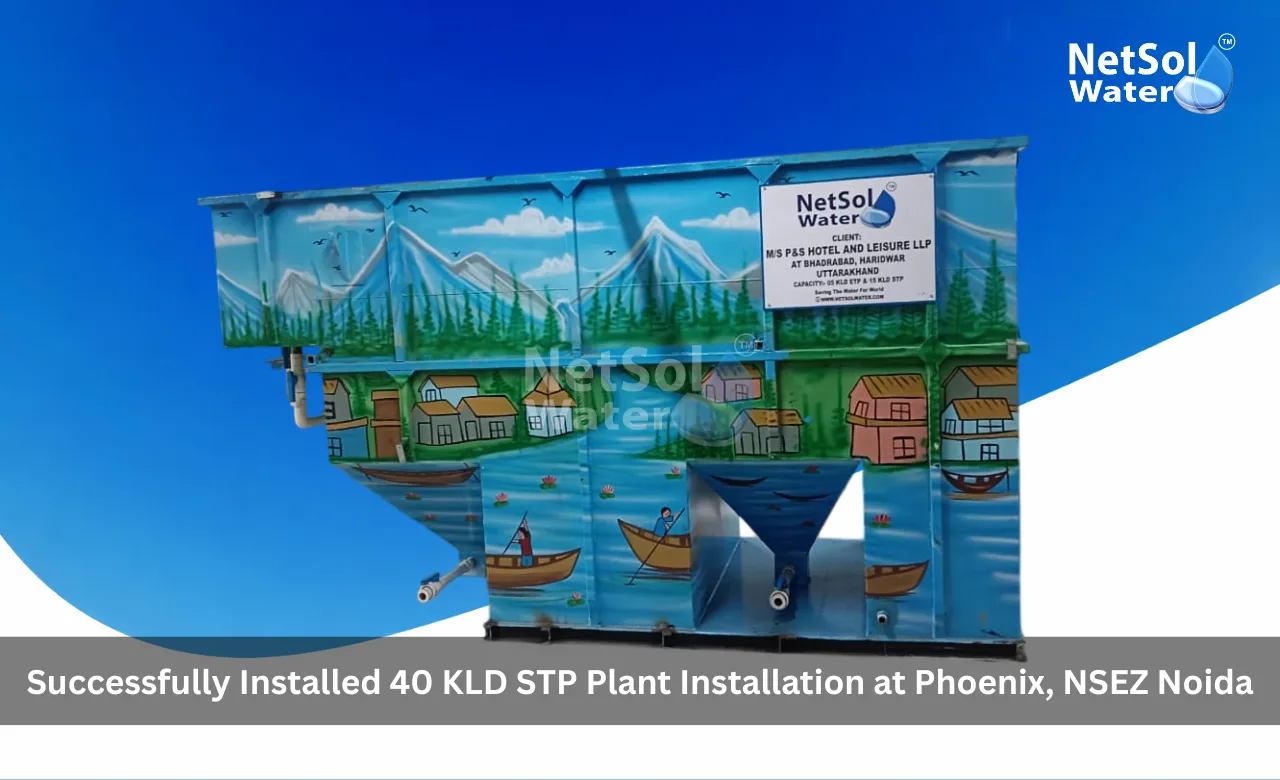
Successfully Installed 40 KLD STP Plant Installation at Phoenix, NSEZ Noida
Handling of wastewater is an essential criteria for all industrial, commercial and institutional buildings, especially in the emerging industrial areas like Noida. The proper design of the Sewage Treatment Plant can not only treat effluents before releasing them into the water bodies but also allow the treated wastewater to be reused for non-potable purposes, thereby minimizing the use of freshwater for non-potable applications and promoting sustainable water management.
Being an established sewage treatment plant manufacturer in Noida, we have successfully installed a 40 KLD Sewage Treatment Plant in Phoenix, NSEZ Noida. The design of the plant is meant to treat sewage produced at the plant, and ensure consistency in treatment by means of a simple, systematic, and convenient treatment process.
The project comprised of planning, procurement of equipment, installation, pipework, electrical integration, testing and commissioning of the entire sewage treatment plant. Operational reliability, space use, treatment efficiency and routine maintenance were given special consideration.
This case study describes the project requirements, treatment process, major equipment, installation methodology, commissioning process, treated-water reuse opportunities and overall benefits of the 40 KLD STP installation.
Project Overview
The project comprised successful installation and commissioning of a 40 KLD Sewage Treatment Plant at Phoenix, NSEZ, Noida. The goal was to create one efficient wastewater-treatment process which would be capable of treating wastewater produced by the activities carried out in the premises on a daily basis.
Domestic wastewater is untreated and is found to contain suspended solids, organic matter, nutrients, microorganisms and other contaminants. Such wastewater may cause environmental issues, odour, unhygienic situations and burden existing drainage system.
The 40 KLD STP was thus designed to treat the wastewater, biologically, clarifying, filtering and dis-infecting it before re-use or proper disposal.
The project was aimed at:
- Capacity of up to 40 kL per day of sewage treatment
- Organic pollutants and suspended solids are reduced.
- The treated water should be clearer and of a better quality.
- A stable biological treatment process is provided.
- Minimize odour and operating difficulties.
- Promoting opportunities for reuse of treated water
- Conservation of freshwater to be used for appropriate non-potable uses
- Offering a small system for the limited installation space.
- Enabling easier plant operation and maintenance
The installation reflects our ability as a trusted Sewage Treatment Plant Manufacturer in Noida to deliver customised sewage-treatment solutions based on the capacity, available space, working conditions and sewage-treatment needs of various plants.
Client Details
The STP was set up for Phoenix at NSEZ, Noida.
The plant had to have a wastewater treatment plant that was appropriately sized to treat the wastewater produced on site. The system had to be reliable, easy to fit and be able to run without undue complexity for the facility-management team.
The following aspects were taken into account before finalizing the system: The expected hydraulic load, treatment objectives, site conditions, wastewater generation requirement, and available space.
Considering these requirements, a 40 KLD STP was chosen as an adequate treatment capacity.
The project encompassed integration of the various treatment stages to ensure that the wastewater flowed systematically through three treatment stages, collection, biological treatment, clarification, filtration, disinfection and final treated water storage.
Project Location
Sewage Treatment Plant was installed at: Phoenix, NSEZ, Noida, Uttar Pradesh
The Noida Special Economic Zone (NSEZ) is an important industrial and commercial zone. Wastewater from the toilets, washrooms, canteen, housekeeping, and other domestic activities at these facilities must be managed in an effective manner by implementing proper infrastructure.
If an STP is installed on the premises, the wastewater can be treated in the vicinity of its production. This decentralized solution minimizes reliance on external wastewater-management solutions and opens up potential re-use of treated water on site.
Choosing a Sewage Treatment Plant Manufacturer who is well-versed in the local industrial operating conditions can also make the plant installation, plant servicing, plant maintenance and future plant modifications easy.
Plant Capacity
Sewage Treatment Plant (STP) capacity that are installed:
40 KLD – 40 Kilolitres Per Day.
It will be able to treat about 40,000 litres of sewage a day, based on the hydraulic loading and operating conditions that the plant specifies.
One of the most crucial phases in the design of an STP can be the sizing of the plant. A system that is too small can fail during times of high wastewater production, and an oversized system will mean extra capital and operating expenses.
Based on the anticipated sewage production and facility requirements, the Phoenix project capacity was chosen.
The plant design also takes into account variations in wastewater flow during different periods of the day. Typically, the generation of sewage does not happen at a steady rate all day. Peak flows can happen at work time, on break or at the end of a shift. Equalisation and controlled pumping is thus essential to achieve more even loading on the biological treatment system.
Treatment Technology
The treatment system is a Moving Bed Biofilm Reactor (MBBR)-based STP, which is a popular biological wastewater-treatment technology for compact commercial and industrial sewage-treatment applications.
MBBR treatment is based on the principle of treating water in an aeration tank with specially designed plastic media. The beneficial microorganisms grow on these media as a biofilm on the surface. In the biological reactor microorganisms decompose biodegradable organic pollutants when wastewater is introduced to the reactor.
The continuous aeration has two significant roles:
It provides oxygen needed for aerobic microorganisms. Ensures bio-film is in good contact with wastewater by moving the MBBR media around the reactor.
The MBBR system is especially beneficial in situations that need a compact biological treatment system. The large protected surface area on the media allows the growth of microorganisms which continue to allow treatment to be performed even if the characteristics of the wastewater fluctuate within the design limits of the plant.
Downstream clarification, filtration and disinfection stages are included to enhance the final treated water quality for the treatment system.
Influent Characteristics
The major component of the influent to the STP is human domestic sewage resulting from activities like washing, cleaning and sanitary operations in the facility.
Common waste products that may be added to a sewage plant include:
- Biodegradable organic matter
- Suspended solids
- Dissolved organic impurities
- Nitrogen-containing compounds
- The presence of traces of oil and grease
- Cleaning residues and detergents
- Microorganisms and pathogens
- Other contaminants that are usually found in domestic wastewater.
Some of the important parameters taken into account while analyzing sewage are: pH, Biological Oxygen Demand (BOD), Chemical Oxygen Demand (COD), Total Suspended Solids (TSS), oil and grease, and microbial contamination.
The true level of these parameters may vary significantly according to water consumption, occupancy, cleaning operation, canteen program and other site conditions.
Therefore, actual plant design data and wastewater-analysis reports should be used to base plant design and operation, rather than a single design composition being assumed.
The 40 KLD system was designed to offer numerous treatment barriers to enable the progressive reduction of the physical solids, biodegradable pollutants, suspended matter and microbial contaminants at successive treatment stages.
Treatment Process
The 40 KLD STP is a sequential treatment facility with a treatment sequence to treat raw sewage to the required treated effluent quality for the intended use or discharge.
The typical process flow of the installed system is:
Raw Sewage → Screening → Collection/Equalization → Biological Treatment → Clarification → Treated-Water Storage → Pressure Sand Filtration → Activated Carbon Filtration → Disinfection → Final Treated Water
| Process Step | Description |
| Screening | The first step in the wastewater treatment system is through a screening process. Screening is designed to catch large floating and suspended substances like plastics, fabrics, paper and junk. This action will prevent damage or blocking of downstream pumps, pipelines and treatment equipment. |
| Collection and Equalization | Sewage is fed into collection or equalisation tank after preliminary screening. The equalization stage helps to equalize fluctuations in wastewater flow and pollutant concentration. By allowing the wastewater to enter the biological treatment system at a more controlled rate, sudden hydraulic surges will not enter the system. Depending on the system design, mixing or aeration can also be provided to minimize septic conditions and keep the wastewater in a relatively homogeneous condition. |
| Biological Treatment | The equalized sewage is pumped to the biological treatment area. An MBBR process uses specially designed bio-media, which are kept in an aerated reactor. Biodegradable organic pollutants in sewage are removed by microorganisms attached to the media. Media is kept moving and aerobic conditions are maintained throughout by air supplied from blowers and diffusers. This phase is mainly responsible for the minimisation of biodegradable organic contaminants and is, therefore, one of the most crucial processes of the STP. |
| Clarification | The biological treatment effluent includes biological solids which must be removed from the treated water. The clarification stage offers conditions for settling the suspended biological solids and obtaining a clearer supernatant. Sludge collected is dealt with on a regular basis based on the plant design and operating procedure. |
| Treated-Water Storage | The clarified wastewater goes to an intermediate treated-water tank. This allows storage prior to tertiary treatment and allows the filtration system to function in a controlled pumping condition. |
| Pressure Sand Filter | The Pressure Sand Filter is tertiary treatment unit in which fine suspended particles which have not been removed during biological treatment and clarification processes are removed. Filtration enhances the physical quality and clarity of the water and decreases remaining suspended solids. |
| Activated Carbon Filter | Water from the sand filter is then fed into an Activated Carbon Filter. Activated carbon can be used to enhance the quality of treated water by adsorbing some dissolved organic compounds and compounds that contribute to water colour and odour. |
| Disinfection | The last treatment step is disinfection either by a dosing or disinfection system. Disinfection is so crucial for the reduction of microbial contamination before treated water is reused and/or discharged properly. After disinfection, the treated water is stored in a final storage facility and can be used for appropriate non-potable uses. |
Major Equipment
A Sewage Treatment Plant can only perform satisfactorily if the mechanical, electrical, biological and filtration systems work as a whole.
The main equipment used in a typical 40 KLD STP system is:
| Equipment | Function |
| Sewage Transfer Pumps | To convey sewage from one stage to the next in the collection, equalization, biological, and treatment process. |
| Air Blowers | Provide the oxygen for the aerobic biological treatment. Blower selection is crucial to maintaining dissolved oxygen and good biological activity. |
| Fine-Bubble Diffusers | These are fitted in the biological tank to spread the air evenly throughout the wastewater. |
| MBBR Media | High surface area media to grow the microorganisms as biofilm. |
| Settling/Clarification System | Remove the biological solids from treated wastewater after biological treatment. |
| Filter Feed Pumps | Feed clarified water at the required pressure to tertiary filters. |
| Pressure Sand Filter | Eliminates the fine suspended impurities that can not be removed by the clarifier. |
| Activated Carbon Filter | Reduces odour, color and some type of dissolved organic materials. |
| Disinfection System | System for controlling microbial contamination prior to treated-water reuse. |
| Piping | Connect treatment units and facilitate correct flow, isolation and access for maintenance of piping. |
| Electrical Control Plant | Used to control pumps, blowers and other electromechanical equipment, and to systemically operate the plant. |
| Level-Control System | Automates the operation of the pumps and prevents tank overflow or dry running. |
Selection of equipment was undertaken while considering equipment capacity, reliability, operating requirements, maintenance requirements, etc.
Installation Process
Installation of 40KLD STP at Phoenix, NSEZ, Noida was done in a planned sequence to ensure proper integration of civil, mechanical, piping and electrical components.
1. Site Assessment
The installation process started with a site assessment of the available space for the STP, access to the site, arrangement of sewage inlet, treated water outlet, electrical availability, pipe routing, and equipment placement.
2. Equipment Positioning
Equipment was arranged in the sequence of the treatment processes. Wherever possible, sufficient access was provided for inspection, operation, servicing and routine maintenance.
3. Mechanical Installation
Pumps, blowers, filters, diffusers, piping accessories, valves and others were installed and connected as per process design.
Special consideration was given to the alignment of equipment and routing of pipes.
4. Piping Integration
Pipe connections were made between the various tanks and treatment units.
Valves were installed at suitable points to allow for equipment and pipelines to be isolated for maintenance or inspection.
5. Electrical Work
The plant control system was used to provide power connections to pumps, blowers and electrical equipment.
Before trial operation, the control wiring, protection systems, level-based operation and equipment switching arrangements were checked.
6. System Inspection
After installation, mechanical and electrical systems were checked for potential leaks, wrong connections, loose parts, wrong direction of flow and electrical problems.
These checks were performed before the plant could be commissioned.
Plant Commissioning
Commissioning is a necessary step as it is not enough to turn on the pumps and blowers.
The 40 KLD STP was commissioned, which required the whole treatment system to be systematically tested.
The first step was to inspect individual pieces of equipment such as pumps, blowers, control panels, valves and filters for correct operation.
Water trials were carried out to check:
- Pump functioning
- Flow direction
- Pipeline integrity
- Valve operation
- Tank connectivity
- Air distribution
- Filter operation
- Electrical controls
- Level-control functions
- Leakage or Abnormal Vibration
Biological system involves the development and stabilisation of microorganisms for treatment of the wastewater. The aeration conditions, loading of water waste, characteristics of sludge and operation of the plant thus have to be monitored in the stabilization period.
After a stable biological environment was established, the entire treatment system from the inlet to final collected treated water was reviewed.
The operating personnel were also trained on the normal plant operation, routine inspection, cleaning needs, sludge management, and filter operation and preventive maintenance.
Treated Water Reuse
A significant benefit of having an STP is the opportunity to re-use treated wastewater rather than using fresh water to each and every application.
Water from the 40 KLD STP may be used for appropriate non-potable purposes including but not limited to:
The landscaping irrigation and gardening are well done.
- Toilet flushing
- Floor washing
- Paved areas are cleaned.
- General housekeeping
- Any other approved non-potable utility applications
Treated-water recycling can contribute significantly to water conservation.
For instance, if a significant portion of the treated water is recycled within the premises, the plant’s need for fresh water for gardening, flushing, or cleaning can be decreased.
Recycling also promotes a more circular management of water, as the wastewater can be seen as a resource to be recovered rather than a waste stream.
When deciding on the final use of treated water, the quality of the water verified by the test results should always be considered as well as environmental or regulatory application parameters.
Results and Performance
After the completion of 40 KLD STP installation in Phoenix, NSEZ Noida, the facility was equipped with an organized wastewater-treatment system, which will collect and treat sewage produced on its premises.
The plant that is already installed offers a number of operational and environmental benefits.
| Result | Description |
| Reliable Wastewater Treatment | This multi-stage treatment system consists of preliminary, biological, clarification, tertiary filtration, and disinfection, which enable more efficient sewage treatment than a single stage system. |
| Prevention of Organic Pollution | Biological treatment will lower the amount of biodegradable organic pollutants found in wastewater. This has a significant impact on the quality of water prior to the use for tertiary treatment and reuse. |
| Improved Water Clarity | Clarification by pressure sand filtration process yields treated water with improved clarity due to removal of suspended solids and fine particles. |
| Better Odour Control | Aeration and biological treatment will ensure the sewage does not stay in uncontrolled septic conditions and aid in better odour control. |
| Water Conservation | Treated water may be used for certain non-potable purposes, thus conserving fresh water. |
| Compact Treatment Solution | The treatment process is appropriate for plants where plant space is limited and the wastewater needs to be treated effectively. |
| Operational Convenience | Regular operation and maintenance of the plant are easier because of the proper equipment layout, valves, pumps, control systems, and filtration arrangements. |
| Sustainable Wastewater Management | The plant’s treatment at the point of generation and reuse of the treated wastewater helps the facility become more responsible and sustainable with water. |
Actual plant performance should be recorded by periodic laboratory testing of inlet and treated-water samples. Parameters of pH, BOD, COD, TSS, oil and grease and microbiological indicators may be monitored based on operating and compliance needs of the facility.
The installation adds to our capability as a Sewage Treatment Plant Manufacturer in Noida that can provide a customized STP solution for commercial, institutional, residential and industrial needs.
Customer Feedback / Testimonial
Treatment technology is not the only key factor for a successful implementation of an STP project, but also for the correct installation, equipment integration, commissioning and technical support.
The 40 KLD STP at Phoenix NSEZ, Noida was designed with the aim of offering a practical and reliable wastewater-treatment plant that meets the specific needs of the site.
Testimonial
Installed and commissioned our NSEZ, Noida Sewage Treatment Plant (STP) systematically and the team provided all the technical coordination and assistance during the project. The STP has been designed in a way that it is going to be treated efficiently and is going to be operated easily.
Looking to hire a Sewage Treatment Plant Manufacturer in Noida?
For any of the commercial buildings, factories, institutions, residential complexes, hotels, hospitals, offices, warehouses, or industrial site, you need an efficient wastewater-treatment system, and the right STP partner is key.
We are a leading Sewage Treatment Plant Manufacturer in Noida, offering customized Sewage Treatment Plant as per the quantity of the wastewater, treatment requirement, available space, functioning condition and the aim for reusing the treated water.
Our sewage-treatment solutions can include:
- STP design and engineering
- Equipment manufacturing and supply
- Complete STP installation
- MBBR-based treatment systems
- Biological treatment solutions
- Pressure Sand Filters
- Activated Carbon Filters
- Pumps and blowers
- Piping and electrical integration
- Plant testing and commissioning
- STP modification and upgrading
- Operation and maintenance support
- Troubleshooting of existing STPs
- Treated-water recycling solutions
Whether you need a 40 KLD STP in Noida or a customized sewage-treatment plant of another capacity, our team can help develop a solution according to your facility’s wastewater-treatment requirements.
Read some interesting information for the Sewage Treatment Plant Manufacturer in Gurgaon
Need an STP for Your Facility in Noida?
Contact us today for consultation, site assessment, STP design, installation, commissioning, or upgrading of your existing wastewater-treatment system.
Choose an experienced Sewage Treatment Plant Manufacturer in Noida for a reliable, efficient, and sustainable wastewater-management solution.
From wastewater treatment to treated-water reuse, we provide complete STP solutions designed around your site’s actual requirements.
Contact Netsol Water
Phone: +91-9650608473
Email: enquiry@netsolwater.com