
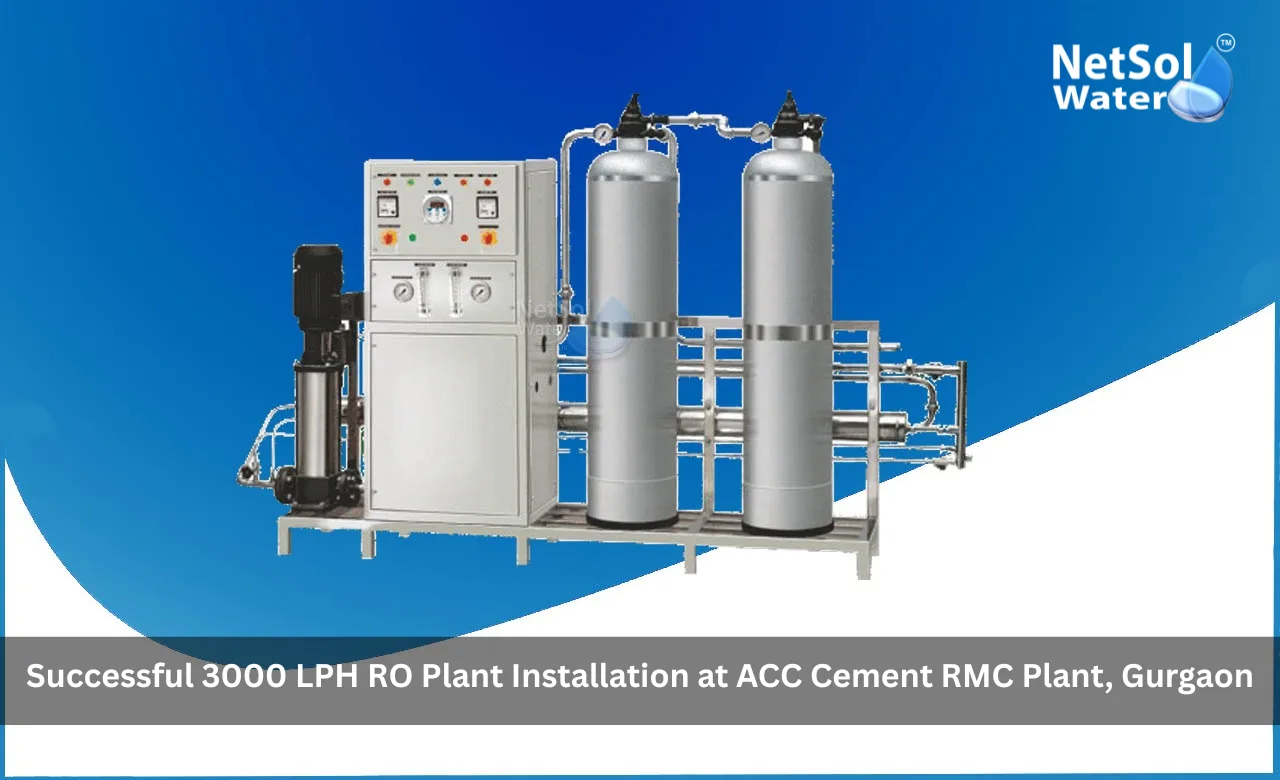
Successfully Installed 3,000 LPH RO Plant at ACC Cement RMC Plant, Gurgaon
A good water quality is essential in a ready-mix concrete (RMC) plant since the water becomes an integral part of the production environment and can affect the consistency, process control, equipment maintenance, and final product quality of the concrete. Netsol Water‘s 3000 LPH RO plant was installed at ACC Cement Ready Mix Concrete plant in Gurgaon to improve its supply of process water. The installation has been well documented by the project team of Netsol Water as a 3000 LPH RO plant to produce high-quality water for the RMC process.
The project shows Netsol Water the real-world benefits of using the right RO capacity, treatment and automation along with site commissioning for an industrial customer. It also demonstrates the importance of choosing an experienced commercial RO plant manufacturer in Gurgaon when the treatment plant is to be used along with the manufacturing activity.
Project Overview
The project was to supply and install a 3000 litres per hour (LPH) RO plant at an ACC Cement RMC plant in Gurgaon, Haryana and test and commission it. The information provided on the public project material is specific to:
| Parameter | Details |
| Customer | ACC Cement Customer |
| Application | Ready Mix Concrete |
| Plant Capacity | 3000 LPH |
| RO plant supplier/Installer | Netsol Water |
The essential goal of the core project was to develop a reliable supply of treated water for the RMC process on site. The RO plant offers a controlled treatment barrier as opposed to just treated source water that may contain varying amounts of dissolved minerals.
The reverse osmosis process operates by pressurizing water to force it through a membrane that allows only water to pass, leaving a purified stream of water and a stream of reject or concentrate. The U.S. Environmental Protection Agency states that RO will remove many dissolved solids and inorganic contaminants from water.
From there the capacity of the 3000 LPH was chosen because it was a practical level for a plant that has variable process-water needs throughout the working day, but robust enough to allow for industrial-scale production. The unit will produce up to 3,000 litres of treated water per hour at nominal capacity.
Client Details
| Field | Details |
| Client | ACC Cement / ACC Limited |
| Industry | Cement, building materials, and ready-mix concrete |
| Process water | Water used in the production process at the RMC plant |
ACC Limited is one of the reputed manufacturers of cement, building materials, and ready-mix concrete in India and is currently part of the Adani Portfolio. According to ACC’s official website, the company has a huge national operating presence with over 117 ready-mix concrete plants.
Controlled batching and repeatability is essential to RMC production. Water is one of the fundamental requirements to make concrete, so a more reliable treated water supply can help with process control.
Project Location
The plant was installed in the premises of ACC Cement Ready Mix Concrete (RMC) plant in Gurugram (Gurgaon), Haryana. Gurugram is an important industrial, commercial, residential, and institutional city of Delhi NCR, having industrial activities, construction activities, institutional activities, hotel and hospitality activities and commercial activities which demand reliable water treatment system. Netsol Water is also a company that supplies commercial RO solutions to Gurgaon only and offers project services like design, installation, testing and support.
The project is also a good local benchmark for companies looking for a reliable Commercial RO Plant Manufacturer in Gurgaon for medium and large scale industrial applications.
Plant Capacity
The installed system is capable to produce 3000 LPH of treated RO water with the given design conditions. According to a published RO product information, Netsol Water‘s 3000 LPH RO unit is a fully automatic reverse osmosis configuration, appropriate for industrial water treatment.
A 3000 LPH system offers valuable flexibility of operation. It can be used for up to 24,000 litres of treated water per hour when running at full capacity. The actual daily production will vary based on the quality of the feed water, plant demand, recovery, storage space, cleaning cycles and operating pressure.
This capability is suitable for an industrial facility that has a much higher demand for treated water than a small commercial facility.
Treatment Technology
RO is the primary treatment technology used.
RO Systems: Pretreated feed water under pressure and forced through a semi-permeable membrane. The water molecules pass preferentially through the membrane and the reject stream carries off a portion of the dissolved salts and other rejected constituents, with a more concentrated reject stream.
Making water clear is not the sole significance of RO for an RMC plant. Its aim is to lower ionic loading of the water and maintain uniformity of the water provided to quality sensitive plant uses. EPA has designated RO as a technology that can remove a wide variety of dissolved solids and inorganics.
Influent Characteristics
Industrial RO plants may be used for source water that contains suspended matter, hardness-forming minerals, dissolved salts, alkalinity, and other components that can impact RO system performance. These factors dictate the pretreatment needed, operating pressure, antiscalant programme, cleaning frequency and recovery level.
For this ACC Cement project, the public installation material does not show laboratory values for inlet TDS, hardness, turbidity, pH, silica, iron or alkalinity. Hence, this case study does not assign the numerical values of the influents.
The treatment configuration should rather be interpreted as a selection, which is made with the aim of making the feed water available in the required state and to minimize the content of dissolved matter in the feed water before it is used in the RMC process. It is technically correct as the RO performance is very sensitive to the chemical nature of the feed water and adequate pretreatment will ensure the membranes are not fouled or scaled.
The technical datasheet for the project should have the actual influent water analysis from the project or commissioning record from Netsol Water added.
Treatment Process
The sequence of the 3000 LPH plant is similar to that of a commercial and industrial RO treatment plant:
Raw-water feed → Pretreatment → Cartridge/micron filtration → Chemical conditioning (as needed) → High-pressure pumping → RO membrane separation → Collection of treated water → Supply to the RMC process.
The raw water first flows to the pretreatment area. Media filtration is used to remove suspended contaminants and to preserve the downstream components. Sand and carbon filtration are pretreatment components of the system along with high-pressure pumping.
Next, fine filtration offers an extra layer of protection of the membrane. Positioning of the antiscalant for dosing and other conditioning may be required to prevent mineral deposits depending on the feed analysis. The high pressure pump is, in turn, used to deliver the pressure needed for the membrane separation process.
In the RO membrane vessels, the feed is divided into two streams: the treated permeate and reject concentrate. The water from the treatment plant is stored for use in the process and the reject water is sent to the site’s approved water-management system.
Operating conditions are optimized during commissioning to ensure a stable flow, pressure and product-water quality.
Major Equipment
The key equipments used for the 3000 LPH RO system are:
| S. No. | Equipment |
| 1 | Transfer pump and raw-water feed system |
| 2 | Pressure sand/media filtration |
| 3 | Activated carbon filtration |
| 4 | Micron/cartridge filter housing |
| 5 | Chemical dosing system, including antiscalant |
| 6 | High-pressure RO pump |
| 7 | RO membrane housings and membrane elements |
| 8 | Pressure gauges and flow indication |
| 9 | Treated-water and reject-water piping |
| 10 | Electrical Control Panel/Automation |
| 11 | Valves, fittings and instrumentation |
| 12 | Treated-water storage/supply interface |
Netsol Water‘s RO treatment yields 3000 LPH, that the treatment is fully automated, and that the RO treatment is of industrial scale, and its more extensive product are sand/carbon pretreatment and high-pressure pumps.
Installation Process
However, at a working RMC factory, co-ordination needs to be carried out such that water-treatment operations don’t needlessly interfere with production. The job of Netsol Water involved installation of 3000 LPH RO plant on site, which has been captured for the ACC’s Gurugram location.
A standard install process for a plant of this type will consist of foundation verification, positioning of treatment skid and filter vessels, raw water and treated water connections, reject drainage, electrical connections, pump rotation, pretreatment flushing, filter media loading or verification, cartridge and membrane install and finally valves and instrumentation checking.
Special care is needed in access for future maintenance. Filters, membrane housings, pumps and dosing systems must be serviceable following the commissioning. Reliable long-term operation is also achieved by proper pipe support, drainage, electrical safety and operator access.
After mechanical and electrical installation the system is taken to the testing and commissioning phase.
Plant Commissioning
Converting an installed RO system into a stable operating utility is called commissioning. First, mechanical and electrical checks, leak testing, line flushing, pump testing, pretreatment testing, and checking instruments and controls for proper response are performed.
The RO is then operated under controlled conditions. Operators gradually bring up the necessary feed pressure and monitor the flow of permeate, reject flow, pressure, and quality of treated water. The goal is not just to achieve 3000 LPH for a short period, but to create repeatable operation in the plant’s design envelope.
The last item to consider is operator handover. Regular checks are required on inlet/outlet quality, pressure differential, filter condition, dosing chemical level, permeate flow, reject flow, pump behaviour and indications of membrane fouling.
Treated Water Reuse
The main application of the treated water was in the RMC process. The above mentioned public project post on the Netsol Water website explicitly mentions the use of water of high quality for the Ready Mix Concrete process.
Process water in an RMC facility can be processed to be used for quality sensitive applications as per the internal SOPs of the plant and requirement for concrete production.
The main operational benefit is that the site now has a treatment step on site that is able to produce a controlled stream of RO permeate instead of sending untreated source water to all uses.
This also allows for more control to be exercised by the plant personnel over the water applied to applications where consistency is of great importance.
Results and Performance
The key achievement so far is the successful installation of a 3000 LPH RO system at the ACC Cement RMC plant in Gurugram and its operation for supplying good quality water to RMC process.
In operational terms, there are four distinct advantages to the installation. It establishes a separate treated-water supply within the facility. Second, RO removes dissolved contaminants and salts which permeate through the normal particulate filtration. Third, the 3000 LPH rating ensures production at an industrial scale, with appropriate process-water demand. Fourth, automation helps to maintain consistent operation, with reduced need for ongoing manual adjustments.
The project represents a suitable sized commercial or industrial RO plant to serve a manufacturing plant where water quantity and quality is significant.
Customer Feedback / Testimonial
The 3000 LPH RO plant was installed as part of our RMC facility and is in reliable operation, “We appreciate the help Netsol Water provided during installation and start-up.”
Call to Action (CTA)
For quality and reliable water purification, Netsol Water can design a system based on your actual feed-water quality, demand, and hourly consumption, whether you have an RMC plant, factory, hospital, institution, commercial complex, or industrial unit.
Netsol Water is a Commercial RO Plant Manufacturer in Gurgaon and provides Commercial RO water solutions along with Project support ranging from selection to design, installation, testing and commissioning as well as after sales support. It has a Gurgaon-based commercial RO page which says that businesses in this region can avail customised RO plants along with lifecycle support.
Need RO Plant in Gurugram for commercial or industrial use that delivers 3000 LPH?
Talk to Netsol Water about your:
| S. No. | Item to Discuss |
| 1 | Raw-water test report |
| 2 | Required treated-water quality |
| 3 | The water requirements for an hour and a day |
| 4 | The amount of water needed per hour and per day |
| 5 | Operating hours |
| 6 | Treated-water storage requirement |
| 7 | Desired automation level |
| 8 | Available installation space |
| 9 | The process or product has been applied to industry or commerce |
For commercial enquiries about RO, contact the Netsol Water +91-9650608473.
Read some interesting information for the Industrial RO Plant Manufacturer in Noida
Successful installation of the ACC Cement RMC system illustrates the ability to use a relatively simple RO system at an industrial plant to deliver a consistent supply of water for process use, which is quality-focused. This project offers a real-world demonstration of a 3000 LPH Commercial RO Plant solution tailored for industrial applications.
When a combination of water analysis, pretreatment, membrane technology, automation, and professional installation and commissioning is used, the commercial RO treatment can be a reliable component of an industrial facility’s water-management infrastructure. This is a practical example of what is being done by Netsol Water at ACC Cement RMC plant in Gurugram.