
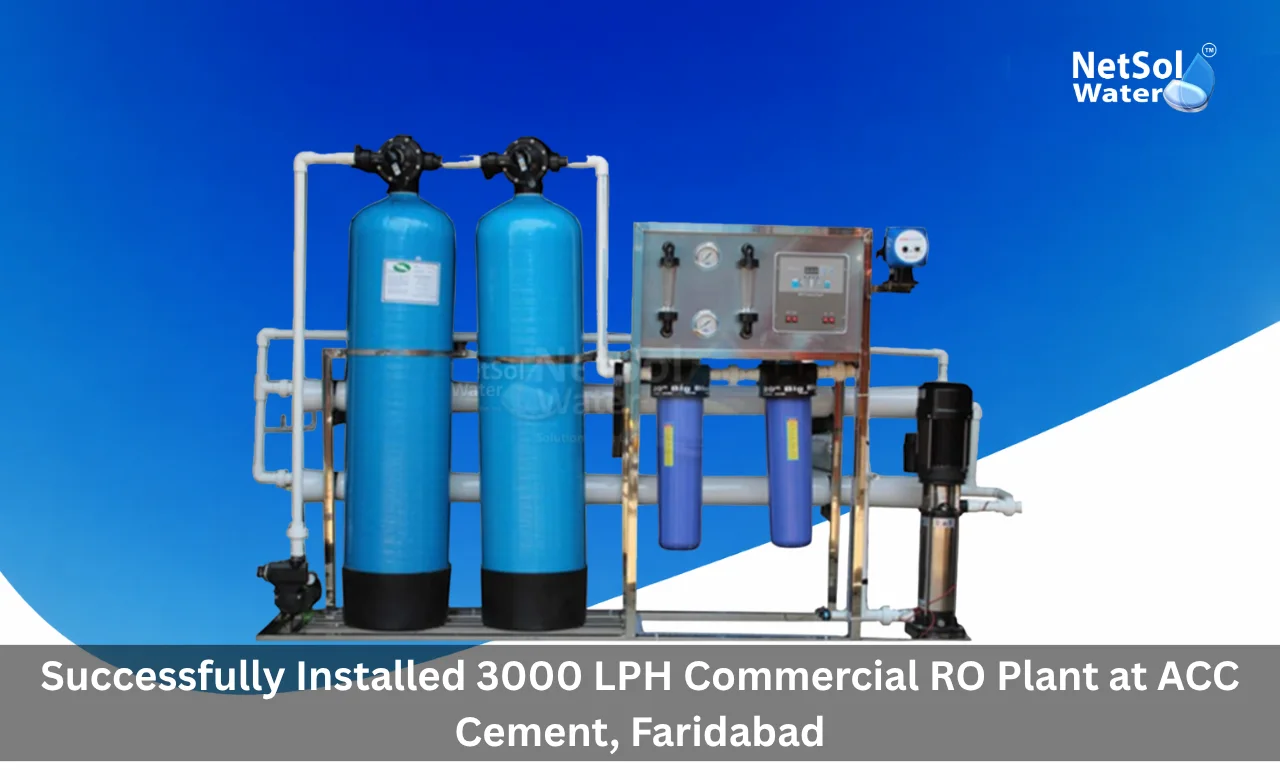
Successfully Installed 3000 LPH Commercial RO Plant at ACC Cement, Faridabad
Water quality plays an important role in maintaining suitable water use across industrial and commercial facilities. When incoming water contains unwanted dissolved salts and other impurities, the facility needs a treatment plant that can produce water suitable for its intended use. The requirement becomes more important when the plant needs a steady supply of treated water for routine operations. In this project, ACC Cement, Faridabad required a commercial RO plant to address its water treatment needs. We completed the installation of a 3000 LPH Commercial RO Plant for the facility.
The project focused on providing a treatment solution that could process incoming water through reverse osmosis and supply treated water at the required plant capacity. A 3000 LPH system offers a defined treatment rate that can support planned water requirements when the operating conditions match the design basis. The installation also required proper placement of the treatment equipment and suitable system connections so that the plant could operate as an integrated unit.
The project demonstrates how a carefully selected RO plant can support water treatment requirements within an industrial facility. It also reflects the role of experienced execution in taking a treatment system from installation through commissioning and regular operation.
Project Overview
A water treatment project becomes useful only when the treatment capacity and process meet the actual requirement of the facility. For that reason the planning stage must focus on the purpose of the system and the quality of water that needs treatment. In the Faridabad installation the client required an RO-based treatment plant with a capacity of 3000 litres per hour. The project therefore focused on the installation of a commercial RO system that could provide treated water at the specified production rate.
The objective was to establish a dedicated water treatment setup that could process the incoming water through reverse osmosis. RO treatment works by using pressure to move water through a semi-permeable membrane. The membrane allows water to pass while rejecting a significant portion of dissolved substances and other unwanted components. This makes RO suitable for applications where dissolved impurities need to be reduced rather than simply removed through basic physical filtration.
The scope of the project included the installation of the treatment plant at the client’s facility and the necessary work required to bring the system into operating condition. The project also involved arranging the equipment in a practical sequence so that water could move through the treatment stages in the intended order.
Selecting the right treatment approach was only one part of the work. The plant also needed proper installation and testing so that the final system could function as planned. This created a direct connection between the project requirement, the treatment technology and the execution work completed at the site.
Client Details
ACC Cement was the client for this installation in Faridabad. The project details identify the facility as an ACC Cement site that required a commercial RO plant for its water treatment requirement.
For any facility that needs treated water, the quality of the incoming source can affect the selection of the treatment process. Water may contain dissolved salts and other impurities that are not adequately addressed through simple filtration. When the intended application requires lower dissolved solids or improved water quality, reverse osmosis can become an important treatment stage.
In this project the confirmed requirement was a 3000 LPH commercial RO plant. The capacity gives the facility a defined treatment rate while the RO process provides the central treatment function. The system was therefore selected and installed around the need to process incoming water and produce treated water at the specified capacity.
The client’s requirement also highlights an important part of commercial water treatment planning. A treatment system must fit the site requirement rather than simply provide a generic filtration arrangement. Capacity, process suitability, installation conditions and operating requirements all need to work together. The successful completion of the installation reflects that project-focused approach.
| Detail | Information |
| Client | ACC Cement |
| Project Location | Faridabad |
| System Installed | Commercial RO Plant |
| Executed By | Netsol Water |
Project Location
The project was completed at ACC Cement in Faridabad. Project location matters because a treatment plant must fit the physical and operating conditions of the site where it will be installed. Even when the treatment process remains the same, the installation approach may depend on available space, equipment positioning and the way the system connects with the site’s existing water arrangement.
Faridabad is an established industrial area and facilities operating there may require organized water treatment systems to support their operational needs. The important point for this installation is that the treatment plant had to function within the client’s Faridabad facility. The equipment therefore needed suitable placement and connection so that the water treatment process could move from raw water entry through RO treatment and onward to treated water collection.
A site-specific installation also requires attention to practical execution. Equipment must occupy an appropriate area while allowing access for operation and maintenance. Connections must be arranged correctly and the treatment train must remain easy to understand for the operating team. These considerations connect directly with the plant capacity and technology selected for the project.
Plant Capacity
Plant capacity determines how much water a treatment system can process over a given period. Choosing the correct capacity helps a facility match the treatment plant with its intended requirement.
For this project the installed plant capacity was 3000 LPH, which means 3000 litres per hour as the stated treatment capacity. The capacity provides a clear operating reference for the system and forms a central part of the project specification.
A capacity of 3000 LPH allows the plant to process water at a controlled treatment rate. In practical operation the actual output can depend on feed water conditions, operating pressure, membrane condition and other design factors.
The capacity also helps the client plan treated water production around the operating schedule of the facility. A defined treatment rate makes it easier to understand how much water the plant is intended to process during its operating hours. It also provides a useful reference during commissioning when the team checks whether the system operates according to the project requirement.
The installation of a 3000 LPH RO plant therefore addressed the project’s central capacity requirement while providing the treatment technology needed to reduce dissolved impurities from the incoming water.
| Specification | Value |
| Plant Capacity | 3000 LPH (Litres Per Hour) |
| Treatment Technology | Reverse Osmosis (RO) |
| Output Streams | Permeate (Treated Water) and Reject |
| Key Influencing Factors | Feed water conditions, operating pressure, membrane condition |
Treatment Technology
Treatment technology determines how the plant converts incoming water into water with improved quality. For this project the selected technology was Reverse Osmosis, commonly known as RO. The technology is widely used where water contains dissolved salts and other substances that need to be reduced through membrane separation.
The installed system was designed around RO treatment at a stated capacity of 3000 LPH. To understand how the plant supports the client’s requirement, it helps to look at the basic working principle of reverse osmosis and how it fits into a complete treatment sequence.
1. Reverse Osmosis Process
Reverse osmosis uses pressure to push feed water through a semi-permeable membrane. This membrane has very small passageways that allow water molecules to move through while restricting many dissolved substances. The result is a treated water stream known as permeate and a separate stream that carries the rejected portion of the feed.
The RO membrane does not work as a simple sieve for visible particles. Its main purpose is to reduce dissolved substances through membrane separation. For this reason the feed water generally needs suitable conditioning and filtration before it reaches the membrane.
The treatment result depends on the quality of the incoming water and the way the RO system operates. Pressure, membrane condition, feed composition and operating controls all affect the treatment process. A properly installed system provides the operating structure needed to keep these factors within the intended design range.
2. Role of Pretreatment
Pretreatment supports RO membrane operation by reducing materials that could damage, block or foul the membrane. In a typical RO system the feed water passes through appropriate filtration and conditioning stages before reaching the membrane assembly.
3. Membrane Separation
Once conditioned feed water reaches the RO membrane under pressure, the membrane separates the water into a permeate stream and a reject stream. The permeate becomes the treated water produced by the system. The reject carries the concentrated portion of substances retained by the membrane.
This separation stage forms the core of the treatment process. It is also one of the main reasons why RO plants are selected for water treatment requirements that involve dissolved impurities.
Influent Characteristics
Understanding incoming water quality is important before operating any RO plant because membrane performance depends on the nature of the feed water. Factors such as dissolved solids, hardness, turbidity, iron and biological content can influence pretreatment needs and membrane operation. A proper design normally uses water analysis to determine the treatment arrangement and operating conditions.
1. Importance of TDS
Total Dissolved Solids, or TDS, indicates the concentration of dissolved substances in water. RO systems are commonly used when the treatment objective includes reducing dissolved solids. The difference between feed water TDS and treated water TDS can also serve as an important operational indicator during plant monitoring.
2. Hardness and Scaling
Hardness can affect RO operation because certain dissolved minerals may form deposits on membrane surfaces under suitable conditions. Scaling can reduce membrane performance and increase cleaning requirements. This is one reason why feed water characteristics matter when preparing the treatment process.
3. Turbidity and Suspended Matter
Turbidity indicates the presence of suspended material that makes water appear cloudy. These materials can interfere with downstream membrane operation when the feed receives insufficient pretreatment. Appropriate filtration helps reduce the load reaching the RO membrane.
4. Other Feed Water Parameters
Iron and microbial content can also influence treatment design. High iron levels may create deposits while biological growth can affect membrane surfaces and system hygiene. The actual significance of these parameters depends on the measured feed water quality.
| Feed Water Parameter | Relevance to RO Operation |
| TDS (Total Dissolved Solids) | Indicates concentration of dissolved substances; key monitoring indicator |
| Hardness | May cause scaling/deposits on membrane surfaces |
| Turbidity | Suspended material that can interfere with membrane operation |
| Iron | High levels may create deposits |
| Microbial/Biological Content | Can affect membrane surfaces and system hygiene |
Treatment Process
A proper treatment sequence ensures that each stage prepares the water for the stage that follows it. In an RO plant the process usually begins with raw water feeding and moves through filtration and membrane treatment before treated water is collected. The precise arrangement depends on the design and feed water conditions. For the installed plant at ACC Cement the treatment technology is reverse osmosis with a treatment capacity of 3000 LPH.
1. Raw Water Entry
The treatment journey starts when incoming water enters the plant. The feed water carries the dissolved and suspended constituents that the treatment system needs to manage. The raw water feed arrangement provides a controlled supply to the treatment train.
A stable feed is important because the downstream stages need water within their intended operating range. Consistent flow also helps the plant move through the treatment stages in an organized manner.
2. Pretreatment and Filtration
Before water reaches the RO membrane, the system normally reduces suspended solids and other contaminants that could affect membrane operation. Filtration helps protect the membrane by lowering the amount of material that reaches the high-pressure stage.
3. Pressure Feed to RO
After suitable pretreatment, the feed water enters the RO stage under pressure. The pressure enables water to pass through the semi-permeable membrane against the natural direction of osmosis.
This stage requires controlled hydraulic conditions so that the membrane can perform its separation function. The high-pressure section therefore forms an essential link between pretreatment and final treated water production.
4. Membrane Separation
At the RO membrane the feed stream separates into permeate and reject. The permeate contains water that has passed through the membrane while the reject contains a greater concentration of the substances that the membrane has held back.
The permeate then moves toward treated water collection. The reject stream follows the system’s designated reject handling arrangement.
5. Treated Water Collection
The treated water produced by the membrane reaches the collection side of the system. This stage marks the completion of the main RO treatment sequence.
The treatment journey can therefore be viewed as a linked process in which raw water enters the system, receives suitable conditioning, passes through pressure-driven membrane separation and emerges as treated water at the plant’s specified capacity.
| Stage | Function |
| Raw Water Entry | Controlled supply of incoming feed water to the treatment train |
| Pretreatment and Filtration | Reduces suspended solids/contaminants before RO membrane |
| Pressure Feed to RO | Applies pressure to push water through the semi-permeable membrane |
| Membrane Separation | Splits feed into permeate (treated) and reject streams |
| Treated Water Collection | Collects the final treated water (permeate) output |
Major Equipment
Equipment selection has a direct effect on how a treatment plant operates because every component must support the treatment sequence. A well-organized plant uses equipment that moves water through the process in a controlled manner while supporting routine operation and maintenance.
1. Feed and Water Transfer Arrangement
The feed section moves incoming water toward the treatment stages. This part of the system provides the initial connection between the site’s water supply and the RO plant. Controlled water movement helps maintain a stable treatment sequence.
2. Filtration Arrangement
Filtration forms the protective stage before RO treatment. It helps remove or reduce suspended material that could otherwise reach the membrane section.
3. High-Pressure Pump
The RO membrane requires pressure for the separation process. A high-pressure pump supplies this operating pressure to the feed stream before membrane treatment. Its role is essential because membrane separation cannot proceed in the required manner without suitable pressure.
4. RO Membrane Assembly
The membrane assembly performs the main separation function. It receives pressurized feed water and separates the flow into permeate and reject. This component represents the core of the reverse osmosis process and directly supports the plant’s water treatment objective.
5. Control and Monitoring Arrangement
An RO system also needs a control arrangement that allows the operator to start, stop and monitor the plant. Monitoring supports stable operation by helping the operator observe important process conditions.
6. Treated Water and Reject Connections
The final part of the system requires suitable connections for treated water and reject streams. These connections help direct each water stream to its intended destination and keep the process flow organized.
Together these functional components form the treatment framework needed to operate the commercial RO system at the specified 3000 LPH capacity.
| Equipment | Role in the Treatment Sequence |
| Feed and Water Transfer Arrangement | Connects site water supply to the RO plant |
| Filtration Arrangement | Protective stage that removes suspended material before RO |
| High-Pressure Pump | Supplies operating pressure required for membrane separation |
| RO Membrane Assembly | Performs the core reverse osmosis separation function |
| Control and Monitoring Arrangement | Enables start/stop control and process monitoring |
| Treated Water and Reject Connections | Directs treated water and reject streams to their destinations |
Installation Process
Successful installation depends on careful planning because a treatment plant must fit the site while maintaining the correct water flow between process stages. Equipment positioning, piping connections and electrical integration must all follow the intended process arrangement.
The installation at ACC Cement, Faridabad began with attention to the site location and the space available for the plant. The treatment equipment needed to occupy a suitable area that allowed the system to operate and gave operators reasonable access for routine inspection and maintenance.
Once the installation area was prepared, the equipment was positioned according to the process sequence. Proper alignment helps maintain a clear path from raw water entry through pretreatment and RO treatment to treated water collection.
The next stage involved connecting the relevant water lines so that each treatment section could receive and discharge water correctly. The feed line had to connect with the incoming water arrangement while the treated and reject streams required their corresponding outlets.
Electrical connections also formed an important part of the installation because the pumps and control arrangements require a reliable power connection for operation. The installation team needed to ensure that the electrical system matched the treatment plant’s operating arrangement.
After the main connections were completed, the system required inspection before commissioning. The team could then move from physical installation to operational testing. This sequence reduced the risk of starting the plant before the basic installation work was complete.
The complete installation process therefore connected the physical equipment with the site’s water and power arrangements and prepared the system for controlled commissioning.
Plant Commissioning
Commissioning confirms that an installed treatment plant can operate as intended. It provides an opportunity to test the water flow, equipment response and treatment sequence before the plant enters normal operation.
Following installation the RO plant was checked as an operating system rather than only as a collection of individual components. The team examined the connections and prepared the system for startup so that water could move through the treatment sequence in the intended direction.
During commissioning the feed arrangement was checked to ensure that water could enter the plant correctly. The treatment stages were then reviewed while the system was brought into operation. The pressure stage and membrane section required particular attention because these components directly support the RO process.
The team also needed to observe the treated water path and confirm that the system separated the permeate and reject streams correctly. Any leakage, incorrect connection or abnormal operating response could be identified during this stage and corrected before regular operation.
Commissioning also provides a basis for checking whether the plant is operating against its specified capacity. In this project the confirmed plant capacity was 3000 LPH. The commissioning stage completed the transition from installation to operation. By checking the system under working conditions the project team could confirm that the installed plant was ready to serve the client’s intended water treatment requirement.
Treated Water Reuse
Treating water creates value only when the facility can use the produced water in line with its requirements. The purpose of installing the RO plant at the ACC Cement facility was to provide treated water through the installed 3000 LPH treatment system.
From a treatment perspective, the RO system provides treated water after the membrane separation stage. The treated stream can then move to the designated collection or use point according to the facility’s operating arrangement.
Effective treated water management also depends on proper storage and distribution after treatment. The water produced by the RO plant must remain protected from contamination if the final application requires maintained quality. The treatment plant therefore represents one part of a broader water-use arrangement within the facility.
The key project outcome is the availability of an installed RO treatment system that can produce treated water at the specified 3000 LPH capacity.
Results and Performance
Project results show whether the installed treatment system has addressed the requirement for which it was selected.
The most important confirmed outcome is the successful installation of a 3000 LPH commercial RO plant at ACC Cement in Faridabad. The project established a dedicated reverse osmosis treatment system at the client’s facility and brought the plant through installation and commissioning.
From a treatment perspective the RO process provides membrane-based separation of dissolved substances from the feed water. This gives the facility a treatment route designed to improve the quality of incoming water through reverse osmosis.
The stated capacity of 3000 LPH also provides a defined treatment rate for the project. This gives the client a clear basis for planning the operation of the water treatment system and for monitoring the plant against its intended capacity.
The installation also creates an organized treatment sequence in which incoming water moves through the relevant stages before treated water reaches the collection side. Proper commissioning supports operational readiness by checking the system under working conditions.
Customer Feedback/Testimonial
Customer feedback provides useful insight into how a completed treatment project is received at the site level. It can help readers understand the practical experience of working with the installation team and the response to the completed system.
Read some interesting information for the Effluent Treatment Plant Manufacturer
Conclusion
A well-planned water treatment system can help industrial and commercial facilities manage their water quality requirements through a process suited to their actual needs. The successful installation of the 3000 LPH RO plant at ACC Cement in Faridabad shows the practical value of selecting a defined treatment capacity and implementing the system with proper installation and commissioning.
Businesses that need a commercial RO system should begin with a clear understanding of their water source, treatment objective and required capacity. These factors help determine the appropriate treatment approach and support better planning for installation, operation and maintenance.
Netsol Water provides commercial and industrial water treatment solutions for different water treatment requirements. As a commercial RO plant manufacturer in Faridabad, Netsol Water can support clients who are evaluating RO-based treatment systems for their facilities.
Every water source has its own characteristics and every facility has its own treatment requirement. Businesses looking for a 3000 LPH RO system or another commercial water treatment capacity can discuss their requirement with Netsol Water to understand the suitable treatment approach.
For more information about commercial RO plants, plant capacity selection and installation requirements, contact Netsol Water and request a consultation for your specific water treatment application.
Contact
Phone: +91-9650608473
Email: enquiry@netsolwater.com