
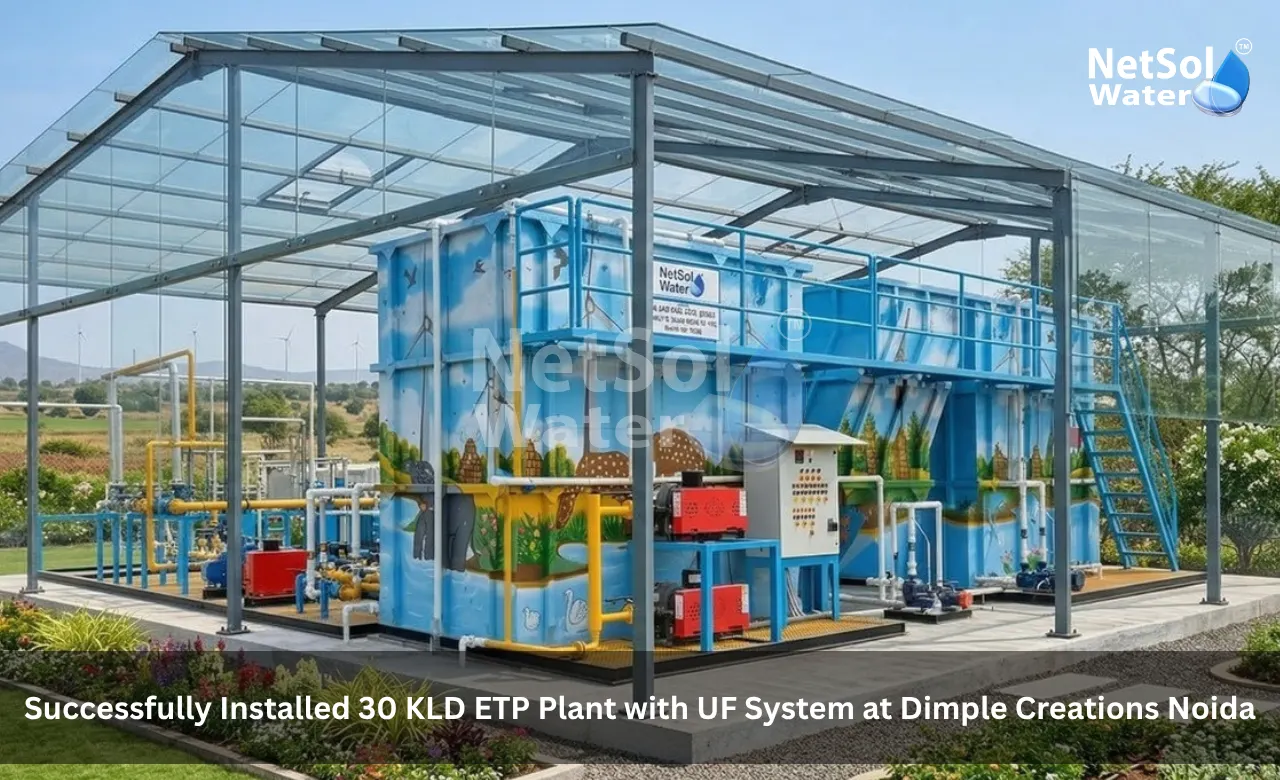
Successfully Installed 30 KLD ETP Plant with UF System at Dimple Creations Noida
Efficient treatment of industrial wastewater is an important part of responsible water management. Industries need suitable treatment systems that can handle their wastewater before the treated water is discharged or considered for reuse. The treatment solution also needs to match the flow requirement of the facility so that the plant can operate in a practical and consistent manner. With this requirement in focus, Netsol Water completed the installation of a 30 KLD Effluent Treatment Plant with a UF system at Dimple Creations in Noida.
The project focused on providing a suitable wastewater treatment arrangement for the client. The installed system combines an Effluent Treatment Plant with Ultrafiltration to support the treatment process and improve the quality of the treated water. A plant of this capacity allows the treatment system to manage the specified wastewater load while providing a structured treatment process from influent collection to final treated water.
The project also reflects the importance of proper planning, equipment selection and commissioning during an industrial wastewater treatment installation. Each stage needs to work with the next so that the complete system performs as intended.
Project Overview
A wastewater treatment project must begin with a clear understanding of the treatment requirement and the expected flow. The objective is not only to install equipment but also to create a treatment process that matches the operating needs of the facility. At Dimple Creations in Noida, the requirement was addressed through the installation of a 30 KLD ETP plant supported by an Ultrafiltration system.
The project scope covered the installation of the treatment plant and the integration of the UF stage into the overall treatment arrangement. The system was planned to provide a defined treatment path for the wastewater generated at the facility. By selecting a 30 KLD capacity, the plant was aligned with the stated treatment requirement of the project.
The work also involved more than equipment placement. The treatment system needed proper connections between different stages so that wastewater could move through the process in the correct sequence. This included site preparation, equipment placement, piping and system connections followed by testing and commissioning.
A well-planned treatment sequence creates the base for stable plant operation. For this reason, the project moved from capacity selection and technology planning to installation and commissioning.
Client Details
Dimple Creations is the client for this wastewater treatment project and is located in Noida. The information available for this project does not provide detailed technical or operational information about the client’s specific production activities. Therefore, the project is best described in terms of the wastewater treatment requirement rather than making assumptions about the client’s industrial process.
The need for an ETP indicates that the facility required a dedicated system for managing and treating its wastewater. Industrial wastewater can contain a combination of suspended matter, dissolved substances and other impurities depending on the source. The treatment system must therefore provide suitable stages to reduce these contaminants before the water moves to the next stage of management.
For Dimple Creations, the selected solution combined an ETP with UF technology. This arrangement created a structured treatment setup in which wastewater could first pass through the required treatment stages and then reach the membrane-based filtration stage. The final treatment quality depends on the influent characteristics and the operating conditions of the complete plant.
Understanding the client’s requirement helped define the plant size and treatment approach. These factors also guided the selection and placement of the major equipment used at the site.
Project Location
The project was completed at Dimple Creations in Noida. Project location plays an important role in the execution of any industrial water treatment installation because the available site conditions influence equipment placement, piping connections and access for installation and maintenance.
Noida has a large industrial and commercial base where facilities may require dedicated systems for managing wastewater. In an industrial facility, wastewater treatment must fit into the available site while maintaining a clear flow path between treatment stages. The installation team therefore needs to consider the working area, equipment arrangement and connection points during execution.
For this project, the selected treatment system was installed at the client’s Noida facility with the objective of providing the required wastewater treatment capacity. The location-specific installation work provided the foundation for connecting the different treatment stages into one complete system.
The project location and available installation area directly influenced the practical execution of the work. This made capacity planning and equipment arrangement important parts of the next stage of the project.
Plant Capacity
Plant capacity determines how much wastewater a treatment system can handle over a given period. Choosing the right capacity helps prevent both under-sizing and unnecessary oversizing. A plant that is too small may not manage the expected wastewater flow properly, while an oversized plant may not be an efficient match for the intended requirement.
The installed ETP at Dimple Creations has a capacity of 30 KLD, which means the system is designed for a treatment capacity of 30 kilolitres per day. This capacity was selected for the project requirement and provides the intended treatment scale for the facility.
The 30 KLD capacity forms the basis for sizing the treatment stages and associated equipment. Each part of the plant must work according to the expected flow so that wastewater can move through the process without creating avoidable bottlenecks. The UF system also needs to operate within the planned treatment arrangement to provide the intended filtration stage.
A suitable capacity is important for both day-to-day operation and system planning. With the capacity established, the next consideration was the treatment technology required to process the wastewater.
Treatment Technology
The treatment technology determines how wastewater moves from its raw condition toward the required treated water quality. Different wastewater streams contain different types of impurities, so the treatment process must use appropriate methods for removing suspended and dissolved contaminants.
For this project, Netsol Water installed a 30 KLD Effluent Treatment Plant with an Ultrafiltration system. The ETP provides the overall wastewater treatment framework while the UF system acts as a membrane-based filtration stage within the treatment arrangement.
1. Effluent Treatment Plant
An Effluent Treatment Plant treats wastewater through a series of physical, chemical and biological or membrane-based processes depending on the characteristics of the influent. The objective is to reduce unwanted contaminants and produce treated water that can be managed according to the intended application.
The treatment process generally begins with the removal of larger and settleable impurities. Further stages then address finer suspended matter and other contaminants. The exact combination of treatment stages depends on the wastewater characteristics and the plant design.
2. Ultrafiltration System
Ultrafiltration uses a membrane with very small pores to separate fine suspended solids, colloidal particles and other larger contaminants from the water. Wastewater passes through the membrane under pressure while retained materials remain on the other side of the membrane.
In the installed system, the UF unit provides an additional filtration stage after the required ETP treatment steps. This helps produce a cleaner treated stream before the water is directed toward its next point of use or management.
The combination of ETP treatment and UF filtration gives the project a structured process in which different treatment stages address different types of impurities. With the technology defined, the next step was to consider the incoming wastewater characteristics.
Influent Characteristics
Understanding influent quality is necessary before deciding how wastewater should be treated. The physical and chemical properties of the incoming water affect equipment selection, process design and membrane operation. Parameters such as TDS, hardness, turbidity, iron, suspended solids, organic load and microbial content can vary from one facility to another.
For the Dimple Creations project, exact laboratory values for parameters such as TDS, hardness, turbidity, iron or microbial content were not provided with the available project information. It would therefore be inappropriate to assign specific numerical values to the influent.
Instead, the treatment system should be viewed in relation to the general nature of industrial effluent. Incoming wastewater may contain suspended and dissolved impurities that need to be reduced through a sequence of treatment stages. The ETP provides the primary treatment framework while the UF stage supports finer separation of suspended and colloidal matter.
Influent characteristics also matter for UF operation. Proper pretreatment helps reduce the load reaching the membrane and supports more stable filtration. This is why the wastewater treatment sequence must be designed as a connected process rather than as separate pieces of equipment.
Treatment Process
A successful wastewater treatment system depends on a proper sequence in which each stage prepares the water for the next one. The treatment process must control the wastewater flow while progressively reducing unwanted contaminants. At Dimple Creations, the 30 KLD ETP with UF was arranged to provide such a sequence.
| Process Stage | Description |
| Wastewater Collection and Initial Treatment | The process begins when wastewater enters the treatment system. At the initial stage, the plant receives the incoming effluent and provides suitable conditions for handling the wastewater before advanced treatment. Initial treatment is important because larger solids and unwanted materials can interfere with downstream equipment. Removing or controlling these materials at an early stage helps protect the later treatment units and creates more suitable conditions for the following steps. |
| Primary Treatment | The next part of the process focuses on reducing suspended and settleable impurities. Depending on the treatment arrangement, physical and chemical treatment can help separate contaminants from the wastewater. This stage prepares the water for further treatment by lowering the concentration of materials that could otherwise increase the load on downstream equipment. Once the initial impurities are controlled, the water can move toward the next treatment stage. |
| Secondary Treatment | Further treatment addresses the contaminants that remain after primary treatment. The exact method depends on the project design and wastewater characteristics. The purpose is to continue reducing the pollutant load and improve the condition of the water before membrane filtration. Good secondary treatment is particularly useful before UF because membrane systems perform better when the upstream process controls the amount of suspended and colloidal matter reaching the membrane. |
| Ultrafiltration Stage | After the required ETP treatment stages, the water moves toward the UF system. During UF, pressure pushes the water through a membrane while larger suspended and colloidal materials are retained. The membrane acts as a fine barrier and helps produce a cleaner permeate stream. At the same time, retained contaminants remain concentrated on the other side of the membrane and need appropriate handling within the plant’s operating arrangement. |
| Treated Water Collection | Once the water passes through the treatment stages and UF filtration, the treated stream moves toward collection or its intended point of use. The final handling of the treated water depends on the client’s application and applicable discharge or reuse requirements. |
This connected process allows each treatment stage to perform a specific role while supporting the overall performance of the 30 KLD plant.
Major Equipment
Proper equipment selection supports smooth operation because every component must match the treatment capacity and process requirement. Pumps, tanks, filtration equipment, membrane units and other components need correct placement and proper connection so that the system can operate as one integrated plant.
| Equipment / Component | Description |
| Effluent Treatment System Components | The ETP includes the equipment required to receive wastewater and move it through the planned treatment stages. Tanks provide space for collection and treatment while pumps maintain the required flow between different sections of the plant. The treatment arrangement also includes equipment that supports the removal of suspended and other unwanted matter. The exact equipment configuration depends on the final plant design and influent requirement. |
| Ultrafiltration Unit | The UF system is one of the main components of this project. Its membrane modules provide fine filtration after the upstream treatment stages. The unit needs suitable feed conditions and controlled flow so that the membrane can perform its separation function effectively. |
| Pumps and Piping | Pumps transfer wastewater and treated water between different treatment stages. Piping provides the physical connection between these sections and maintains the intended flow path. Correct piping connections are important because even a well-designed treatment process can face operating problems if the flow is not directed correctly. For this reason, the installation team needed to connect the complete system according to the planned treatment sequence. |
Installation Process
Plant installation requires careful coordination because the final system must fit the site and also maintain the intended process flow. The work begins with site preparation and continues through equipment placement, piping, electrical connections and system checks.
At the Dimple Creations site, the installation process began with preparation of the designated area. The team assessed the available space and arranged the equipment so that the different treatment stages could be connected in a practical sequence.
Once the site was ready, the major treatment equipment was placed according to the planned layout. Proper positioning helped provide access for operation, inspection and maintenance while maintaining connections between the treatment sections.
The next stage involved connecting the process piping. The piping system had to link the wastewater collection, treatment stages, UF unit and treated water outlet in the correct order. Pump connections were also completed so that water could move from one stage to another.
Electrical and control connections followed the mechanical installation. These connections support the operation of pumps and associated equipment and allow the plant to be operated according to its intended sequence.
After the installation work was completed, the team moved into testing and commissioning. This stage helped confirm that the installed equipment and connections were ready for operation.
Plant Commissioning
Commissioning is necessary because installation alone does not confirm that a treatment plant is ready for regular use. The commissioning stage allows the team to check the installed system under operating conditions and identify any issues before routine operation begins.
During commissioning, the team checked the operation of the major components and verified the movement of water through the treatment stages. Pumps and piping connections were checked for correct flow while the UF system was assessed as part of the integrated process.
The team also reviewed the operating sequence of the plant to make sure each treatment stage performed its intended function. Equipment response and system connections were examined during the testing process.
Commissioning provided the final operational check for the 30 KLD ETP. Once the treatment stages and equipment worked together as intended, the plant was ready to support the client’s wastewater treatment requirement.
Treated Water Reuse
Treated water has greater practical value when the facility can manage it effectively after treatment. Depending on the final water quality and the client’s application, treated wastewater may be considered for suitable non-potable uses or handled according to the applicable discharge requirements.
For the Dimple Creations project, the available information does not specify a particular internal reuse application or a measured reuse volume. Therefore, no specific end use is being claimed. The UF-based treatment arrangement provides an additional filtration stage that can support the production of improved treated water quality for the intended downstream application.
Any reuse decision should follow the required water quality criteria and the client’s actual operating needs. Where reuse is suitable, treated water can help reduce dependence on fresh water for selected applications. Where reuse is not planned, the treated stream can be managed according to applicable wastewater disposal requirements.
Results and Performance
Project results show whether the installed treatment solution meets the intended capacity and operating requirement. For an industrial wastewater project, performance must be assessed through treatment capacity, process operation and the quality of the treated water.
The completed installation provides a 30 KLD treatment capacity at Dimple Creations and includes UF filtration as part of the treatment system. The project therefore delivers the specified treatment infrastructure for managing the client’s wastewater requirement.
The completed installation also demonstrates the practical integration of an ETP with a UF system. Instead of treating membrane filtration as a separate unit, the project places UF within the wider treatment process so that upstream treatment supports the membrane stage.
No specific influent and treated water laboratory values were provided for this project. Therefore, numerical removal efficiencies or specific improvements in parameters such as TDS, COD, BOD, hardness or turbidity cannot be stated accurately.
From an installation perspective, the project achieved its stated objective by establishing the required wastewater treatment plant at the client’s Noida facility. The successful completion of installation and commissioning provides the client with a dedicated system designed around the specified 30 KLD treatment requirement.
Read some interesting information for the Sewage Treatment Plant Manufacturer in Delhi
Customer Feedback / Testimonial
Customer feedback provides useful insight into how a completed water treatment project performs from the client’s perspective. It can highlight practical aspects such as installation quality, equipment operation and overall satisfaction with the completed work. The successful installation and commissioning of the 30 KLD ETP with UF system at the client’s Noida facility. The completion of these activities reflects the delivery of the specified treatment solution for the project.
Call to Action
Effective wastewater treatment requires more than selecting a plant capacity. It also requires suitable technology, proper equipment selection, correct installation and careful commissioning. The successful completion of the 30 KLD ETP with UF system at Dimple Creations shows how a properly planned treatment setup can address a defined industrial wastewater requirement.
As an experienced Effluent Treatment Plant Manufacturer in Noida, Netsol Water provides wastewater treatment solutions designed around specific flow and treatment requirements. Businesses looking for an ETP, UF-based treatment system or a related industrial water treatment solution can discuss their requirement with the Netsol Water team.
Contact Netsol Water to understand the suitable treatment approach for your facility and to request a consultation for your wastewater treatment project.
Contact Netsol Water
Phone: +91-9650608473
Email: enquiry@netsolwater.com