
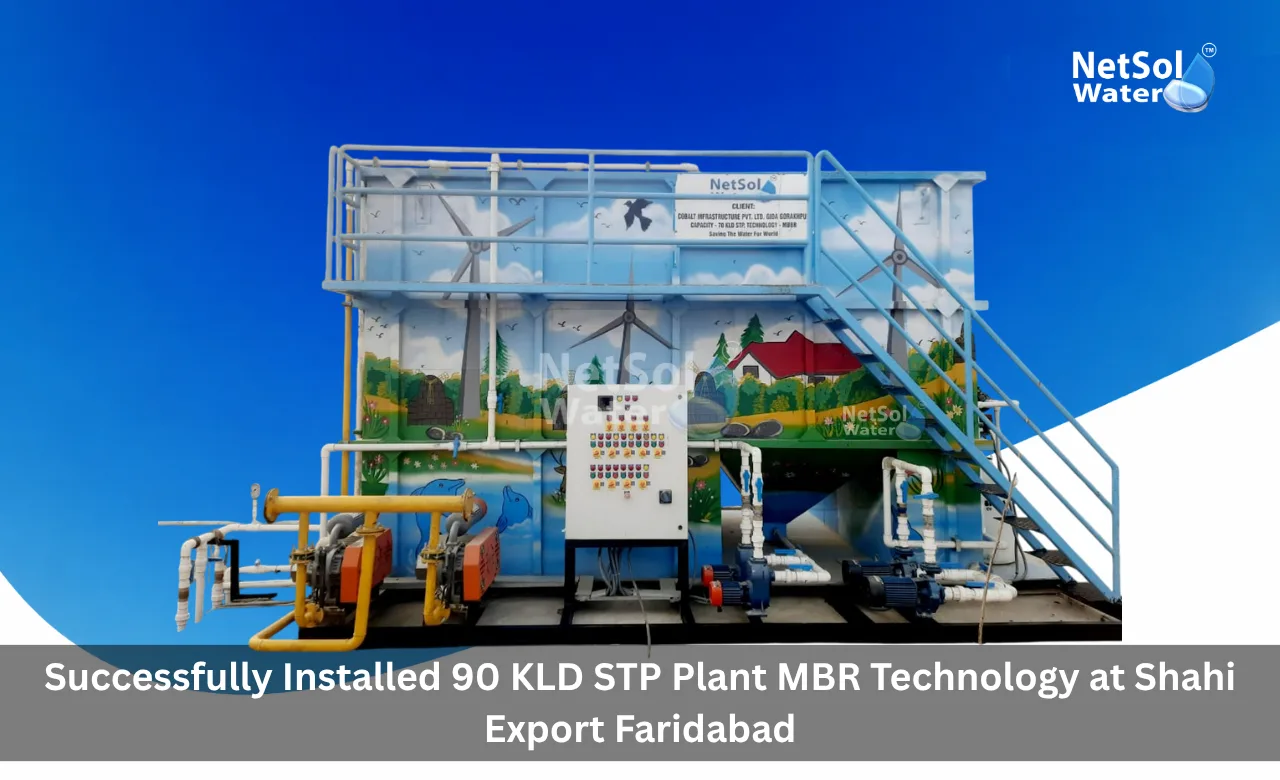
Successfully Installed 90 KLD STP Plant MBR Technology at Shahi Export Faridabad
Effective sewage treatment has become an important requirement for facilities that generate wastewater through their daily activities. Proper treatment helps a facility manage sewage in a controlled manner and supports the responsible use of treated water. At Shahi Export in Faridabad, the requirement was to establish a suitable sewage treatment system that could handle the intended wastewater load and provide treated water for reuse within the facility. To meet this requirement, a 90 KLD sewage treatment plant based on MBR technology was installed at the project site.
The project focused on creating a treatment system that matched the stated capacity requirement while using a treatment technology designed for biological treatment and membrane-based separation. MBR combines these two functions within one treatment arrangement. This allows the process to treat sewage through biological activity and then separate treated water from the biological solids through membranes.
The installation also involved the practical work needed to place the equipment at the site and connect the treatment stages into a working system. After installation, the plant went through testing and commissioning to prepare it for operation. The completed project provided Shahi Export with a dedicated treatment solution for the specified sewage treatment requirement in Faridabad. The project also reflects the type of treatment work that can be delivered by a sewage treatment plant manufacturer in Faridabad for facilities seeking a planned wastewater management system.
Project Overview
A sewage treatment project needs to consider more than just the installation of individual equipment. The treatment system must match the required capacity and follow a suitable process from sewage entry to treated water output. At Shahi Export in Faridabad, the project centered on the installation of a 90 KLD STP using MBR technology. The system was planned to address the client’s stated need for sewage treatment at the facility.
The objective of the project was to provide a dedicated treatment arrangement capable of handling the required sewage quantity. Instead of treating wastewater through a simple standalone process, the project used MBR technology to combine biological treatment with membrane filtration. This approach created a process in which microorganisms support the breakdown of biodegradable pollutants while membranes separate the treated water from the biological mixture.
The scope of the work included the installation of the treatment plant at the project location along with the placement of major treatment equipment and the required system connections. The installation needed to bring different treatment stages together into one operating arrangement. Each part of the plant had a specific role and needed to work in coordination with the other stages.
Capacity also remained an important consideration throughout the project. A 90 KLD plant was selected according to the capacity stated for the facility. The completed installation therefore focused on creating a treatment system around this defined capacity rather than using an unspecified or oversized arrangement.
Client Details
Shahi Export was the client for this sewage treatment project in Faridabad. The need for an STP indicates that the facility required a structured method for managing sewage generated at the site. A dedicated treatment system helps convert incoming sewage into treated water through a controlled process. This provides a defined treatment route instead of allowing wastewater to remain unmanaged or move directly toward disposal.
For a facility with a fixed treatment requirement, selecting the correct plant capacity and process becomes important. The treatment plant must be able to receive sewage and move it through the required stages without disturbing the intended treatment sequence. The choice of a 90 KLD capacity established the scale around which the system was installed.
The client also needed a treatment technology that could support biological treatment and membrane-based separation. MBR technology provided the process framework selected for the project. Its use allowed the installation to combine biological treatment with membrane filtration as part of the same treatment approach.
The location of the facility was equally important because the complete treatment system had to be installed and commissioned at the client’s site in Faridabad.
| Detail | Information |
| Client | Shahi Export |
| Project Location | Faridabad |
| System Installed | Sewage Treatment Plant (STP) |
| Technology | MBR (Membrane Bioreactor) |
| Executed By | Netsol Water |
Project Location
The project was completed at Shahi Export in Faridabad. Project location matters because a sewage treatment plant must operate within the physical conditions of the facility where it is installed. Equipment placement, connection between treatment stages and access for operation all need to be considered within the available site arrangement.
Faridabad provides the project with a defined industrial and commercial setting in which wastewater treatment requirements can vary from one facility to another. In this project, the available information identifies the requirement as a 90 KLD sewage treatment plant using MBR technology.
The installation had to bring the different treatment components together at the Faridabad location in a practical sequence. The plant needed suitable positioning so that sewage could enter the treatment system and move through the planned stages. Equipment connections also had to support the movement of wastewater and treated water across the process.
The location further influenced the installation and commissioning activities because the plant had to be made functional within the client’s existing facility. This required organized placement of the treatment components and careful system integration.
Once the site requirement was established, plant capacity became the next key consideration because the size of the STP determines the amount of sewage the system is designed to handle.
Plant Capacity
Plant capacity gives the treatment system a clear operating scale. It defines the quantity of sewage that the plant is designed to process and helps establish the size and arrangement of the treatment process. Selecting a capacity that matches the stated project requirement is therefore important when planning a sewage treatment plant.
For Shahi Export, the installed sewage treatment plant has a capacity of 90 KLD. KLD means kilolitres per day and expresses the plant’s treatment capacity on a daily basis. The specified value of 90 KLD formed the capacity basis for the project.
The plant was therefore designed and installed around the stated requirement for handling sewage at 90 KLD. This capacity gives the facility a defined treatment framework for its wastewater management needs.
Capacity and technology also work together. The 90 KLD requirement was not considered separately from the selected MBR process. The treatment stages had to operate as part of one system capable of handling the intended sewage quantity. This included the biological treatment stage and the membrane separation stage that form the core of MBR technology.
With the capacity established, attention can turn to the treatment technology that supports the treatment process.
| Specification | Value |
| Plant Capacity | 90 KLD (Kilolitres Per Day) |
| Treatment Technology | MBR (Membrane Bioreactor) |
| Core Stages | Biological Treatment + Membrane Separation |
| Output | Treated Water (for reuse) and Managed Sludge |
Treatment Technology
The selected treatment technology plays a major role in determining how sewage moves through the plant and how treated water is separated from biological solids. For this project, Shahi Export selected MBR technology, which stands for Membrane Bioreactor.
MBR combines biological wastewater treatment with membrane filtration. In a conventional biological treatment arrangement, microorganisms break down biodegradable matter in sewage and the treated liquid is then separated from the biological solids through a separate clarification step. In an MBR system, membranes perform the separation function after biological treatment.
This combination changes the way the treatment process is arranged. The biological reactor provides the environment needed for microorganisms to act on biodegradable pollutants. The membrane stage then separates the treated water from the suspended biological solids. The result is a treatment sequence in which biological activity and membrane separation work together.
1. Biological Treatment
The biological part of an MBR system uses microorganisms to treat biodegradable components in sewage. These microorganisms consume suitable organic matter as part of their biological activity. The process reduces the pollutant load in the wastewater before membrane separation takes place.
This stage needs controlled operating conditions so that the biological population can perform its treatment function. The wastewater therefore moves through the biological treatment section before reaching the membrane stage.
2. Membrane Separation
The membrane section forms the defining feature of MBR technology. Membranes act as a physical barrier that separates treated water from the biological solids present in the reactor mixture.
Because the membrane performs the separation function, the treatment sequence can maintain a high degree of solid-liquid separation within the process. The treated liquid passes through the membrane while retained solids remain in the biological treatment system and can continue to participate in the process.
3. Why MBR Was Used
The project selected MBR because the treatment requirement called for a sewage treatment plant based on this technology. MBR provided an integrated treatment approach in which biological treatment and membrane separation formed part of the same process.
The technology also created a clear connection between the treatment stages. Sewage first enters the biological treatment section. The biological process acts on the biodegradable pollutants. The resulting mixture then reaches the membrane stage where treated water is separated from the biological solids.
Understanding the incoming sewage is another important part of the treatment design because the treatment process must be considered in relation to the characteristics of the water entering the plant.
Influent Characteristics
Incoming sewage characteristics influence the way a treatment plant is designed and operated. Parameters such as suspended solids, organic content, turbidity, nutrients and microbial load can affect the treatment process. Understanding these characteristics helps engineers determine the treatment sequence and assess the conditions under which the plant will operate.
Influent should be understood in general terms as sewage requiring biological treatment and membrane separation. The treatment system receives the incoming wastewater and prepares it for the biological process. The characteristics of the sewage determine how effectively the biological stage can treat the biodegradable load and how the membrane stage performs during separation.
Sewage enters the plant and moves through the arranged stages before reaching the MBR section. The next section explains how these stages work together.
| Influent Parameter | Relevance to Treatment |
| Suspended Solids | Affects biological treatment load and membrane performance |
| Organic Content | Determines the biodegradable load treated by microorganisms |
| Turbidity | Indicates suspended material entering the system |
| Nutrients | Influences biological process conditions |
| Microbial Load | Relevant to biological treatment activity and system hygiene |
Treatment Process
A well-arranged treatment process ensures that sewage moves through each stage in a controlled order. Each treatment stage has a specific function and prepares the wastewater for the next stage. In an MBR-based STP, the process connects preliminary handling, biological treatment and membrane separation into one continuous treatment route.
1. Sewage Collection and Inlet
The treatment journey begins when incoming sewage reaches the plant inlet. The inlet provides the entry point through which wastewater enters the treatment system.
At this stage, the plant receives the wastewater generated at the facility and directs it into the initial treatment arrangement. Proper flow into the plant is important because all later treatment stages depend on a steady and controlled wastewater path.
2. Preliminary Screening
The first treatment stage generally focuses on removing larger materials that may interfere with downstream equipment and treatment units. Screening provides a physical barrier that retains coarse materials present in the incoming sewage.
This stage protects later equipment by reducing the quantity of larger unwanted material entering the biological and membrane treatment sections. The screened wastewater can then move forward for further treatment.
3. Biological Treatment
After preliminary handling, the wastewater enters the biological treatment stage. Here, microorganisms act on biodegradable pollutants contained in the sewage.
The biological process forms the core of wastewater treatment because it reduces biodegradable organic matter through microbial activity. The biological mixture remains within the treatment system so that the microorganisms can continue acting on the wastewater.
For an MBR plant, this biological stage connects directly with the membrane separation process. The process therefore does not treat biological activity and solid separation as completely separate systems. Instead, both functions form part of the same treatment arrangement.
4. Membrane Bioreactor Stage
The membrane bioreactor section brings biological treatment and membrane filtration together. The biologically treated mixture reaches the membrane stage where the membranes separate the liquid from the retained biological solids.
Treated water passes through the membrane barrier while the biological solids remain within the treatment process. This separation allows the system to produce a clarified treated-water stream without depending on a conventional settling stage for the primary solid-liquid separation.
The membrane stage therefore supports the final separation required before treated water moves to its designated use or collection point.
Treated Water Collection
After membrane separation, the treated water leaves the treatment process as the output stream of the STP. The water can then move toward storage or reuse according to the facility’s intended arrangement. At the Shahi Export project, the plant was installed to address the specified sewage treatment requirement.
Sludge Management
Biological treatment produces excess biological solids that need to be managed as part of normal plant operation. The treatment system therefore includes the handling of retained solids so that the biological process can remain balanced.
The process creates a clear treatment path from sewage entry through biological treatment and membrane separation to treated water production. The equipment installed across these stages allows the process to operate as one integrated system.
| Stage | Function |
| Sewage Collection and Inlet | Entry point where incoming wastewater enters the plant |
| Preliminary Screening | Removes larger materials before further treatment |
| Biological Treatment | Microorganisms break down biodegradable pollutants |
| Membrane Bioreactor Stage | Membranes separate treated water from biological solids |
| Treated Water Collection | Collects final treated water output |
| Sludge Management | Handles excess biological solids generated during treatment |
Major Equipment
Proper equipment selection supports the movement of sewage through the treatment sequence and allows each treatment stage to perform its intended function. A treatment plant is not a single machine. It is an integrated arrangement in which multiple components work together.
1. Screening Arrangement
The screening stage handles larger unwanted materials at the inlet. Its main purpose is to protect the downstream treatment process from coarse matter that could affect equipment and flow.
By controlling this material at the beginning of the process, the plant can direct more suitable wastewater toward the biological treatment stage.
2. Biological Treatment System
The biological treatment section provides the environment in which microorganisms treat biodegradable material in the sewage. This section forms an important part of the MBR process because membrane separation depends on the biological treatment occurring before filtration.
The biological reactor therefore acts as the central treatment area where the wastewater undergoes biological transformation.
3. Membrane System
The membrane assembly performs the liquid-solid separation that distinguishes MBR technology from many conventional treatment arrangements. It allows treated water to pass through the membrane while retaining biological solids.
This function helps connect the biological stage directly with the treated-water output.
4. Pumps and Flow Connections
Pumps and connecting pipelines form the movement system of the plant. They transfer wastewater and treated water between the required sections of the treatment process.
Correct connections are important because even a well-designed treatment stage cannot perform properly if the fluid path between sections is incomplete or incorrectly arranged.
5. Control and Supporting Components
A working STP also depends on supporting components used to manage operation and maintain process flow. These may include control arrangements and other plant accessories associated with the installed system.
The installed equipment collectively supports the 90 KLD treatment process and allows the MBR system to move from wastewater entry to treated water production.
| Equipment | Role in the Treatment Sequence |
| Screening Arrangement | Removes larger unwanted material at the inlet |
| Biological Treatment System | Provides environment for microbial treatment of sewage |
| Membrane System | Performs liquid-solid separation core to MBR technology |
| Pumps and Flow Connections | Transfers wastewater and treated water between sections |
| Control and Supporting Components | Manages operation and maintains process flow |
Installation Process
Plant installation requires careful coordination because multiple pieces of equipment must occupy the correct positions and connect to one another in the correct sequence. The installation process also needs to respect the available site arrangement so that operation and access remain practical.
At Shahi Export in Faridabad, the installation focused on establishing the 90 KLD MBR-based STP as a functioning treatment system. The work began with preparation for equipment placement and arrangement at the designated site.
1. Site Preparation
The first stage involved preparing the installation area for the treatment equipment. A suitable work area is necessary before equipment can be positioned and connected.
Site readiness supports the next phase by ensuring that the main plant components have an appropriate location and that the installation team can carry out the required work in an organized manner.
2. Equipment Placement
Once the site was ready, the treatment equipment was positioned according to the planned process arrangement. Placement had to consider the order of treatment stages so that wastewater could move logically from one section to the next.
The MBR components were positioned as part of the overall treatment route. Their placement allowed the biological process and membrane separation stages to function together.
3. Interconnection Work
After equipment placement, the plant components needed to be connected. Piping and flow connections created the path for wastewater to move through the various treatment stages.
Electrical and control connections were also needed where applicable for the operation of plant equipment. Proper interconnection ensured that individual components could function as part of the complete system.
4. System Checks
Installation work was followed by checks of the connected system. These checks helped identify issues related to alignment, connections and equipment readiness before commissioning.
This stage was important because it provided a controlled transition from physical installation to operational testing.
Once installation and connections were completed, the plant could move into the commissioning stage where the system was tested as a working treatment unit.
Plant Commissioning
Commissioning confirms whether an installed treatment plant can operate as intended. It provides an opportunity to test the equipment, verify the treatment sequence and identify any issues before regular operation begins.
For the 90 KLD MBR-based STP at Shahi Export, commissioning followed the completion of installation and system connections. The process focused on bringing the plant into operating condition and checking the relationship between the treatment stages.
The team checked the installed system so that wastewater could move through the planned sequence. Equipment operation was reviewed along with the connections between major treatment sections.
The commissioning process also provided an opportunity to verify the operation of the MBR arrangement. Since membrane performance forms an important part of the technology, the membrane stage needed to work with the biological treatment section as part of the integrated process.
Operational checks are especially important when a plant includes several interconnected treatment stages. Commissioning therefore helps confirm that the complete system works together rather than checking every component only in isolation.
The plant was prepared for regular operation after the required installation and commissioning activities were completed. Any long-term performance evaluation should use actual operating records from the facility because the supplied project information does not include extended performance data.
With the plant commissioned, the next consideration becomes the practical use of the treated water generated by the system.
Treated Water Reuse
Treatment becomes more meaningful when the facility can use the resulting treated water in an appropriate manner. Reuse can reduce the need to use fresh water for applications where treated wastewater is suitable.
The treated water produced by the MBR-based system can be directed according to the facility’s permitted and planned reuse requirements. Common reuse planning depends on the required water quality, local rules and the intended application.
An important benefit of having a dedicated treatment plant is that the facility has a defined process for handling its sewage and producing treated water. This provides a basis for controlled water management within the site.
The value of reuse also depends on consistent treatment performance. A properly maintained treatment process helps the plant continue producing treated water according to its operating objectives.
Results and Performance
Project results help show whether the installed treatment system addressed the requirement for which it was selected. In this project, the main measurable facts available are the plant capacity, the selected technology and the successful installation and commissioning of the system.
The completed project installed a 90 KLD Sewage Treatment Plant with MBR technology at Shahi Export in Faridabad. The installation established a dedicated sewage treatment facility based on the specified capacity and process technology.
From an operational perspective, the completed system provides the site with a structured treatment sequence. Incoming sewage can move through the treatment stages before reaching the membrane separation section. This creates a defined route from wastewater entry to treated water production.
The MBR configuration also integrates biological treatment and membrane separation into the same treatment approach. This arrangement supports the treatment objective by allowing biological activity to address biodegradable pollutants while the membranes perform the liquid-solid separation function.
The successful installation and commissioning of the plant are important project outcomes because they demonstrate completion of the required treatment infrastructure. The system was not only supplied as equipment. It was installed and prepared for operation at the client’s Faridabad facility.
A proper assessment of future plant performance should use actual operating records and laboratory analysis from the facility. Such records can show how the STP performs under real operating conditions over time.
For the documented project scope, the key outcome remains clear: Shahi Export received a 90 KLD sewage treatment plant using MBR technology with the installation and commissioning completed at its Faridabad site.
Customer Feedback/Testimonial
Customer feedback provides useful insight into how a completed treatment project is viewed from the client’s side. It can reflect the experience of having the treatment plant installed and brought into operation.
Read some interesting information for the Industrial RO Plant Manufacturer
Conclusion
A well-planned sewage treatment system gives a facility a defined method for managing wastewater and producing treated water through a controlled process. At Shahi Export in Faridabad, the installation of a 90 KLD STP with MBR technology established a dedicated treatment solution built around the specified project capacity. The system combines biological treatment with membrane separation and provides an integrated route for sewage treatment.
The completed installation and commissioning also show the importance of coordinating equipment placement, system connections and operational checks during a wastewater treatment project.
Organizations looking for a Sewage Treatment Plant in Faridabad can discuss their capacity requirements, wastewater characteristics and treatment objectives with Netsol Water. Netsol Water is the leading Sewage Treatment Plant Manufacturer in Faridabad and can provide guidance for suitable sewage treatment solutions based on the requirements of the facility.
For similar wastewater treatment needs, contact Netsol Water to discuss your project and request a consultation for an appropriate treatment plant solution.
Contact
Phone: +91-9650608473
Email: enquiry@netsolwater.com