
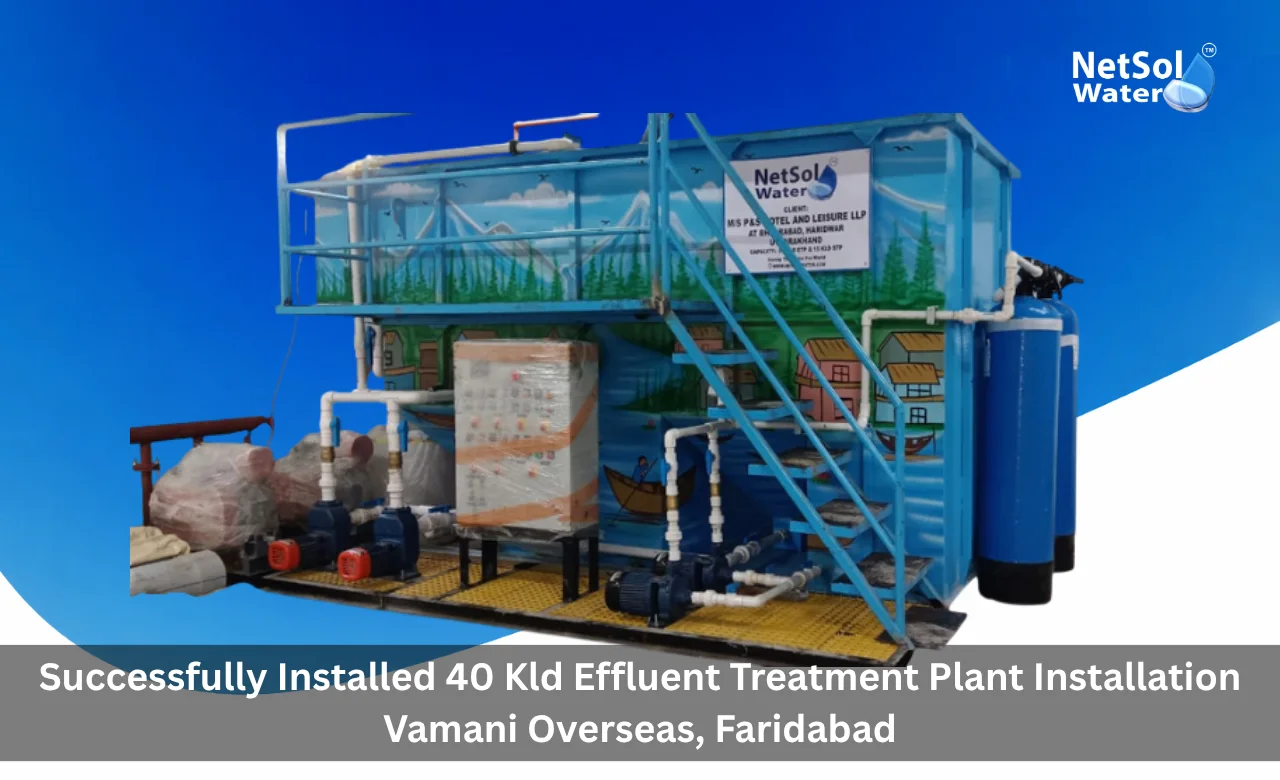
Successfully Installed 40 KLD Effluent Treatment Plant Installation Vamani Overseas, Faridabad
Industrial facilities need a planned system to manage wastewater generated during daily operations. For a garment manufacturing facility, wastewater management becomes especially important because process water can carry suspended matter, organic load and other impurities that require treatment before the water moves to the next stage of its management. A suitable effluent treatment plant helps organize this process and creates a controlled route from wastewater collection to treated effluent.
We completed the installation of a 40 KLD Effluent Treatment Plant for Vamani Overseas in Faridabad. The project was developed for an industrial facility operating in the apparel and garment sector. The project focused on providing the facility with a dedicated wastewater treatment arrangement suited to its industrial setting. The installed capacity was 40 KLD. This means the plant was designed around a daily treatment requirement expressed in kiloliters per day.
The importance of such an installation goes beyond simply moving wastewater through a treatment plant. An industrial facility needs a clear treatment route that allows wastewater to be collected, processed and managed in an orderly manner. It also needs a system that can be monitored as part of its environmental management practices. Vamani Overseas has publicly reported that its wastewater parameters are monitored through third-party laboratory testing. Its sustainability reporting also states that treated wastewater from its ETP is managed for reuse, recycling or discharge according to the applicable treatment and management requirements.
This project reflects the role of an appropriately sized ETP in industrial wastewater management. It also shows why capacity, site conditions, treatment objectives and operational requirements need to be considered together when developing a wastewater treatment solution.
Project Snapshot
| Parameter | Details |
| Client | Vamani Overseas |
| Location | Sector 24, Faridabad, Haryana |
| Plant Capacity | 40 KLD |
| Industry Served | Apparel & Garment Manufacturing |
| Scope of Work | Installation of a dedicated Effluent Treatment Plant |
| Executed By | Netsol Water |
Project Overview
Every wastewater treatment project begins with a clear understanding of the facility and the nature of the wastewater it generates. A treatment plant must fit the operational requirement of the site. It must also provide a structured route for wastewater management so that the client can handle effluent in a controlled way. The 40 KLD installation at Vamani Overseas was undertaken to provide such a dedicated treatment arrangement for the Faridabad facility.
The project requirement centred on industrial effluent treatment. Vamani Overseas operates in the apparel manufacturing sector and has a facility in Sector 24, Faridabad. Its official website describes the company as an Indian manufacturer specializing in soft woven apparel for women, men and children. The company’s public information also lists Faridabad as its operating base and identifies Sector 24 as its location.
For an industrial facility of this nature, wastewater management needs to remain connected with daily operations. Wastewater can arise from activities associated with manufacturing and supporting processes. The treatment system therefore has to provide a defined point where industrial effluent enters the treatment arrangement and a controlled path through which treated water is produced.
The installed capacity of 40 KLD gave the project a clear design reference. The plant was not presented as an unrestricted treatment system. Instead, it was associated with a specified daily treatment capacity.
The scope of such a project also involves more than placing treatment units at a site. Installation requires coordination between civil readiness, equipment placement, interconnections, electrical work and process checks. The successful completion of the installation created a dedicated treatment facility for the client’s wastewater management requirement.
The next aspect of the project is the client itself because the nature of the facility provides the context in which the treatment system was required.
Client Details
Vamani Overseas is an apparel manufacturing company based in Faridabad, Haryana. Its official company information describes the organization as an Indian manufacturer operating from the National Capital Region and specializing in soft woven apparel for women, men and children. The company states that it was established in 2008 and provides apparel manufacturing and related services for brands in different markets.
The company’s public information describes an extensive manufacturing operation. Its garment division includes multiple manufacturing and operating locations. The need for an industrial wastewater treatment system must be understood within this manufacturing context. Manufacturing operations that use water can generate wastewater that requires collection and treatment before discharge or further reuse. The treatment plant provides a dedicated route for handling this wastewater rather than leaving its management dependent on informal or uncontrolled practices.
Public environmental information also places Vamani Overseas within the textile category in Faridabad. A Haryana pollution control record lists Vamani Overseas facilities in Sector 24 under the textile category. The record includes separate entries associated with the company’s premises and identifies the garment division.
Vamani’s own sustainability reporting further shows that wastewater quality receives regular attention. The company states that parameters such as pH, hardness and total dissolved solids along with other ZDHC-related parameters are monitored through third-party laboratory testing. This provides useful context for understanding why wastewater treatment and monitoring form an important part of the facility’s environmental management practices.
Client Profile at a Glance
| Attribute | Details |
| Company | Vamani Overseas |
| Sector | Apparel & Garment Manufacturing |
| Established | 2008 |
| Specialization | Soft woven apparel for women, men and children |
| Facility Location | Sector 24, Faridabad |
| Pollution Control Category | Listed under textile category (Haryana pollution control record) |
| Monitored Parameters | pH, hardness, TDS and other ZDHC parameters |
Project Location
Location influences the practical planning of any treatment plant. The plant must fit within the available industrial premises. It must connect with the existing wastewater collection arrangement and it must support the operating pattern of the facility without creating unnecessary disruption.
The project was completed at Vamani Overseas in Faridabad, Haryana. The company’s official contact information identifies Sector 24, Faridabad as its head office location and gives the business address within the Sector 24 industrial area.
Faridabad forms part of the wider National Capital Region and has a long-established industrial base. For a manufacturing facility operating in such an environment, wastewater treatment needs to form part of regular site management. Treatment arrangements also need to fit the physical limitations of an existing industrial site.
The 40 KLD installation at Vamani Overseas was consequently planned around a defined treatment capacity and an industrial site where the wastewater treatment system had to work as part of the broader facility.
With the location established, plant sizing becomes the next important consideration.
Plant Capacity
Plant capacity determines how much wastewater a treatment system is designed to handle within a defined period. Choosing the correct capacity helps ensure that the treatment plant corresponds with the intended wastewater management requirement. It also provides a reference for equipment sizing, process design and operational planning.
The installed plant capacity for this project was 40 KLD. KLD means kilolitres per day. The stated project capacity therefore provides the central reference for the installation.
A 40 KLD plant is intended for a daily treatment requirement of 40 kilolitres. For Vamani Overseas, the 40 KLD capacity established the size of the treatment solution associated with the project. It provided a defined daily treatment framework for managing industrial effluent at the facility.
The same principle applies to plant performance. Capacity describes the designed treatment scale. It does not by itself establish removal efficiency, treated-water quality or final reuse volume.
The technology section should therefore focus on what is documented about the project and avoid assigning an unverified process configuration.
Treatment Technology
Treatment technology determines how industrial wastewater moves from its untreated condition toward a controlled treated-water output. The choice depends on the wastewater characteristics, required treatment level, capacity, site conditions and intended end use or disposal route.
The project reference confirms a 40 KLD Effluent Treatment Plant for Vamani Overseas in Faridabad. It describes the installation in the context of textile wastewater treatment.
1. Role of an ETP
An ETP treats wastewater generated from industrial activities. The treatment process is selected according to the type and concentration of pollutants present in the incoming stream. Depending on the industrial application, treatment may address suspended solids, biodegradable organic matter, oils, colour, dissolved matter and other contaminants.
The basic purpose remains consistent. Wastewater enters the treatment system. The plant applies suitable physical, chemical and biological treatment stages where required. The treated stream then moves toward its intended reuse, recycling or discharge route.
2. Technology Selection for Industrial Effluent
In an industrial application, technology selection should follow wastewater testing rather than a fixed formula. Different industrial processes can create different wastewater characteristics. Apparel and textile facilities can also have multiple wastewater streams with different compositions.
A suitable design therefore considers the actual flow and quality of the wastewater. It also considers the treatment objective. The treatment requirement can be different when the final goal is discharge compared with internal reuse.
Vamani Overseas has stated that it monitors wastewater parameters including pH, hardness and total dissolved solids through third-party laboratory testing along with other relevant parameters.
The key documented technology for this project is therefore the industrial ETP itself. Any tank-by-tank treatment arrangement beyond that should be confirmed from the project’s technical records rather than presented as a fact.
Influent Characteristics
Understanding influent quality is one of the first requirements in wastewater treatment design. A treatment system can only be properly selected when the project team understands the nature of the water entering the plant. Flow rate alone is not enough. The incoming water may contain different combinations of suspended matter, dissolved substances and organic pollutants.
There is still useful information about the parameters that matter to Vamani’s wastewater management. The company’s sustainability reporting states that it carries out regular monitoring of pH, hardness, total dissolved solids and other ZDHC parameters through third-party laboratory testing. This confirms that water quality assessment forms part of its wastewater management practices.
1. pH
pH indicates whether water is acidic, neutral or alkaline. It can affect chemical treatment and biological treatment conditions. For this reason, pH is normally checked when assessing an industrial wastewater stream. Vamani’s published sustainability report confirms that pH is among the parameters monitored at its facilities.
2. Hardness and TDS
Hardness represents dissolved calcium and magnesium salts while TDS represents the total amount of dissolved substances in water. These parameters help describe the mineral content of a wastewater stream and can influence downstream treatment considerations. Vamani has publicly identified both hardness and TDS among the parameters monitored through third-party laboratory testing.
3. Organic and Suspended Load
Parameters such as BOD, COD and TSS are also commonly considered when assessing an industrial effluent stream. They help describe the biodegradable organic load, the total oxidizable load and the amount of suspended matter present in wastewater.
This distinction is important because influent quality directly influences treatment design. A technically correct case study should separate documented project information from general engineering explanation.
Wastewater Parameters at a Glance
| Parameter | What It Indicates |
| pH | Whether water is acidic, neutral or alkaline; affects chemical and biological treatment |
| Hardness | Dissolved calcium and magnesium salts in the wastewater |
| TDS | Total dissolved substances present in the water |
| BOD | Biodegradable organic load in the wastewater |
| COD | Total oxidizable load in the wastewater |
| TSS | Amount of suspended matter present in the wastewater |
Treatment Process
An ETP works through a sequence in which each treatment stage prepares the water for the next stage. The exact sequence depends on the wastewater characteristics and the selected process design.
1. Effluent Collection
The treatment journey starts when industrial wastewater reaches the plant collection point. The objective at this stage is to bring the wastewater into one controlled treatment route. A defined collection arrangement helps prevent uncontrolled movement of effluent and provides a clear entry point for treatment.
For an operating industrial facility, collection must remain connected with the wastewater-generating areas of the site. The plant therefore becomes part of the broader wastewater flow system rather than functioning as a separate standalone installation.
2. Preliminary Screening
Industrial effluent can carry physical material such as fibres, larger particles and other solids. Preliminary screening helps remove materials that could interfere with pumps or downstream treatment equipment.
Screening is especially relevant for industrial wastewater because physical contaminants can affect later stages even when their quantity is relatively small. Removing such material early helps protect the treatment train.
3. Equalization
Wastewater flow and quality can change during working hours. Equalization helps moderate these variations before the water enters sensitive downstream treatment stages.
An equalization arrangement receives wastewater and provides a controlled feed to later treatment stages. This helps reduce the impact of sudden changes in flow or pollutant concentration.
4. Chemical Treatment
Depending on the incoming water quality, an industrial effluent treatment plant may use chemical treatment to support the removal of suspended particles, colour, oils or other substances. Chemical dosing can help bring contaminants together so that they can be separated from the water more effectively.
5. Biological Treatment
Biological treatment is used in many industrial wastewater systems to reduce biodegradable organic matter. Microorganisms consume suitable organic compounds under controlled conditions. The biological stage requires proper process conditions because treatment performance depends on factors such as wastewater characteristics, dissolved oxygen, retention conditions and biomass management.
6. Solid-Liquid Separation
After physical, chemical or biological treatment, the treated water generally needs separation from the solids generated during the process. Depending on the process design, this may involve settling or another separation method.
This stage prevents separated solids from moving forward with the treated-water stream. It also creates a sludge stream that must be managed separately.
7. Final Treatment and Treated Water Collection
The final stage depends on the required output quality. Additional filtration or disinfection may be used where the application demands further polishing.
The treated water is then collected for the intended management route. Vamani’s sustainability reporting states that wastewater treated in its ETP is managed for reuse, recycling in processes such as washing or irrigation, or discharge. The report describes this as part of the company’s wastewater management approach at facility level.
8. Sludge Management
Industrial wastewater treatment also produces solids that must be handled separately. Sludge may arise from physical separation, chemical treatment or biological activity. Proper sludge handling keeps the liquid treatment process separate from the solid waste stream and supports orderly plant operation.
Treatment Process at a Glance
| Stage | Function |
| Effluent Collection | Brings wastewater into one controlled treatment route |
| Preliminary Screening | Removes fibres and larger solids to protect equipment |
| Equalization | Moderates variations in flow and pollutant concentration |
| Chemical Treatment | Supports removal of suspended particles, colour and oils |
| Biological Treatment | Microorganisms reduce biodegradable organic matter |
| Solid-Liquid Separation | Separates treated water from generated solids |
| Final Treatment & Collection | Additional polishing where required; treated water collected |
| Sludge Management | Handles solids generated during treatment separately |
Major Equipment
Equipment selection determines how well the treatment process can operate as one connected system. Pumps, tanks, blowers, mixers, screens, control systems and separation units each serve a specific purpose. Their selection has to match the process design and the expected flow.
1. Collection and Transfer Equipment
A wastewater collection arrangement typically works with transfer pumps that move incoming effluent toward the treatment stages. These pumps must suit the wastewater characteristics and the required flow.
The transfer system connects the plant with the facility’s wastewater network. A suitable arrangement helps maintain controlled movement of wastewater and reduces interruptions in treatment.
2. Screening Equipment
Screens remove larger physical material from the incoming effluent. This helps protect pumps and downstream process units.
In textile and garment-related wastewater applications, physical solids can include fibres and other process-related materials. Early removal can reduce the chance of blockage or interference later in the treatment train.
3. Equalization Equipment
Equalization tanks provide a buffer between incoming wastewater and downstream treatment. They may include mixing or aeration arrangements where the selected process requires them.
The objective is to reduce sudden changes in hydraulic and pollutant loading so that later treatment stages receive a more manageable feed.
4. Chemical Dosing System
Where chemical treatment is part of the process, dosing equipment controls the addition of treatment chemicals. Correct dosing matters because insufficient chemical addition may reduce treatment performance while excess dosing can increase chemical consumption and sludge generation.
5. Biological Treatment Equipment
Biological treatment requires equipment that creates suitable conditions for microbial activity. Depending on the selected technology, this may include aeration equipment, blowers, diffusers, mixers or attached-growth media.
6. Separation and Sludge Handling Equipment
The treatment process also needs equipment for separating solids from water and moving sludge for further handling. Sludge pumps and related transfer systems are commonly used for this purpose.
7. Electrical and Control System
An ETP needs an electrical and control arrangement that coordinates the pumps, motors and other operating equipment. The control system helps operators start, stop and monitor the treatment process according to the plant design.
For a plant installed in an active manufacturing facility, proper electrical coordination is particularly important because the treatment system must work with the site’s operating environment.
The equipment works as one treatment arrangement rather than as isolated machines. This integration is especially important during installation and commissioning.
Major Equipment Summary
| Equipment | Function |
| Collection & Transfer Equipment | Moves incoming effluent toward the treatment stages |
| Screening Equipment | Removes larger physical material from incoming effluent |
| Equalization Equipment | Buffers hydraulic and pollutant load variations |
| Chemical Dosing System | Controls addition of treatment chemicals |
| Biological Treatment Equipment | Creates suitable conditions for microbial activity |
| Separation & Sludge Handling Equipment | Separates solids from water and moves sludge |
| Electrical & Control System | Coordinates pumps, motors and operating equipment |
Installation Process
Proper installation turns a treatment design into an operating plant. The work requires planning before equipment arrives at the site and continues through mechanical placement, interconnections, electrical work and operational checks.
For the 40 KLD installation at Vamani Overseas, the project objective was to establish the ETP within the Faridabad facility.
1. Site Preparation
Installation begins with readiness of the area where the treatment system will operate. The site must provide suitable access for moving equipment and enough prepared space for the treatment arrangement.
Civil readiness is also important because tanks, equipment supports and operating areas need suitable foundations or prepared structures.
2. Equipment Placement
Once the site is ready, treatment equipment is moved into its planned position. Placement needs to follow the process layout so that water can move through the intended treatment sequence.
3. Mechanical Connections
Mechanical installation connects tanks, pumps, process units and other equipment. Piping provides the route through which wastewater, treated water, sludge and other process streams move.
The connection work has to follow the process flow so that wastewater reaches the correct treatment stage in the required order.
4. Electrical Connections
The plant also needs electrical power for pumps, motors, blowers and control systems where applicable. Electrical installation connects the equipment with the control arrangement and prepares the system for testing.
Safety checks become important at this stage because the treatment plant combines water, electrical systems and industrial equipment.
5. Process Integration
The final part of installation brings individual sections together as one operating system. Water lines, sludge lines, electrical connections and control functions have to work together.
Once the installation is complete, the project moves into commissioning. This step verifies whether the installed system operates as intended.
Plant Commissioning
Commissioning is necessary because an installed plant is not automatically a working treatment system. Each component must operate correctly and the complete process must function in the required sequence.
For a project such as the Vamani installation, commissioning provides the transition from physical installation to plant operation. Equipment is checked and the process sequence is reviewed before the system becomes part of regular wastewater management.
The first stage of commissioning normally involves checking individual equipment items. Pumps, motors, electrical controls and other installed components need to be verified for correct operation.
The next stage checks the process connections. Water should move through the intended route without unexpected interruption. Operators also need to understand how the equipment responds during starting, stopping and normal operation.
Process conditions are then reviewed against the project requirement. Since the 40 KLD capacity is the documented project reference, the commissioning process must establish that the plant is ready to operate around that design capacity.
A successful commissioning process also helps identify issues that may not be visible during mechanical installation. Small connection problems, control issues or flow restrictions can often be identified during controlled operation and corrected before routine use.
Commissioning also matters for plant operators. A treatment system produces better results when operators understand the normal operating sequence and know what to monitor.
Treated Water Reuse
Effective wastewater management does not end when treatment is completed. The next question is how the treated water will be managed. Reuse and recycling can reduce the need for fresh water in suitable applications while also creating a more organized water management cycle.
Vamani Overseas has publicly reported that wastewater treated through its Effluent Treatment Plant is considered for reuse and recycling in activities such as washing or irrigation, as well as for discharge where applicable. The company’s sustainability report states that treated wastewater is monitored and that its treatment process is intended to maintain the required treated-water quality.
This information provides useful context for the 40 KLD installation because it shows that ETP treatment at Vamani forms part of a broader wastewater management strategy rather than being viewed only as an end-of-pipe arrangement.
Reuse has to match the quality of the treated water and the requirements of the intended application. Water intended for one use may require a different quality from water intended for another use. This is why treatment objectives and reuse planning should be considered together.
The project therefore contributes to a water management structure in which wastewater can move from collection and treatment toward an appropriate reuse, recycling or discharge route.
Results and Performance
Project results provide the clearest indication of whether a treatment installation has met its intended purpose. In wastewater treatment, results can be measured through parameters such as flow handled, treated-water quality, equipment performance, operating stability and the amount of treated water reused.
For the Vamani project, the documented result is the successful installation of a 40 KLD ETP at the Faridabad facility. The public project reference confirms the installation and associates it specifically with Vamani Overseas.
The plant capacity itself establishes the treatment scale. A 40 KLD installation creates a defined treatment arrangement for industrial wastewater within the project scope.
At the wider facility level, Vamani’s sustainability reporting states that wastewater parameters are monitored through third-party laboratories. The company also states that the treated wastewater from its Effluent Treatment Plant is managed for reuse, recycling or discharge and that monitoring results have remained within the applicable requirements described in its report.
From an operational perspective, the project provides several practical outcomes that follow directly from the installation itself. First, the facility has a dedicated industrial wastewater treatment system associated with a defined 40 KLD capacity. Second, wastewater treatment becomes part of a planned plant-based process rather than an isolated activity. Third, the treatment system creates a structured route for managing treated water after processing.
The successful completion of the installation also demonstrates the importance of matching wastewater infrastructure with the needs of an operating industrial facility.
For organizations evaluating similar projects, this distinction between verified project data and general treatment expectations is important. A technically sound evaluation should always use actual laboratory results and commissioning data before claiming specific removal performance.
Customer Feedback/Testimonial
We are satisfied with the installation of the 40 KLD Effluent Treatment Plant at our Faridabad facility. The project addressed our requirement for a dedicated system to manage industrial effluent in a more organized and controlled manner. The installation was completed as planned and provided us with a treatment system suited to our operational requirement.
The project team understood our wastewater treatment needs and worked on the installation accordingly. The completion of the plant has given us a structured system for handling wastewater generated at our facility. We also value the importance of regular wastewater monitoring and proper management of treated water as part of our environmental practices.
We appreciate the support provided during the project and are pleased to have a dedicated effluent treatment plant at our facility. The 40 KLD installation has become an important part of our wastewater management system and supports our efforts toward responsible water and effluent management.
Read some interesting information for the Sewage Treatment Plant Manufacturer in Gurgaon
Call to Action
Industrial wastewater treatment requires the right combination of capacity, process planning, equipment selection and site execution. The successful installation of the 40 KLD ETP at Vamani Overseas in Faridabad demonstrates how a defined treatment capacity can become part of a structured wastewater management system for an industrial facility.
Vamani Overseas operates in the apparel manufacturing sector and manages wastewater as part of its broader environmental practices. Its public sustainability reporting highlights the monitoring of wastewater parameters and the management of treated ETP water for reuse, recycling or discharge.
For industrial organizations planning a new wastewater treatment system, the project also highlights an important principle. A treatment plant should be selected around the actual wastewater requirement rather than around a standard product alone. Flow, water quality, treatment objective, available space and the intended treated-water route all influence the final design.
Netsol Water is the leading Effluent Treatment Plant Manufacturer in Faridabad and provides wastewater solutions for industrial applications. The company works across water and wastewater treatment systems and offers effluent treatment plant solutions for different industrial requirements.
A properly planned effluent treatment plant can help an industrial facility bring wastewater collection, treatment and water management into one organized process. The right solution also gives the facility a clearer basis for monitoring and future water reuse planning.
Businesses looking for an ETP Plant Manufacturer in Faridabad can discuss their wastewater flow, process details, water quality requirements and site conditions with Netsol Water. A site-specific assessment can then help identify the suitable treatment approach, capacity and supporting infrastructure for the project.
Contact Netsol Water
| Contact Mode | Details |
| Phone | +91-9650608473 |
| enquiry@netsolwater.com |