3000 LPH RO Plant - Sewage Treatment Plant Manufacturers

Successfully-Installed-3000-LPH-RO-Plant-for-Building-Dhawandeep-Society-Connaught-Place-Delhi.webp

September 10, 2026by Netsol Water

Successfully Installed 3000 LPH RO Plant for Building, Dhawandeep Society, Connaught Place Delhi

Access to suitable water quality is an important requirement for buildings and commercial facilities where water is needed for regular use. A proper treatment system helps manage the available water and provides treated water that can support the intended purpose of the facility. This requirement led Dhawandeep Society in Connaught Place, Delhi to install a 3000 LPH RO plant for its water treatment needs.

Netsol Water completed the installation of the 3000 LPH RO plant at the building. The project focused on providing a practical treatment system that matched the required treatment capacity. RO was selected as the core treatment technology for the plant because it is widely used to treat water through a membrane-based process. The installation gave the client a dedicated water treatment system that could produce treated water at the planned capacity.

The project also reflects the role of proper planning and installation in commercial water treatment. From equipment placement to system connections and commissioning, each stage contributes to the working of the complete plant. As a commercial RO plant manufacturer in Delhi, Netsol Water carried out the project with focus on the stated capacity and the requirements of the site. The following sections explain the project in detail and describe how the installed system supports the facility’s water treatment needs.

Project Overview

A commercial water treatment project needs a system that matches the requirement of the facility and fits the available site conditions. The objective is not only to install treatment equipment but also to establish a complete operating system that can receive incoming water and process it into treated water at the required capacity. The Dhawandeep Society project followed this basic approach.

The client required a Reverse Osmosis plant with a capacity of 3000 litres per hour. Netsol Water took up the installation work and provided the required RO treatment solution for the building. The main objective was to establish a dedicated treatment system that could handle the intended water treatment requirement of the site.

The project scope covered the installation of the RO plant and the associated work needed to place the system into operation. This included arranging the equipment at the site and completing the necessary system connections so that the treatment unit could function as one integrated plant. The work also included commissioning and performance checks before regular operation.

Selecting the appropriate plant capacity was an important part of the project planning. A 3000 LPH system provides a defined treatment output and gives the facility a treatment capacity aligned with the project requirement. With the basic project framework established, the next step is to understand the client and the location where the treatment system was installed.

Client Details

Dhawandeep Society is the client associated with this water treatment installation. The available project information identifies the site as a building located in Connaught Place, Delhi.

Buildings need dependable access to treated water for their intended daily requirements. Water entering a facility may require treatment before it can be used for the planned applications. The need for a dedicated RO plant indicates that the client required a controlled water treatment process rather than relying only on untreated incoming water.

The 3000 LPH RO plant therefore served as the central treatment system for the project. By installing a plant with the required treatment capacity, the client gained a dedicated system designed around the stated requirement. The project also provided a structured treatment setup that could be commissioned and operated as a complete unit.

The location of the project also played an important role in planning the installation. The next section looks at that location and its relevance to the project.

Detail Information
Client Dhawandeep Society
Facility Type Building (residential/commercial society)
Location Connaught Place, Delhi
Solution Provided 3000 LPH RO Plant
Installed By Netsol Water


Project Location

The project was completed at Dhawandeep Society in Connaught Place, Delhi. The location is important because a commercial water treatment installation must be planned around the actual building site. Equipment has to be placed appropriately and connected in a manner that supports the overall water treatment arrangement.

The project location also required the installation team to work within an existing building environment. In such situations, the treatment system has to be integrated into the available space while maintaining a logical connection between the incoming water and the treated water outlet. Proper site planning helps reduce installation problems and supports easier system operation.

For this project, the installation was completed at the identified building location in Connaught Place. The work focused on establishing the 3000 LPH RO plant at the site and preparing the system for regular operation. With the site and project setting defined, plant capacity becomes the next important consideration.

Plant Capacity

Plant capacity determines how much water a treatment system can process over a given period. Choosing the correct capacity helps ensure that the treatment plant matches the intended requirement of the facility. A plant that is too small may not meet the expected demand while a capacity that does not match the requirement may lead to inefficient planning.

For Dhawandeep Society, Netsol Water installed a 3000 LPH RO plant. The term LPH means litres per hour and indicates the treatment capacity of the system. In this project, the installed plant was designed for a treatment capacity of 3000 litres per hour.

The selected capacity gives the facility a defined treatment output and forms the basis for planning the operation of the system. It also provides a clear reference for understanding the size of the installed treatment solution. The capacity was therefore a central part of the project and remained consistent through installation and commissioning.

The installed capacity also connects directly with the selected treatment technology. Once the required output was established, Reverse Osmosis provided the treatment method around which the plant was installed.

Parameter Specification
Installed Capacity 3000 LPH (Litres Per Hour)
Treatment Technology Reverse Osmosis (RO)
Project Site Dhawandeep Society, Connaught Place, Delhi
Plant Type Commercial RO Plant for Building
Design Basis Defined treatment output aligned with the building’s requirement


Treatment Technology

The treatment technology determines how the incoming water will be processed and what type of treatment mechanism the plant will use. For this project, the core technology was Reverse Osmosis. RO is a membrane-based water treatment process that uses pressure to move water through a semipermeable membrane.

1. Reverse Osmosis Process

During Reverse Osmosis treatment, water is directed towards the RO membrane under pressure. The membrane allows water to pass through while restricting many dissolved substances present in the feed water. This produces a treated water stream known as permeate. The remaining concentrated stream is separated from the treated water during the process.

The RO system works as a controlled treatment stage rather than simply storing or transferring water. Water first enters the treatment arrangement and is then directed to the membrane section under suitable operating conditions. The membrane performs the main separation function and produces treated water for the intended application.

2. Role of RO in the Project

The use of RO technology gave Dhawandeep Society a dedicated membrane treatment system with a defined capacity of 3000 LPH. The RO process itself remained the main treatment technology used for the installation.

Understanding the quality of water entering the plant is also important when designing and operating an RO system. This leads to the influent characteristics considered for the project.

Influent Characteristics

Incoming water quality is an important consideration in any water treatment project. Parameters such as dissolved solids, hardness, turbidity, iron and microbial content can influence how a treatment system should be designed and operated. Proper knowledge of the feed water helps determine the treatment requirements and the conditions under which the plant should operate.

For the Dhawandeep Society project, the available information confirms the installation of a 3000 LPH RO plant but does not provide specific laboratory test values for the influent water. RO plants operate more effectively when the incoming water condition is understood before treatment. Feed water characteristics influence the treatment arrangement and can also affect membrane operation.

In this project, the treatment system was installed according to the stated requirement for the building. Once incoming water enters the treatment system, it must follow a controlled treatment sequence. The next section explains that treatment journey.

Treatment Process

A proper treatment process provides an organised path for water to move from the incoming source to the treated water outlet. Each stage should support the next stage so that the complete plant can operate as one treatment system. In the Dhawandeep Society installation, Reverse Osmosis formed the main treatment stage within the installed system.

1. Raw Water Entry

The treatment journey begins when incoming water reaches the plant. This water becomes the feed stream for the treatment system. The raw water must enter the plant through the designated inlet arrangement so that it can move through the treatment stages in the correct sequence.

2. Feed and Treatment Arrangement

The feed water is directed through the treatment setup towards the RO section. The water is prepared and conveyed to the RO stage through the installed treatment arrangement.

3. Reverse Osmosis Treatment

At the RO stage, pressure drives water through the semipermeable membrane. The membrane performs the main separation step and produces treated water from the feed stream. Dissolved substances that do not pass through the membrane remain in the concentrated stream.

4. Treated Water Collection

After passing through the RO membrane, the treated water is collected through the designated outlet arrangement. This treated water becomes the output of the 3000 LPH RO plant and can then be directed for the intended use within the facility.

The complete process depends on the correct functioning of all connected equipment. This makes equipment selection and installation quality important parts of the project.

Stage Function
Raw Water Entry Incoming water reaches the plant and becomes the feed stream
Feed and Treatment Arrangement Feed water is directed through the setup towards the RO section
Reverse Osmosis Treatment Pressure drives water through the membrane; separates permeate and concentrate
Treated Water Collection Treated water is collected through the designated outlet for intended use


Major Equipment

A water treatment plant can perform effectively only when its major components work together in the correct sequence. Proper equipment placement and connection support the movement of water through the system and help establish stable plant operation.

The central equipment in this project was the 3000 LPH RO plant. The RO unit contains the membrane treatment section that performs the main water separation process. It serves as the core of the installed treatment system and determines the stated treatment capacity of the project.

The plant also requires appropriate arrangements for water entry, movement through the treatment section and collection of treated water. The confirmed scope is the installation of the 3000 LPH RO plant for Dhawandeep Society. The installation process then connected the plant to the site requirement and prepared the system for commissioning.

Equipment Role in the System
3000 LPH RO Plant (Core Unit) Contains the membrane treatment section; core of the installed system
Water Entry Arrangement Allows feed water to enter the treatment system
Treatment Section Moves water through the process towards the RO membrane
Treated Water Collection Arrangement Collects and directs treated water for intended use


Installation Process

Plant installation requires careful planning because the equipment must be positioned correctly and connected in a way that supports the intended water flow. Good installation practice also helps the commissioning team test the system without unnecessary interruptions.

The installation at Dhawandeep Society began with preparation of the site for the treatment plant. The team arranged the installation area and prepared the location for equipment placement. Proper positioning was important so that the RO plant could be installed as a functional unit within the building environment.

After site preparation, the 3000 LPH RO plant was placed at the designated location. The installation team then completed the required water and system connections. These connections created a continuous path through which feed water could enter the plant and treated water could leave the system.

The connected plant was then reviewed to ensure that the installation arrangement matched the intended treatment process. The team checked the physical setup and prepared the system for trial operation. This step provided a direct transition from installation work to commissioning.

Plant Commissioning

Commissioning is necessary before regular operation because installation alone does not confirm that a treatment plant is ready for use. The commissioning stage gives the team an opportunity to test the system and verify that the equipment and connections operate together as expected.

For the Dhawandeep Society project, commissioning followed the completion of the installation work. The installed RO plant was put through operational checks so that the system could be assessed before regular use. The team reviewed the functioning of the treatment arrangement and checked that water could move through the plant as intended.

The commissioning stage also provided an opportunity to confirm that the installed system matched the project requirement of 3000 LPH.

Once the plant was checked and prepared for operation, the treated water produced by the system could be considered as the output of the installed treatment process. Its practical use within the facility forms the next part of the project.

Treated Water Reuse

Treated water becomes valuable when the output from the plant can support the intended needs of the facility. A treatment system should therefore be considered not only in terms of water processing but also in terms of how the treated water will be used after production.

For Dhawandeep Society, the installed RO plant provided a dedicated treated water output at a capacity of 3000 LPH.

The important outcome is that the building received an organised water treatment solution capable of producing treated water through the RO process. This creates a structured source of treated water for the intended facility requirements.

The value of the installation can be understood more clearly by looking at the measurable project outcomes and the confirmed benefits of the completed system.

Results and Performance

Project results help show whether the installed treatment solution meets the intended requirement. In this project, the clearest measurable result is the successful installation of a 3000 LPH RO plant at Dhawandeep Society in Connaught Place, Delhi.

The installation established the required RO treatment capacity for the building. The completed system also provided a dedicated process for producing treated water through Reverse Osmosis. These outcomes directly reflect the stated scope of the project.

The project also demonstrates successful completion across the main stages of site installation and commissioning. The plant was installed and prepared for operation as a complete treatment system.

The strongest documented performance outcome is the successful completion and commissioning of the 3000 LPH RO installation. It gave the client a treatment system with a defined capacity and a clear operating process. This practical result forms the basis for the client’s response to the completed work.

Confirmed Outcome Status
Installation of 3000 LPH RO Plant Completed
System Connections (water & equipment) Completed
Plant Commissioning Completed
Laboratory/TDS Data Not provided — not included in this case study


Customer Feedback/Testimonial

Customer feedback provides useful insight into the completion of a water treatment project. It also helps communicate whether the installed system addressed the basic requirement for which it was planned.

The installation of the 3000 LPH RO plant at our building in Dhawandeep Society, Connaught Place, Delhi provided us with a dedicated Reverse Osmosis treatment system as required for the project. The plant installation was completed according to the planned capacity of 3000 LPH. We appreciate the completion of the installation and commissioning work and the establishment of a proper RO treatment setup at our site.

The project gave us a defined water treatment system that is suited to the stated requirement of the building. The successful installation of the plant has provided a clear treatment arrangement for producing treated water through the RO process. We value the completion of the work and the professional execution of the installation.

Read some interesting information for the Industrial RO Plant Manufacturer in Noida

Conclusion

Providing a suitable water treatment system begins with understanding the required capacity and selecting a treatment process that matches the facility’s needs. The installation completed at Dhawandeep Society in Connaught Place, Delhi established a 3000 LPH RO plant for the building and created a dedicated system for treating incoming water through Reverse Osmosis.

The project shows the practical value of proper planning, installation and commissioning. The 3000 LPH capacity provides a defined treatment output while the RO process gives the facility a structured membrane-based treatment method.

Netsol Water brings experience in commercial water treatment solutions and works with clients to develop and install systems according to their treatment requirements. As a Commercial RO Plant Manufacturer in Delhi, Netsol Water can assist businesses, buildings and other facilities that require suitable RO treatment solutions.

For your commercial water treatment requirement, contact Netsol Water to discuss your project, understand the required treatment capacity and explore a suitable RO plant solution for your site.

Contact Netsol Water

Contact Details
Phone +91-9650608473
Email enquiry@netsolwater.com


Successfully-Installed-3000-LPH-RO-Plant-at-SMC-Corporation-Noida.webp

August 25, 2026by Netsol Water

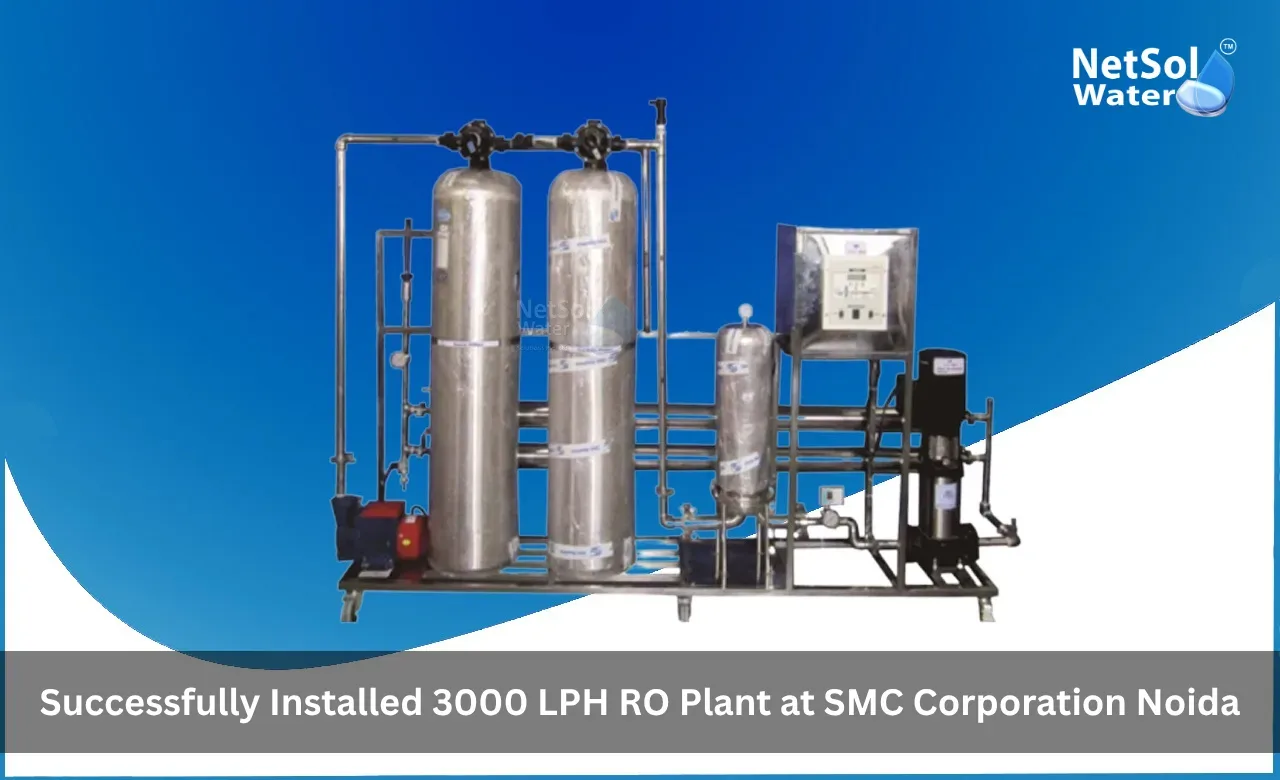
Successfully Installed 3000 LPH RO Plant at SMC Corporation Noida

Reliable water treatment plays an important role in facilities where a regular supply of suitable-quality water is needed for day-to-day operations. For SMC Corporation in Noida, the requirement was to install a commercial RO plant that could provide treated water at a suitable operating capacity. To meet this need, Netsol Water completed the installation of a 3000 LPH RO plant at the client’s Noida facility.

Netsol Water is a leading water and wastewater treatment company in the Noida region. The company manufactures commercial and industrial RO plants in different capacities and provides design, installation and commissioning support for water treatment projects.

The project focused on providing SMC Corporation with an RO-based water treatment solution that could support its operational water requirements. A properly selected RO system helps reduce dissolved impurities from feed water and produces treated water for suitable applications. The 3000 LPH capacity also provided a defined treatment rate for the facility. This project shows how a Commercial RO Plant Manufacturer in Noida can support a commercial facility through planned system selection, installation and commissioning.

Project Overview

A commercial water treatment project requires more than the supply of an RO machine. The treatment capacity must match the intended demand and the system must fit the available facility and operating conditions. The installation at SMC Corporation was planned around these basic requirements.

The project involved the installation of a 3000 LPH Reverse Osmosis plant at SMC Corporation in Noida. The main objective was to provide a dedicated water treatment system that could process incoming water and produce treated water through the RO process. The selected capacity gave the facility a treatment output of up to 3,000 litres per hour under the rated operating conditions of the plant.

The scope of the project centred on the installation of the RO treatment plant and the activities required to bring the plant into operation. This included positioning the treatment equipment, completing the required connections and carrying out testing before regular operation. Since water treatment performance depends on correct installation as well as the treatment process itself, the project required attention to both equipment setup and commissioning.

Netsol Water‘s commercial RO systems are offered across a wide range of capacities. Its published commercial RO range includes systems from small commercial units to much larger installations. The 3000 LPH plant selected for this project therefore formed part of a broader commercial water treatment capability.

Client Details

SMC Corporation is the Indian subsidiary of SMC Corporation Japan and operates in the field of pneumatic and automation technology. SMC India was incorporated in 1995 and has its head office at A-4, Sector-88, Noida. The company operates manufacturing facilities in India and maintains a network that supports its industrial customers.

The Noida facility provides an industrial setting where a dependable utility water supply can support normal facility operations. In such an environment, water quality must be considered when selecting a treatment system because untreated water may contain dissolved salts, suspended matter or other impurities that make it unsuitable for a specific application.

The project information available for this installation does not provide detailed information about SMC Corporation‘s exact end use of the RO water. Therefore, it would not be correct to assign a specific application such as drinking, process water, boiler feed or cleaning water without supporting documentation. The confirmed requirement was the installation of a 3000 LPH RO plant at the client’s Noida facility.

With the client requirement established, the location became an important part of the project planning and execution.

Project Location

The project was carried out at SMC Corporation, A-4, Sector-88, Noida. SMC Corporation‘s official corporate information identifies this address as its Noida head office and factory location.

Noida is a major industrial and commercial area within the Delhi-NCR region. An industrial facility in this setting may have continuous utility requirements and limited tolerance for interruptions in essential services. Water treatment equipment must therefore be installed in a way that suits the available site and allows the system to operate as intended.

The project location also offered a practical advantage for Netsol Water because the company operates in Noida and the wider Delhi-NCR region. Netsol Water is a water and wastewater treatment company and provides commercial RO solutions for customers in the region.

With the site and facility requirements understood, the next consideration was choosing a treatment capacity that matched the intended demand.

Plant Capacity

Plant capacity determines how much water a treatment system can process within a given period. Selecting an appropriate capacity helps ensure that the system can support the required water demand without being significantly undersized or unnecessarily oversized.

For this project, Netsol Water installed a 3000 LPH RO plant, where LPH means litres per hour. At its rated capacity, the system is designed to treat up to 3,000 litres of feed water per hour. If operated continuously at its rated flow, this corresponds to a theoretical gross treatment throughput of 72,000 litres over 24 hours. Actual daily production can vary according to operating hours, feed-water conditions, recovery, membrane performance, cleaning cycles and other plant conditions.

Parameter Value
Rated Capacity 3000 LPH (Litres Per Hour)
Theoretical Gross Throughput (24 hrs continuous) 72,000 litres


The 3000 LPH specification provided SMC Corporation with a defined treatment capacity for its facility. It also established a clear operating benchmark for the installed equipment.

Netsol Water‘s published commercial RO range includes capacities from 50 LPH to 10,000 LPH and beyond for larger requirements, showing that commercial systems can be selected according to the expected water demand.

Capacity alone, however, does not determine treatment performance. The quality of the incoming water and the selected treatment technology also influence the design.

Treatment Technology

Reverse Osmosis is widely used when a water treatment system needs to reduce dissolved salts and other impurities from water. The process uses pressure to push feed water through a semi-permeable membrane. Water passes through the membrane while a significant portion of dissolved substances and other contaminants remains in the reject stream.

For the SMC Corporation project, the selected technology was Reverse Osmosis. The basic purpose of the RO stage was to convert incoming feed water into treated water through membrane-based separation.

1. Reverse Osmosis Working Principle

The RO process starts when feed water reaches the membrane under pressure. The pressure must be sufficient to overcome the natural osmotic pressure of the feed water. As the pressurised water moves across the membrane surface, water molecules pass through the membrane while many dissolved salts and other unwanted substances are retained.

This process makes RO different from simple filtration. A conventional filter mainly removes suspended particles based on their physical size. RO also addresses many dissolved impurities that cannot be removed through ordinary mechanical filtration.

Netsol Water explains that its RO plants use membrane treatment to reduce impurities from incoming water and produce purified water.

2. Importance of Pretreatment

RO membranes need suitable feed-water conditions to maintain performance. Suspended particles, excess turbidity, chlorine and other substances can affect membrane life and operating efficiency. For this reason, commercial RO plants commonly use suitable pretreatment before water reaches the RO membrane.

The exact pretreatment arrangement installed at SMC Corporation has not been provided in the available project information. Therefore, specific filter models, dosing arrangements, membrane models or chemical treatment values cannot be confirmed for this project. The treatment discussion remains focused on the confirmed RO technology and the normal role of pretreatment in protecting the membrane.

Influent Characteristics

Understanding the incoming water quality is an important part of RO system planning. Water sources can contain different levels of dissolved solids, hardness, turbidity, iron, organic matter and microbial content. The treatment design should consider these characteristics before the equipment is selected and commissioned.

For this project, no detailed feed-water laboratory report or exact influent values have been provided. There are therefore no confirmed project-specific figures for TDS, hardness, turbidity, iron, pH or microbial load that can be reported.

The absence of these figures does not change the purpose of the installed RO system. Rather, it means that the case study should not assign numerical values that have not been documented. In a normal RO design process, these parameters help determine pretreatment requirements, membrane selection, operating pressure and expected performance.

The incoming water first needs suitable conditioning so that it can enter the membrane stage under appropriate conditions. From there, the treatment process can continue toward the production of treated water.

Treatment Process

A successful RO installation depends on a properly arranged treatment sequence. Each stage supports the next by preparing the water for the following treatment step. This reduces the load placed on the RO membrane and supports stable operation.

1. Raw Water Entry and Pretreatment

The treatment journey begins when raw or feed water enters the treatment system. Before the water reaches the RO membrane, the system normally prepares the feed through pretreatment. This stage can remove suspended matter and reduce substances that may create problems for the membrane.

The exact pretreatment equipment used at SMC Corporation has not been specified in the project details. However, the principle remains the same. Water must reach the membrane in a condition suitable for RO operation.

2. Pressure and Membrane Treatment

After the necessary pretreatment, feed water moves toward the high-pressure section of the RO system. The pump provides the pressure needed to drive water through the semi-permeable RO membrane.

The membrane separates the incoming stream into two paths. The permeate contains the water that passes through the membrane. The reject stream carries a higher concentration of retained dissolved substances and does not form part of the treated-water output.

3. Treated Water Collection

The permeate then moves toward the treated-water collection or subsequent use point. The final arrangement depends on the site’s piping and storage configuration.

This sequence provides a clear connection between the raw water source and the treated-water output. Proper operation of each stage helps the plant maintain the intended treatment function.

Major Equipment

Proper equipment selection supports consistent plant operation. An RO plant needs several components to move water, condition the feed, apply pressure and carry out membrane separation.

For this project, the confirmed major treatment equipment is the 3000 LPH RO plant itself. The plant includes the RO treatment assembly required to process feed water at its rated capacity. Netsol Water‘s commercial RO systems commonly use components such as membranes, high-pressure pumps, pressure vessels, control panels and dosing pumps, depending on the plant configuration.

Equipment Function
RO Membrane Assembly Performs the main separation process. It allows water to pass through under pressure while retaining a substantial portion of dissolved impurities.
High-Pressure Pump Provides the pressure needed for membrane separation. Its operation is directly linked to maintaining the pressure conditions required by the RO process.
Control Panel Helps the operator manage the plant and monitor its operating sequence. The exact control philosophy and automation level installed at SMC Corporation have not been provided.
Pretreatment and Supporting Components Protects the RO membrane and helps prepare the feed water. The specific filter vessels, dosing units, valves and instruments used for this project are not documented in the information available.


As a result, no unverified equipment list is presented as a project fact.

Installation Process

Plant installation requires careful planning because the equipment must fit the site while maintaining proper connections between the different treatment stages. The work should also allow operators to access the system for normal inspection and maintenance.

The installation at SMC Corporation involved placing the 3000 LPH RO system at the client’s Noida facility and preparing it for operation. The equipment had to be positioned appropriately before the required piping, water connections and electrical connections could be completed.

Once the equipment position was established, the installation team could connect the treatment sections so that water could move through the intended process. Electrical and control connections were also required to prepare the plant for testing.

The final stage of installation involved checking the physical setup and confirming that the system was ready for commissioning. This step was important because a treatment plant must be mechanically and electrically prepared before performance testing can begin.

Plant Commissioning

Commissioning confirms whether an installed treatment system is ready for regular operation. It provides an opportunity to check the plant under operating conditions and identify installation issues before the system enters normal service.

After installation, the RO plant was prepared for testing and commissioning. The commissioning process involved checking the operating sequence and confirming that the equipment could function as intended. Water movement through the treatment system had to be verified along with the operation of the principal components.

The commissioning stage also provided an opportunity to observe the plant’s treatment behaviour at its intended operating capacity. A proper commissioning process helps confirm that the system is connected correctly and that the plant can move from installation into routine operation.

The available project information does not include detailed commissioning readings such as recovery percentage, feed pressure, permeate TDS or hourly production records. These figures have therefore not been added to the project results.

Treated Water Reuse

Treating water becomes more useful when the resulting water can support an appropriate application within the facility. RO-treated water can be directed to a designated use point depending on the quality requirement and the site’s internal water management arrangement.

For the SMC Corporation project, the confirmed scope establishes the installation of a 3000 LPH RO plant but does not specify the exact final use of the treated water. It would therefore be inappropriate to state that the water was used for a particular process without supporting information.

The practical value of the system lies in creating a dedicated source of treated water for the client’s identified requirement. When used appropriately, such a system can help provide greater control over the quality of water supplied to the intended application.

Results and Performance

Project results provide a practical measure of whether the installed system met its intended purpose. In this installation, the major confirmed outcome was the successful installation and commissioning of a 3000 LPH RO plant at SMC Corporation‘s Noida facility.

The system established a dedicated RO-based treatment capacity of 3,000 litres per hour. This provided the client with a defined water treatment system rather than depending only on untreated incoming water for the relevant requirement.

The treatment technology also created a process for reducing dissolved impurities through membrane separation. Netsol Water identifies RO as one of its core commercial water treatment solutions and offers commercial systems in different capacities for varied applications.

No project-specific laboratory figures, before-and-after water quality results or long-term operating data were provided. The performance discussion is therefore limited to the confirmed installation, capacity and successful movement of the plant into operation. This approach keeps the project record factual and avoids presenting unverified performance claims.

Customer Feedback/Testimonial

Customer feedback helps demonstrate how a completed project performs from the client’s perspective. It can also provide useful information about installation quality, plant operation and overall project satisfaction. The 3000 LPH RO plant was successfully installed at the specified Noida facility and taken through the required commissioning stage.

Read some interesting information for the Industrial RO Plant Manufacturer in Gurgaon

Call to Action

Netsol Water‘s completed installation at SMC Corporation shows how a properly selected RO system can provide a dedicated water treatment solution for a commercial facility. The project combined a defined treatment capacity with membrane-based purification and onsite installation support. Netsol Water operates from the Noida region and provides commercial RO systems in a range of capacities for different water treatment requirements.

Businesses looking for a Commercial RO Plant Manufacturer in Noida can consult Netsol Water to discuss their feed-water source, treatment capacity and application requirements. A suitable system should always be selected after understanding the site’s water quality and expected demand rather than simply choosing a standard capacity.

Netsol Water is the leading commercial RO plant manufacturer, supplier and exporter based in Noida, according to its published company information, and provides commercial RO systems across a broad capacity range.

For organisations planning a new RO installation or upgrading an existing water treatment system, professional consultation can help define the right treatment approach. Contact Netsol Water to discuss your requirement and request a suitable commercial RO plant solution for your facility.

Contact Netsol Water at:

Contact Details
Phone +91-9650608473
Email enquiry@netsolwater.com


What-are-the-Applications-of-Commercial-Water-Softeners.webp

August 11, 2026by Netsol Water

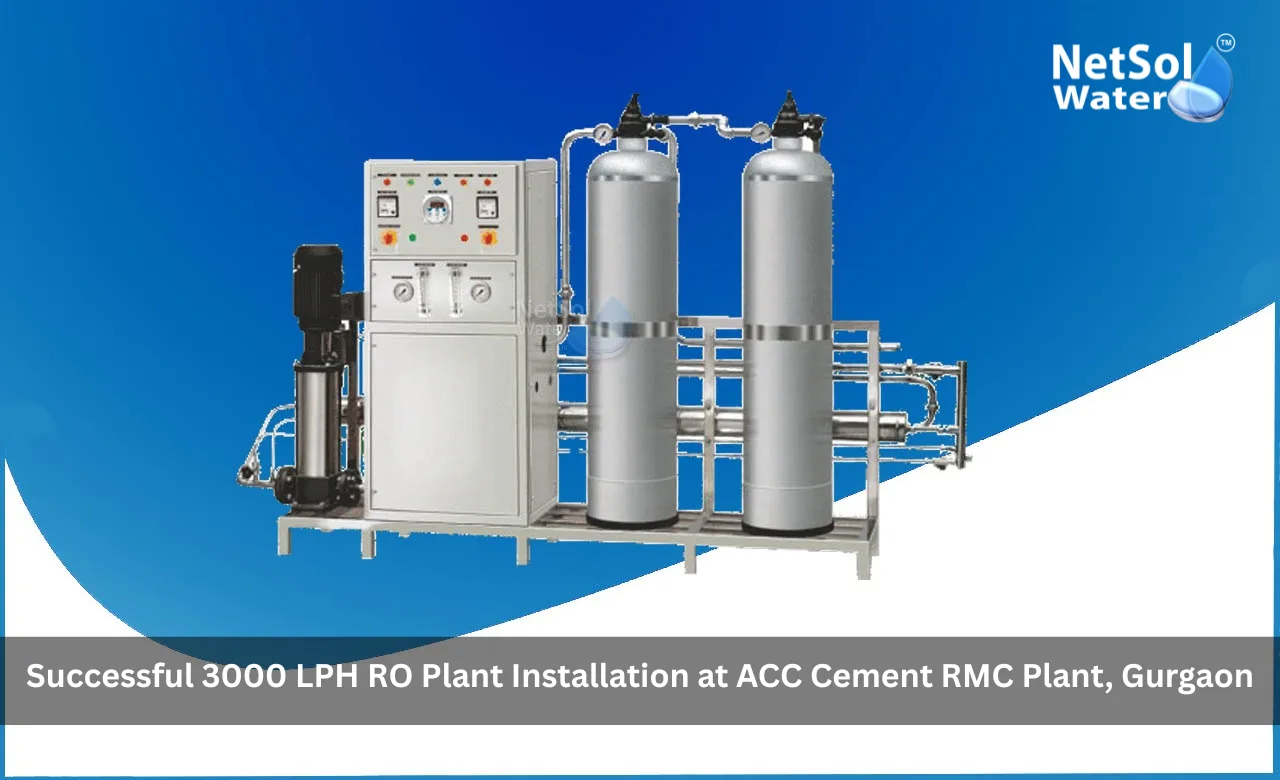
Successfully Installed 3,000 LPH RO Plant at ACC Cement RMC Plant, Gurgaon

A good water quality is essential in a ready-mix concrete (RMC) plant since the water becomes an integral part of the production environment and can affect the consistency, process control, equipment maintenance, and final product quality of the concrete. Netsol Water‘s 3000 LPH RO plant was installed at ACC Cement Ready Mix Concrete plant in Gurgaon to improve its supply of process water. The installation has been well documented by the project team of Netsol Water as a 3000 LPH RO plant to produce high-quality water for the RMC process.

The project shows Netsol Water the real-world benefits of using the right RO capacity, treatment and automation along with site commissioning for an industrial customer. It also demonstrates the importance of choosing an experienced commercial RO plant manufacturer in Gurgaon when the treatment plant is to be used along with the manufacturing activity.

Project Overview

The project was to supply and install a 3000 litres per hour (LPH) RO plant at an ACC Cement RMC plant in Gurgaon, Haryana and test and commission it. The information provided on the public project material is specific to:

Parameter Details
Customer ACC Cement Customer
Application Ready Mix Concrete
Plant Capacity 3000 LPH
RO plant supplier/Installer Netsol Water


The essential goal of the core project was to develop a reliable supply of treated water for the RMC process on site. The RO plant offers a controlled treatment barrier as opposed to just treated source water that may contain varying amounts of dissolved minerals.

The reverse osmosis process operates by pressurizing water to force it through a membrane that allows only water to pass, leaving a purified stream of water and a stream of reject or concentrate. The U.S. Environmental Protection Agency states that RO will remove many dissolved solids and inorganic contaminants from water.

From there the capacity of the 3000 LPH was chosen because it was a practical level for a plant that has variable process-water needs throughout the working day, but robust enough to allow for industrial-scale production. The unit will produce up to 3,000 litres of treated water per hour at nominal capacity.

Client Details

Field Details
Client ACC Cement / ACC Limited
Industry Cement, building materials, and ready-mix concrete
Process water Water used in the production process at the RMC plant


ACC Limited is one of the reputed manufacturers of cement, building materials, and ready-mix concrete in India and is currently part of the Adani Portfolio. According to ACC’s official website, the company has a huge national operating presence with over 117 ready-mix concrete plants.

Controlled batching and repeatability is essential to RMC production. Water is one of the fundamental requirements to make concrete, so a more reliable treated water supply can help with process control.

Project Location

The plant was installed in the premises of ACC Cement Ready Mix Concrete (RMC) plant in Gurugram (Gurgaon), Haryana. Gurugram is an important industrial, commercial, residential, and institutional city of Delhi NCR, having industrial activities, construction activities, institutional activities, hotel and hospitality activities and commercial activities which demand reliable water treatment system. Netsol Water is also a company that supplies commercial RO solutions to Gurgaon only and offers project services like design, installation, testing and support.

The project is also a good local benchmark for companies looking for a reliable Commercial RO Plant Manufacturer in Gurgaon for medium and large scale industrial applications.

Plant Capacity

The installed system is capable to produce 3000 LPH of treated RO water with the given design conditions. According to a published RO product information, Netsol Water‘s 3000 LPH RO unit is a fully automatic reverse osmosis configuration, appropriate for industrial water treatment.

A 3000 LPH system offers valuable flexibility of operation. It can be used for up to 24,000 litres of treated water per hour when running at full capacity. The actual daily production will vary based on the quality of the feed water, plant demand, recovery, storage space, cleaning cycles and operating pressure.

This capability is suitable for an industrial facility that has a much higher demand for treated water than a small commercial facility.

Treatment Technology

RO is the primary treatment technology used.

RO Systems: Pretreated feed water under pressure and forced through a semi-permeable membrane. The water molecules pass preferentially through the membrane and the reject stream carries off a portion of the dissolved salts and other rejected constituents, with a more concentrated reject stream.

Making water clear is not the sole significance of RO for an RMC plant. Its aim is to lower ionic loading of the water and maintain uniformity of the water provided to quality sensitive plant uses. EPA has designated RO as a technology that can remove a wide variety of dissolved solids and inorganics.

Influent Characteristics

Industrial RO plants may be used for source water that contains suspended matter, hardness-forming minerals, dissolved salts, alkalinity, and other components that can impact RO system performance. These factors dictate the pretreatment needed, operating pressure, antiscalant programme, cleaning frequency and recovery level.

For this ACC Cement project, the public installation material does not show laboratory values for inlet TDS, hardness, turbidity, pH, silica, iron or alkalinity. Hence, this case study does not assign the numerical values of the influents.

The treatment configuration should rather be interpreted as a selection, which is made with the aim of making the feed water available in the required state and to minimize the content of dissolved matter in the feed water before it is used in the RMC process. It is technically correct as the RO performance is very sensitive to the chemical nature of the feed water and adequate pretreatment will ensure the membranes are not fouled or scaled.

The technical datasheet for the project should have the actual influent water analysis from the project or commissioning record from Netsol Water added.

Treatment Process

The sequence of the 3000 LPH plant is similar to that of a commercial and industrial RO treatment plant:

Raw-water feed → Pretreatment → Cartridge/micron filtration → Chemical conditioning (as needed) → High-pressure pumping → RO membrane separation → Collection of treated water → Supply to the RMC process.

The raw water first flows to the pretreatment area. Media filtration is used to remove suspended contaminants and to preserve the downstream components. Sand and carbon filtration are pretreatment components of the system along with high-pressure pumping.

Next, fine filtration offers an extra layer of protection of the membrane. Positioning of the antiscalant for dosing and other conditioning may be required to prevent mineral deposits depending on the feed analysis. The high pressure pump is, in turn, used to deliver the pressure needed for the membrane separation process.

In the RO membrane vessels, the feed is divided into two streams: the treated permeate and reject concentrate. The water from the treatment plant is stored for use in the process and the reject water is sent to the site’s approved water-management system.

Operating conditions are optimized during commissioning to ensure a stable flow, pressure and product-water quality.

Major Equipment

The key equipments used for the 3000 LPH RO system are:

S. No. Equipment
1 Transfer pump and raw-water feed system
2 Pressure sand/media filtration
3 Activated carbon filtration
4 Micron/cartridge filter housing
5 Chemical dosing system, including antiscalant
6 High-pressure RO pump
7 RO membrane housings and membrane elements
8 Pressure gauges and flow indication
9 Treated-water and reject-water piping
10 Electrical Control Panel/Automation
11 Valves, fittings and instrumentation
12 Treated-water storage/supply interface


Netsol Water‘s RO treatment yields 3000 LPH, that the treatment is fully automated, and that the RO treatment is of industrial scale, and its more extensive product are sand/carbon pretreatment and high-pressure pumps.

Installation Process

However, at a working RMC factory, co-ordination needs to be carried out such that water-treatment operations don’t needlessly interfere with production. The job of Netsol Water involved installation of 3000 LPH RO plant on site, which has been captured for the ACC’s Gurugram location.

A standard install process for a plant of this type will consist of foundation verification, positioning of treatment skid and filter vessels, raw water and treated water connections, reject drainage, electrical connections, pump rotation, pretreatment flushing, filter media loading or verification, cartridge and membrane install and finally valves and instrumentation checking.

Special care is needed in access for future maintenance. Filters, membrane housings, pumps and dosing systems must be serviceable following the commissioning. Reliable long-term operation is also achieved by proper pipe support, drainage, electrical safety and operator access.

After mechanical and electrical installation the system is taken to the testing and commissioning phase.

Plant Commissioning

Converting an installed RO system into a stable operating utility is called commissioning. First, mechanical and electrical checks, leak testing, line flushing, pump testing, pretreatment testing, and checking instruments and controls for proper response are performed.

The RO is then operated under controlled conditions. Operators gradually bring up the necessary feed pressure and monitor the flow of permeate, reject flow, pressure, and quality of treated water. The goal is not just to achieve 3000 LPH for a short period, but to create repeatable operation in the plant’s design envelope.

The last item to consider is operator handover. Regular checks are required on inlet/outlet quality, pressure differential, filter condition, dosing chemical level, permeate flow, reject flow, pump behaviour and indications of membrane fouling.

Treated Water Reuse

The main application of the treated water was in the RMC process. The above mentioned public project post on the Netsol Water website explicitly mentions the use of water of high quality for the Ready Mix Concrete process.

Process water in an RMC facility can be processed to be used for quality sensitive applications as per the internal SOPs of the plant and requirement for concrete production.

The main operational benefit is that the site now has a treatment step on site that is able to produce a controlled stream of RO permeate instead of sending untreated source water to all uses.

This also allows for more control to be exercised by the plant personnel over the water applied to applications where consistency is of great importance.

Results and Performance

The key achievement so far is the successful installation of a 3000 LPH RO system at the ACC Cement RMC plant in Gurugram and its operation for supplying good quality water to RMC process.

In operational terms, there are four distinct advantages to the installation. It establishes a separate treated-water supply within the facility. Second, RO removes dissolved contaminants and salts which permeate through the normal particulate filtration. Third, the 3000 LPH rating ensures production at an industrial scale, with appropriate process-water demand. Fourth, automation helps to maintain consistent operation, with reduced need for ongoing manual adjustments.

The project represents a suitable sized commercial or industrial RO plant to serve a manufacturing plant where water quantity and quality is significant.

Customer Feedback / Testimonial

The 3000 LPH RO plant was installed as part of our RMC facility and is in reliable operation, “We appreciate the help Netsol Water provided during installation and start-up.”

Call to Action (CTA)

For quality and reliable water purification, Netsol Water can design a system based on your actual feed-water quality, demand, and hourly consumption, whether you have an RMC plant, factory, hospital, institution, commercial complex, or industrial unit.

Netsol Water is a Commercial RO Plant Manufacturer in Gurgaon and provides Commercial RO water solutions along with Project support ranging from selection to design, installation, testing and commissioning as well as after sales support. It has a Gurgaon-based commercial RO page which says that businesses in this region can avail customised RO plants along with lifecycle support.

Need RO Plant in Gurugram for commercial or industrial use that delivers 3000 LPH?

Talk to Netsol Water about your:

S. No. Item to Discuss
1 Raw-water test report
2 Required treated-water quality
3 The water requirements for an hour and a day
4 The amount of water needed per hour and per day
5 Operating hours
6 Treated-water storage requirement
7 Desired automation level
8 Available installation space
9 The process or product has been applied to industry or commerce


For commercial enquiries about RO, contact the Netsol Water +91-9650608473.

Read some interesting information for the Industrial RO Plant Manufacturer in Noida

Successful installation of the ACC Cement RMC system illustrates the ability to use a relatively simple RO system at an industrial plant to deliver a consistent supply of water for process use, which is quality-focused. This project offers a real-world demonstration of a 3000 LPH Commercial RO Plant solution tailored for industrial applications.

When a combination of water analysis, pretreatment, membrane technology, automation, and professional installation and commissioning is used, the commercial RO treatment can be a reliable component of an industrial facility’s water-management infrastructure. This is a practical example of what is being done by Netsol Water at ACC Cement RMC plant in Gurugram.